You are currently browsing Tara Lazar’s articles.
 by
by Dear Reader,
About this time you should feel a strong connection with the characters you created. It’s natural for writers to think of their characters as their own children and even scold them sometimes. “Don’t act like this!” “Don’t do that!” Admit it, we’ve all at one time yelled at our characters. And that’s just what we’re talking about today. The bonds we form with our characters.
How to Bring Your Characters to Life
As a creative person your characters can be inspired from any part of your life. A cookie monster living in a cookie jar, a little boy who likes to play dress up and go on adventures with his imaginary friends, maybe even a gorilla who can’t stand the taste of bananas! But you need to think about what makes these characters stand out from the crowd. Be original. Today I’ll give you a few writing prompts that always work for me when creating my characters.
Living in Your Character’s Shoes
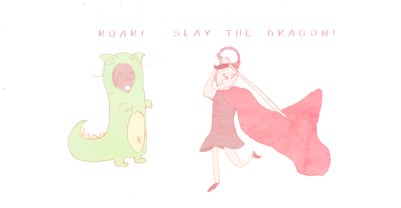
Do you remember playing pretend when you were young? When those monkey bars were a castle for the queen and king guinea pigs? When you’re a kid the world is your canvas. You can be anything and anyone you want to be! But as we grow older we tend to forget how “playing pretend” can actually help our creative minds grow.
So the first thing I want you to do is get into the mind of your characters and for a day solve your problems like your character would. Jump into their shoes and become them for one whole day. Once you do that you’ll see how attached you truly are with your characters. So put on those princess or prince crowns, get that magical wand and start your adventures!
Crafting Your Characters
Animators and illustrators tend to have an advantage when it comes to the craft of characters. Why? It’s because they know how to draw and get their characters out of their heads and onto paper. But who says a writer can’t delve into the doodling world ever so often?
Take a piece of paper, a pencil and scribble what you think your character looks like. This doodle doesn’t have to be perfect. Honestly, a quick sketch is all you need. You can also mold your characters out of clay and make them 3D to get a feel of what they would look like if they were standing next to you, or at least in the palm of your hand.
Once you get your characters out of your head your bond will surely become much stronger.
Short Back-Stories
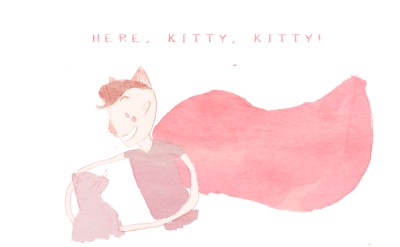
This section isn’t about the regular short story that ranges from 500-1,000 words; it’s about your characters back-stories. Every character has a back-story, from the main characters to the minor, supportive cast. Back-stories help your characters develop overtime. It doesn’t have to be dramatic or comical, it can be as simple as why your character prefers cats to dogs (even though that may be an unsettled argument).
All you need to do is ask yourself this, “My character is this way because…?” and it will surely take you on an adventure.
So remember, playing pretend, crafting your characters and writing back-stories isn’t a crime. It’s a gift you can give to your characters. Once you do that you’ll discover a way to click with your readers and make your characters extremely relatable. You can do this! Just take your time, breath and walk in your characters shoes.
.
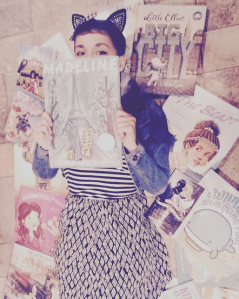
Katya is a KidLit TV producer, writer, and editor and is also the host of KidLit TV’s original shows Field Trip! and Inside Scoop. You can find her on location hosting Field Trip!, interviewing authors, illustrators and industry experts. For Inside Scoop Katya shares the latest and greatest news in the children’s literary world straight from the authors and illustrators themselves. Katya will soon be heard on, KidLit Radio, as the host where she talks with parents, teachers and librarians about the importance of literacy. She also has a YouTube Channel, KidlitKat, that teaches kids, teens and adults about the kid lit world and other forms of literature. In addition, Katya is currently working on two middle grade novels, a picture book and a graphic novel all of which she will be illustrating. Be on the look out for cat ears!
Find Katya online at KatyaSzewczuk.org, on Facebook, Twitter @Katyaszew and Instagram @KatyaShoveChuck.

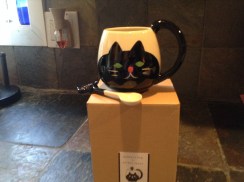
Katya is giving away this cute kitty mug and spoon!

Leave a comment below to enter. One comment per person, please.
This prize will be given away at the conclusion of PiBoIdMo. You are eligible for this prize if:
- You have registered for PiBoIdMo.
- You have commented ONCE ONLY on today’s post.
- You have completed the PiBoIdMo challenge. (You will have to sign the PiBoIdMo Pledge at the end of the event.)
Good luck, everyone!
 by Carter Higgins
Looks like we’ve all made it to the hump day of PiBoIdMo! Congratulations! Turn to your neighbor and give out some high-fives. Your notebook might be empty or busting at the seams, and it really doesn’t matter, because you are doing it. So here’s to the back half of this month being as successful as the front, and here’s to more furious scribbling in those notebooks.
But with all of that forward motion, let’s rewind a little. Have you ever reverse engineered your process to chase an idea? This is a big experiment for me, because it’s a new trick in my trusty old bag, but it’s one that makes a lot of deep, true, heart-of-the-thing sense.
Just this month I’ve been talking with my agent about a new manuscript, one that makes us both a little goosebumpy and hopeful. But, true to what I’m learning is my signature maneuver, it’s a teensy bit abstract. Sure, the plot makes sense if you dig around in the dirt a little. And yeah, the characters have a heck of a journey when you squint and look real hard. But what’s there, the obvious thing that makes those goosebumps and hope, is the feeling of it. And I’m okay with that.
So as we wrap our brains around this text and sprinkle it with wishes as it blows out into the world, here’s what’s stuck with me—it’s a question my agent asks me nearly every single time we’re close to sending something out on submission, and it’s only now, years later, that I see its beginning-of-the-process, idea-making potential.
It’s this:
“I’d like to hear from you what YOU feel this story is about. You know, not a synopsis, but an about about.”
An about about.
In theory, that’s a simple question, right? But picture books are big, rich beasts, bigger than plot and arc and character development and the rules.
Here’s what I wrote back, about what it’s about about:
“This is a look at the risky business of breaking a routine, and what might happen when missed connections get bumped out of whack by just a hair. These two just do what they do, day after day, and are unaware of the friendship that is just a few blocks out of their routine. It’s about the magic of everyday things shaken out differently enough to make something wonderful, only if you look.”
That’s what it’s about about.
This book is about routine. It’s about friendship. It’s about everyday magic and the unexpected.
But that doesn’t tell YOU, PiBoIdMo-er, what it’s about, only what it’s about about. And that’s because what picture books are really, truly about about are big, huge things. The other things? Your brilliant characters and arcs and the nitty gritty? I might even say they aren’t as essential or important or heart-making as the about about.
Can you make some room in your notebook for this kind of reverse engineering? What’s the about about of your idea? Maybe it’s about about the loneliness of waiting. Your details of plot and character could be endlessly different from a fellow PiBoIdMoer’s—maybe there’s a kid who’s always picked last for the kickball team, or the excruciating watch of a favorite stuffed animal swirling around in the wash. Maybe it’s Santa himself on December 26th, beginning the countdown of days one more time. Those three stories would have entirely unique feelings and execution, but their about about is mostly the same.
And the about is certainly one beautiful, well-crafted thing, but the about about is what matters the most. What’s yours?
Carter is a librarian at an independent school in Los Angeles. She is the author of A Rambler Steals Home (HMH, 2016) and two forthcoming picture books from Chronicle Books. Everything You Need for a Treehouse is about about creating a place that becomes a home. And This Is Not a Valentine is about about the ickiness and confusion of first love. She is an Emmy-winning visual effects and motion graphics artist whose career has covered all the nooks and crannies of visual storytelling. She writes about picture books and graphic design at her blog, Design of the Picture Book and is a contributor of bookish love at All the Wonders. You can also find her on Twitter @carterhiggins.
Carter is giving away a picture book critique (for a fiction manuscript 1000 words or less).
Leave a comment below to enter. One comment per person, please.
This prize will be given away at the conclusion of PiBoIdMo. You are eligible for this prize if:
- You have registered for PiBoIdMo.
- You have commented ONCE ONLY on today’s post.
- You have completed the PiBoIdMo challenge. (You will have to sign the PiBoIdMo Pledge at the end of the event.)
Good luck, everyone!
 by
by I write picture books. That means that my readers are very short. I remember what it was like to be a kid, but it’s not as easy to remember what it feels like to be little in a world of big people. What do kids notice at that height? And more importantly, what am I missing? It was time for a change of perspective.
On my way to the New York Public Library, I stopped by Bryant Park to find out what a walk through the park would look like through the eyes of my readers. I held the camera at about 33” from the ground, and here’s what I saw…
The first thing I notice is legs. And butts. And the ground is much closer. Then I notice a little bird preening under a cafe table. Then a white wall—and I had to see what was on the other side of it. But first I had to chase a pigeon—I just HAD to.
I took a peek over the wall, and I saw one little fellow ice skating with a penguin. Then I’m drawn to the lights and sounds of the carousel with it’s toads, rabbits and horses flying through the air, and notice one unusual rider, as well.
A vine running up the side of a building is tempting to climb. I watch friendly jugglers and dream about joining the circus. And at the end of the day, I meet a friend and we play. Which is what our readers love to do most of all.
I hope this helps you come up with even more ideas this month. Our little ones are counting on you!
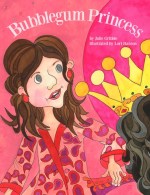 Julie Gribble creates and produces works for children and the children’s literature community in both the United States and Great Britain. She founded KidLit TV to help connect children’s book creators to their readers. She’s been nominated for two Emmy Awards and is a multi award-winning writer, screenwriter, filmmaker, and producer. Her charming picture book, Bubblegum Princess, is based on a true story about Kate Middleton and was released on the day Prince George was born.
Julie sits on the Children’s Committee of the British Academy of Film and Television Arts: BAFTA-NY. Find her on Facebook and Twitter @JulieGribbleNYC.
.
Julie is giving away a Kidlit TV prize pack of a book bag, pencils, stickers, magnets, temporary tattoos, earbuds, pins, and a party hat just like the KidLit TV kitty’s!

Leave a comment below to enter. One comment per person, please.
This prize will be given away at the conclusion of PiBoIdMo. You are eligible for this prize if:
- You have registered for PiBoIdMo.
- You have commented ONCE ONLY on today’s post.
- You have completed the PiBoIdMo challenge. (You will have to sign the PiBoIdMo Pledge at the end of the event.)
Good luck, everyone!
 by
by What inspires me? I’ve been pondering. Tonight on my walk, I was looking up. The universe was pitch-black, pierced with sparkles of light. I saw a mist of white, spray across the night sky. The Milky Way inspires me. Thinking about the Hubble telescope, gazing at the edge of the universe after its long lonely journey, sending off its last photograph and last silent farewell, the most mind blowing photo of our universe and its millions, if not billions of stars, and billions of galaxies, fills my stomach with butterflies.
Lines, lines inspire me. When I think that a true line goes on forever in both directions, farther than the Hubble Telescope, on to eternity, that fills my mind with wonder. And to think that if you bend a line so that the ends meet, that also goes on forever, Alpha and Omega. A circle is a line. That fills my mind with wonder.
And when I think of Einstein and the speed of light, that blows my mind, but then squaring the speed of light, that’s unfathomable.
And then I look at my dog, Judah, who wags his tail and greets me every morning without fail. Who is loyal to me, who always believes the best in me, and really doesn’t care how I perform. Just loves me. That fills me with warmth and wonder.
Miracles inspire me. A newborn soul. A newborn snowflake. The fact that there are more stars than grains of sand. The sound of squeaky snow. The silence of falling snow against a lamp-lit night. Tracks that cut and mark the snow, authoring a path. The starkness of a cardinal on a backdrop of white. A sunset that meets dusk and sends animals burrowing and settling for sleep. The warmth of a kitten sleeping on my lap. The whisper of a baby’s breath while sleeping. I see miracles and inspiration all around me. I find them in the simple little things. I stop and look. When I write, that’s what inspires me, and then I hope it inspires you.
Sarvinder lives in Iowa with her husband and three kids, two cats, and one border collie (who likes to herd their chickens). She credits her sparse writing style to her songwriting, which translates well into writing sparse text for children. Her first picture book, BOOM BOOM, was recently published by Beach Lane Books/Simon & Schuster. Her second book, BLUE SKY, is with Dial/Penguin and illustrator Kadir Nelson. You can learn more about Sarvinder by visiting her website, Sarvinder.com and her blog, SarvinderAuthor.blogspot.com.
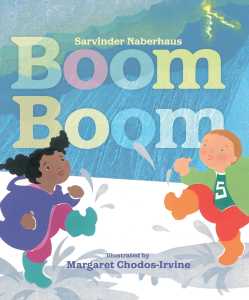 Sarvinder is giving away a copy of BOOM BOOM.
Leave a comment below to enter. One comment per person, please.
This prize will be given away at the conclusion of PiBoIdMo. You are eligible for this prize if:
- You have registered for PiBoIdMo.
- You have commented ONCE ONLY on today’s post.
- You have completed the PiBoIdMo challenge. (You will have to sign the PiBoIdMo Pledge at the end of the event.)
Good luck, everyone!
 by
by Everyday life is what inspires most of my work. The problem is choosing what interests me enough to spend 6 months to a year working it out. For every good idea there are 50 stinkers.
For that reason, I have boxes full of 4×6 index cards with ideas, phrases, titles, and character descriptions written on them along with scribbled sketches. I keep every idea, because some of the stinkers eventually redeem themselves or lead to a new idea. Every now and then I read through the cards to see if I can find a workable idea. My next book is from the stinker box, inspired by an idea that is at least ten years old.
Sometimes, an idea crawls under my porch. A stray cat gave birth to four kittens under our front porch. We adopted all of them. Three of the kittens did everything mama cat did, but that fourth kitten just napped. This became the basis of the book Mama Cat Has Three Kittens.
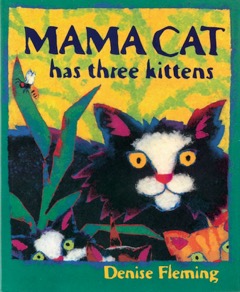
In reality there were four kittens, but three kittens made for a better story. Be assured that the fourth kitten was not harmed in the making of the story. The kittens in the book look nothing like the real kittens and, except for the napping kitten, their personalities are different. But the book was inspired by a real situation.
At the time we adopted the kittens we had a dog, Warfy, who had grown up with older cats. Poor Warfy was terrified of the tiny kittens. She wanted nothing to do with them. Warfy morphed into Buster, an only dog who had a perfect life until a small kitten came to share his home. Buster is my canine version of Niles Crane from the TV show Frasier. I always had Niles in mind when writing and drawing Buster.

My sister, Rochelle, needed to find a kennel for her pup, Hershey. She and her husband doted on their dog and she searched high and low to find just the right place for her baby’s first time away from home. She chose a doggy camp which gave me the idea for Buster Goes to Cowboy Camp. Of course I enlarged upon what happened, changed things, added things, and exaggerated. You do not have to stick to the actual facts of the incident that inspires you.

The physical look of Buster was inspired by dogs in a sculptural paper piece I created, titled Green Dogs at Night. That paper piece also led me to to the idea for Pumpkin Eye, which went through a complete transformation before I arrived at the finished story. Ideas evolve—this becomes that, a dog becomes a cat.
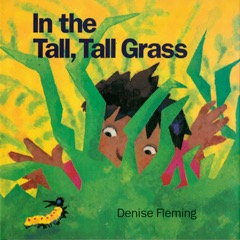
When my daughter was very young we would take snacks and a blanket over to the field behind where we live. We would watch the creatures in the tall grasses go about their lives. In the Tall, Tall Grass was the outcome these outings.
Along with the field was a creek and a wood. I spent many hours walking this land. Sadly the land was eventually bought and developed. Where Once There Was a Wood was the story of this loss of open space. I did not want readers to feel hopeless after reading the book so I added back matter that shares how to create habitats with the land you have.
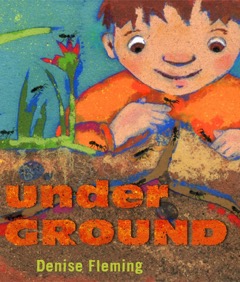
Sometimes a phrase will float through my mind “Cows in the pasture, moo, moo, moo. Roosters in the barnyard, cock a doodle do” and on and on, and before I know it I have a book. Barnyard Banter, Beetle Bop, and underGround all started this way.
The most important thing is to stay open to ideas. Write ALL your ideas down. Review them now and again. You never know when a new idea may pop up that helps you reimagine an old idea.
Even the stinkers may surprise you.
Denise Fleming is the author/illustrator of 25 picture books. Her books are illustrated by pulp painting, a paper making technique. See more of her work at DeniseFleming.com.
Denise is giving away one of her books.
Leave a comment below to enter. One comment per person, please.
This prize will be given away at the conclusion of PiBoIdMo. You are eligible for this prize if:
- You have registered for PiBoIdMo.
- You have commented ONCE ONLY on today’s post.
- You have completed the PiBoIdMo challenge. (You will have to sign the PiBoIdMo Pledge at the end of the event.)
Good luck, everyone!
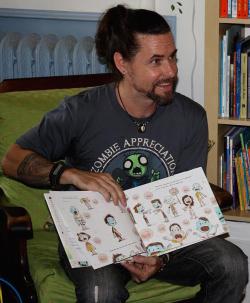 by Joe McGee
Inspiration…that’s what we’re here to discuss, isn’t it?
To bandy around, to kick back and forth like a dented Campbell’s soup can on a weed-choked school blacktop. You know, the kind of blacktop where a hundred little sneakers will soon be racing around, attached to skinny ankles, attached to band-aide slathered kneecaps, attached to Star Wars t-shirt wearing torsos, attached to toothless grins on eager faces.
You there…yes, you. The adult standing over by the bleachers. Can you—there, that’s better. No shirts tucked in. Can we smear some dirt on your knees? Maybe leave a little cheese doodle smear on your cheek? Let’s put a few candy wrappers, a rock, and a marble or two in your pocket. Good, now we can talk. I mean, after all, we’re talking about writing for kids, right?
How can we write for kids if our adult selves get in the way? How can we write good stories, fun stories, silly stories, important stories, or stories that resonate for kids if we can’t see the world through their eyes? Roald Dahl may have said it best when he said, “adults should get down on their knees for a week, in order to remember what it’s like to live in a world in which the people with all the power literally loom over you.”
Now, I’m not suggesting that you get down on your knees and crawl around for a week. That’d be creepy and impractical and our knees might just protest and never straighten again. So, I’ll give you figurative license. Stop looking from the outside in, and look from the inside around. BE A KID. Lose your schedule and your deadlines, and your adult insecurities and your social checks and balances and your mature reservations and all the rest of the baggage that our adult passports insist we maintain. Try and experience the world as a child. Truly put yourself in their shoes, with their limitations, experiences, understanding and perception. PERCEPTION. It’s all about perception, right?
In fact, why not dedicate an entire journal to…no, let’s call it your PASSPORT—your passport into the magical realm of childhood. “Anything to claim?” they’ll ask you at the gate. “I claim to have left my rational adult mind behind,” will be your answer. So, with passport in hand, visit childhood at least once a week. Experience the world as a child. Eat a meal as a child. Try guacamole the first time as a child, or wonder what’s in the basement as a child, or make sense of the stars as a child. It’s not easy, not at first…you’ll find that you accidentally brought along a bit of your adulthood the first dozen or so trips….a tie, your checkbook, your maturity. Don’t worry, we won’t tell the authorities. Nobody likes a squealer. You’ll get the hang of it.
Record the world on those trips. Ask questions, be curious. See what’s important, or scary, or confusing, or ridiculous. Why can’t I have a llama for a pet? What happens if I fill the bathtub with Jell-O? What does the Tooth Fairy do with all those teeth? No, really…what does the Tooth Fairy do with all those teeth? Tell me.
Ask questions through a child’s eyes. Feel the world through a child’s heart.
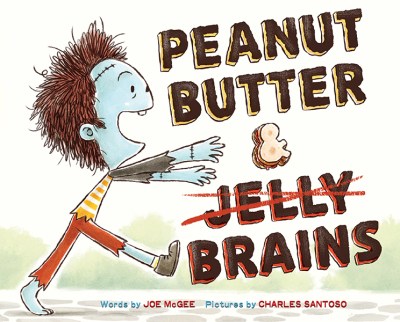
That’s one of the ways that PEANUT BUTTER & BRAINS came to be. I have three boys, and my middle son, Logan, was in third grade at the time. He wasn’t wearing the “cool shoes”…the kind of shoes parents take out second mortgages for, and so some of the neighborhood kids were giving him a real hard time. As a parent, I was furious. Of course I was protective of him and angry that he was being bullied and gnashing my teeth at the consumerist machine, but I knew that he was not alone. There were a lot of kids out there “not wearing the cool shoes.” I wanted to understand how they felt, not me, as an adult, as his father. So I grabbed my passport and checked into childhood. The result was this incredible feeling of ostracism and loneliness that comes across in poor Reginald’s attempt to find himself. Because in my book, he’s not trying to do what everyone else is doing, he’s trying to find himself – to be comfortable in his own skin. That’s what I discovered when I checked my adult self at the door – that my son was struggling to be comfortable in his skin, not struggling to be like everyone else.
There’s a whole world right under our noses, but that is NOT where it belongs. Our noses need to be level with that world, to be in that world. Grab your passport, open your minds and hearts, and live in the world inhabited by those wonderful little minds for whom we write.
You have my permission to be childish.
Joe McGee is the author of PEANUT BUTTER & BRAINS (Abrams, 2015). Joe received his MFA in Writing for Children and Young Adults from the Vermont College of Fine Arts low residency program and his MA in Writing from Rowan University, Glassboro, NJ, where he currently teaches writing.
He is a former airborne Army platoon leader, has climbed an active volcano, and can fly small, fixed-wing aircraft if the situation calls for it. He is represented by Linda Epstein of the Jennifer DeChiara Literary Agency. Joe is working on several picture books, revising a middle-grade novel, and at work on a graphic novel collection. He lives in rural Pennsylvania. You can find him online at joemcgeeauthor.com and on Twitter @mcgeejp.
Joe is giving away a copy of PEANUT BUTTER & BRAINS. In the comments below, answer this question: from a child’s POV, what does the Tooth Fairy do with all those teeth?
One comment per person, please.
This prize will be given away at the conclusion of PiBoIdMo. You are eligible for this prize if:
- You have registered for PiBoIdMo.
- You have commented ONCE ONLY on today’s post.
- You have completed the PiBoIdMo challenge. (You will have to sign the PiBoIdMo Pledge at the end of the event.)
Good luck, everyone!
As a guest blogger during this high-gear month of generating Pi Bo ideas, I’m honored to share in the charge to Inspire! My first word of inspiration is this:
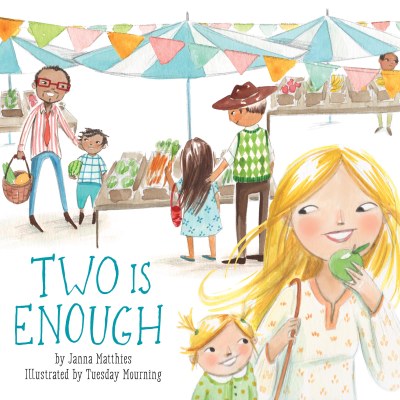
My new picture book, TWO IS ENOUGH (adorably illustrated by Tuesday Mourning), releases today! YIPPEE!!
While this might seem like shameless self-promotion (let’s face it, it is), it is also a reminder that people who only a few years ago were not published can one day accomplish that goal. Furthermore, we published authors—after only 4 books or, I hear, even after 25—are still dreaming, churning out ideas, putting bad ones through the shredder, writing, revising, submitting and hoping for the next book. The dream is attainable, and the process is ongoing for us all. We’re in this together!
My second word of inspiration is where I’ll land for today’s post. And it’s good news in a world where life can be hard. Here it is:
Your tough experiences, and those of people you love, can be fodder for meaningful children’s books.
Which brings me back to my new book, TWO IS ENOUGH. This book celebrates the special bond of love in a family of two—one adult and one child. The idea came when my dear, single friend Christine adopted a baby boy, Carter. When I looked for the perfect gift for them, all I found were stories on a theme of “When WE brought you home…” Clearly not the perfect gift for them. I thought about what kind of book Christine and Carter and families like them might need—something that celebrates what they have without reminding them of what they have not. And the answer was clear: LOVE. Whether shaped by adoption, divorce, death of a parent or something else, two-person families have unique challenges. Still…two is completely, fully, wholly, abundantly enough for lots of love. By honing in on the heart of my friend’s real story, I decided the best approach to this book was to stick strictly to the positives.
I’ve taken a different approach to tough topics in two of my other books: THE GOODBYE CANCER GARDEN and PETER, THE KNIGHT WITH ASTHMA. In writing these fictional books inspired by my own family’s health challenges, I chose to directly address the difficulties and then point toward hope.
One note: When we write directly about tough stuff for our youngest audiences, I believe we must be both honest about the facts and considerate of cognitive and emotional maturity. And because I was not writing a textbook or medical pamphlet, no sterile depiction of treatment events would do! I brainstormed about relatable ways to create a strong story and landed on the bridge-building tool of the metaphor.
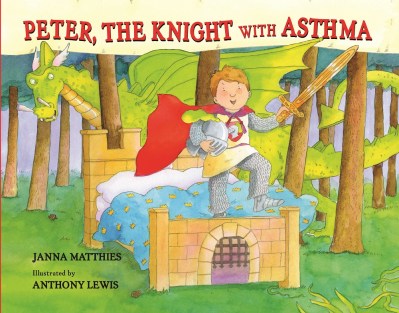
The dragon in PETER, THE KNIGHT WITH ASTHMA is a metaphor for asthma. The brave knight is the child empowered to fight and tame his disease.
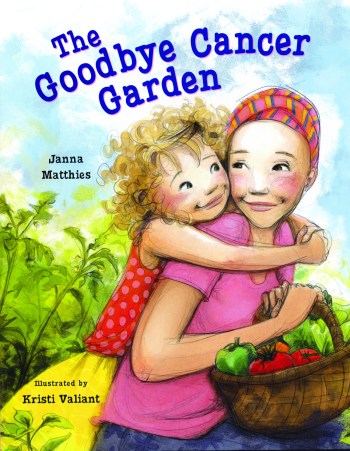
In THE GOODBYE CANCER GARDEN, the barren winter ground represents a body with cancer. The seasonal cycle of vegetable gardening is as a metaphor for regeneration and hope. And while I used medical terms like chemotherapy and surgery, I explained them simply amidst a full-bodied story with multi-dimensional characters. We picture book creators, with the powerful combination of words and illustrations, have a unique opportunity to step into dark places and shine a light for our readers.
As an aside, books that help young readers face tough issues often fall within the category of “bibliotherapy” books—particularly those that get down to the nitty gritty like my asthma and cancer books. Even topics like potty training, starting school or how babies are born may fit this category or the broader heading of “concept” books (Check out THE BABY TREE by Sophie Blackall—clever, artistic, fun!). As you pore over piles of pictures books, as all good PiBoIdMo participants should do, notice those that touch on tough topics. Study the ones that transcend the issue and lead you—and ideally the children around you—to laugh, release some tears, take courage, or go plant a garden.
My parting question for you is this: What are the tough topics in the narrative of your life or in the lives of children you love? Consider taking some of these and giving them a shot at redemption through a picture book. What story can you create that will inspire young readers toward hope?
 Janna Matthies is a children’s book author and guitar-toting early ed music teacher. Her books include TWO IS ENOUGH (Running Press Kids, 2015); THE GOODBYE CANCER GARDEN (Albert Whitman, 2011), which earned a starred review from School Library Journal and 2011 Best Foreign Children’s Book at the Sharjah International Book Fair; PETER, THE KNIGHT WITH ASTHMA (Albert Whitman, 2009); and MONSTER TRUCKS (Piggy Toes Press, 2009). She’s also written for Spider and Humpty Dumpty magazines. Janna lives in Indianapolis with her husband and three kids.
Find her at JannaMatthies.com and on Facebook.
Janna is giving away a copy of her new book TWO IS ENOUGH.
Leave a comment below to enter. One comment per person, please.
This prize will be given away at the conclusion of PiBoIdMo. You are eligible for this prize if:
- You have registered for PiBoIdMo.
- You have commented ONCE ONLY on today’s post.
- You have completed the PiBoIdMo challenge. (You will have to sign the PiBoIdMo Pledge at the end of the event.)
Good luck, everyone!
 by
by I recently celebrated my 20th anniversary as a children’s book editor. (Still loving it as much as ever!) One of the questions I am still asked most often is why an author and illustrator so rarely collaborate directly. Why WOULDN’T it be a great thing for the two creative parents to discuss and brainstorm? Why don’t I encourage lengthy Skype chats about their amazing book-to-be? What’s up with those control-freak publishers anyway?!
Most people assume the worst: surely author and illustrator are kept apart so the publishers can hold all the cards, hoard all the power. But I am here to tell you this couldn’t be further from the truth! The reason editors and art directors keep the wordsmith separate from the artist is to allow for maximum inspiration and creative freedom on BOTH sides. Authors needn’t weigh down their manuscripts with descriptions of scenery or characters, and illustrators are allowed unencumbered freedom to conjure with paintbrush or pixels the story’s characters and surroundings without trying to match an author’s vision of them.
I’d like to share three very recent examples of how well it can work out when an author trusts an illustrator and refuses to define how a character should look or how a plot should unfold visually:
- When Tara Lazar sent in her hilarious picture book manuscript for NORMAL NORMAN, in which a scientist attempts to pin down a definition for the word “normal,” I needled her to tell me more. Who exactly is this scientist? And who—or what—is Norman?? But Tara could not be persuaded—she had complete faith that illustrator Stephan Britt (AKA S.britt) would know exactly what to do with the scientist narrator and his or her mysterious test subject. It was fascinating to see Stephan experiment.
.
First Norman looked a bit like a lion.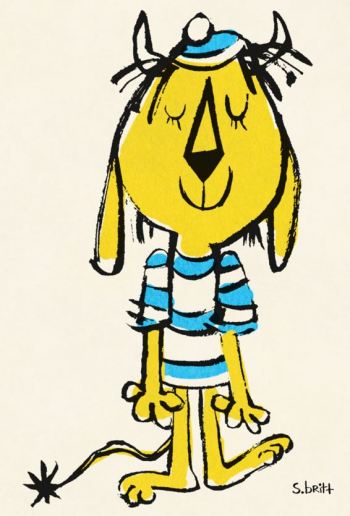
Then he looked more like a friendly monster.

Finally Stephan found exactly the right Norman.

Who knew he would be a purple orangutan in square-frame glasses?!
And much to our surprise, the scientist turned out to be a young Latina girl in black Mary Janes and a stylish bob. This certainly would NOT have been the case had Tara (or art director Merideth Harte or I) attempted to sway Stephan in some definite direction.

- Tammi Sauer is another author who very rarely includes illustration notes in her manuscripts. When I acquired YOUR ALIEN, I asked Tammi what the lost extraterrestrial in her story might look like, and all she would say is that she hoped it would be so adorable that readers everywhere would wish for an alien to crash land in THEIR front yards.
 By giving illustrator Goro Fujita complete carte blanche to imagine the cutest alien in the whole universe, Tammi got exactly what she’d hoped for. See for yourself!
- My final example of an author bravely allowing an illustrator’s inspiration to take the driver’s seat is Kim Norman and her charming THIS OLD VAN, sung to the tune of “This Old Man.”
. Not only did she boldly leave wide open what exactly the characters should look like . . . she also left the entire ending up for grabs! In this rollicking picture book road trip, a pair of hippie grandparents receive a very important invitation from their grandson. Soon they are zipping cross-country in their trusty old van, which must deliver them to their destination in time for The Big Event. But WHAT IS THAT EVENT?, I kept asking Kim. She assured me that illustrator Carolyn Conahan would come up with something PERFECT, but I was too anxious. Surely an illustrator would want some guidance from the author on something as crucial as the ending, wouldn’t she?? Reluctantly, at my insistence, Kim brainstormed a few ideas—perhaps the grandson was starring in the school play or had a big solo in a recital? Carolyn wisely ignored the illustration notes and surprised us with a grand finale so clever that any alternative is unthinkable now: of course the grandson is racing his own miniature version of the old van in the Downhill Derby!

For those of you writing picture books, I challenge you to leave 50% of the inspiration to an illustrator. You are not alone and by no means have to do all the heavy lifting. Write the story and then step away. And for those of you illustrating picture books, I challenge you to ignore any illustration notes that don’t inspire you! Trust one another from afar, inspire one another at a distance, and then get together AFTER the book is printed to celebrate what your wonderful, individual, untainted visions brought into the world.
Meredith Mundy, Executive Editor at Sterling Children’s Books, has always had a passion for character-centered picture books with heart, but she is also seeking everything from funny, original board books to unforgettable middle grade novels to gripping contemporary YA fiction. While she enjoys editing lively nonfiction, she wouldn’t be the right editor for poetry collections or projects geared primarily toward the school and library market.
Meredith is very proud to be blogging alongside such a wonderful group of people, including five stellar Sterling authors/illustrators whose picture books are among her very favorites: Josh Funk, Tara Lazar, Kim Norman, Tammi Sauer, and Liza Woodruff.
Want to give the slush pile the slip? Want to know what advice a seasoned picture book editor would give you? Now’s your chance! Meredith is giving away a free picture book critique.
Leave a comment below to enter. One comment per person, please.
This prize will be given away at the conclusion of PiBoIdMo. You are eligible for this prize if:
- You have registered for PiBoIdMo.
- You have commented ONCE ONLY on today’s post.
- You have completed the PiBoIdMo challenge. (You will have to sign the PiBoIdMo Pledge at the end of the event.)
Good luck, everyone!
 by
by You never know WHEN inspiration will hit
So carry a pen, and be READY for it!
The story of Witch Spa I’m sharing with you,
was LIT-ER-ALLY a dream that came true.
One night, around 3, I sat up in bed
and the words “WITCH SPA” flew into my head.
I said them out loud, then laughed, and passed out
and asked the next day, “what was THAT all about?”
I started to answer myself in real time,
and somehow the words, they came out IN RHYME!
That’s never really happened before,
But when story comes knockin’, you answer the door.
“A Witch Spa is clearly a place witches go…
to recoup and regroup from October’s big show…”
And so it flowed forth, and I let it come out,
pushed PAUSE on my own editorial doubt:
(*which is CRITICAL, I’ll come back to this later)
“After all of the Halloween hullabaloo
With the tricking and treating a haunting to do
And plotting and planning and endless late nights
The cooking and cackling and long broomstick flights
a witch needs a break and a little vacation,
a witch needs a place for some REAL relaxation.
A witch must admit, though it may be bourgeois,
She’s booked herself into the faboo WITCH SPA!”
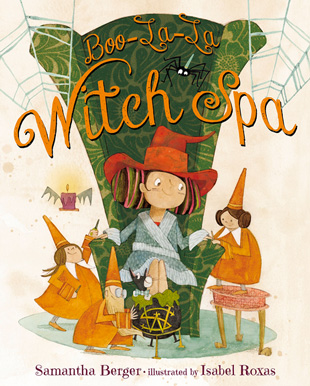
(*note, actual editor killed the word bourgeois)
But almost the rest of the first draft still stands,
from a dream in my head, to the book in my hands.
SO–
Everyone writes in their own writer-way
But here are a few things I think I can say:
1. (*my point from earlier)
Check your self-editor at the front door,
and leave yourself free to fully explore!
Your writing will be a BERGILLION times greater
If you blather it out, and edit it later.
To do both at once, leaves you quite agitated,
makes writing and progress both constipated.
(Fecchhh!)
So ramble and blurt, and fly your flag free,
and do not worry about who’s gonna see.
2. Have you ever witnessed a kid hard at play?
Fully engaged in a world far away?
Drawing or building or digging in sand?
Well, working and playing, they go hand in hand!
So get into play mode, and play for yourself
Don’t worry about how your book hits the shelf.
Go blow some bubbles, sing really loud!
Forget all the rules, and what’s not allowed.
Meow at the moon, run around nakiepants!
Put on a wig, do a Stanky Leg dance!
Go back and touch base with your child within
That’s always an inspirational place to begin.
3. If you are filled with picture book ambition
Challenge yourself with a daily tradition:
A warm-up doodle, a chapter, a page —
A little brain-juice for the mind to engage.
Hold yourself to it, don’t ever cop out–
That’s what PiBoIdMo is really about.
Blah blah blah, Sam.
Enough rhyming!
Write on, PiMoIdMo-thers!
Samantha Berger writes and writes and writes (she even wrote *this*).
She has written picture books like CRANKENSTEIN! illustrated by Dan Santat (Little, Brown, 2013), A CRANKENSTEIN VALENTINE (Little, Brown December, 2014), WITCH SPA illustrated by Isabel Roxas (Dial, August 2015), and SNOOZEFEST illustrated by Kristyna Litten (Dial, January 2015).
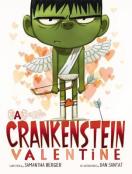
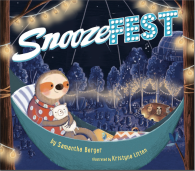
She also has written picture books like SANTA’S REINDEER GAMES illustrated by John Manders (Cartwheel, 2011), MARTHA DOESN’T SHARE, and MARTHA DOESN’T SAY SORRY illustrated by Bruce Whatley (Little, Brown 2010, 2009), which won a Parent’s Choice Award Honor.
She has written cartoons and promos for Nickelodeon and other networks. She has written comic books and commercials.
She has written movie trailers, theme songs, slogans, magazine articles, poems, TV-books, sticker books and professional books.
You name it, Sam writes it.
And when she ISN’T WRITING…. She’s doing voice-overs, traveling the world, and helping rescue dogs.
THEN…
she writes about that, too!
Samantha splits her time between New York City and sunny California.
Samantha is giving away one of her books! Ooh-la-la!
Leave a comment to enter. One comment per person, please.
This prize will be given away at the conclusion of PiBoIdMo. You are eligible for this prize if:
- You have registered for PiBoIdMo.
- You have commented ONCE ONLY on today’s post.
- You have completed the PiBoIdMo challenge. (You will have to sign the PiBoIdMo Pledge at the end of the event.)
Good luck, everyone!
 by
by INSPIRATION!
If you are anything like me, the second you hear that word, your mind goes blank and suddenly you have no clue at all what gets your creative juices flowing. Fortunately, after hitting mental roadblocks so many times over the years, I have a finely tuned system now and I never run out of ideas EVER. That is a lie. But, what I have done is tried to look at my experience with writers’ block as an opportunity to see what gets me out of it, and keep those tools in my creative arsenal.
I’d say there are a few main ways that I activate my muse:
- Lists. I’m a hardcore list maker. I LOVE lists. Writing lists, drawing lists, drawing someone writing a list. One of my favorite lists is my list of words/things/images that I like. I keep it in the back of my sketchbooks and I just add to it all the time and when I’m done with a sketchbook, I start a new list. When I come across something that peaks my interests, like say “knots in a tree” I add it to the list. Then I have it to refer back to later to help get me going for stories. You never know how the smallest little phrase or image can spark a story or character idea.
.
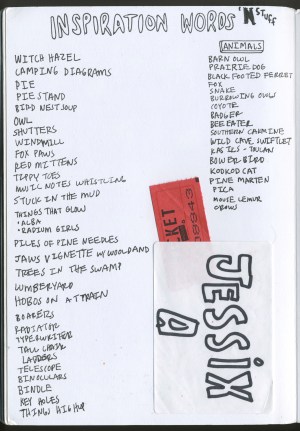
Then I will usually draw a character doing one of the things from my lists, which is just really fun and definitely helps build a story in my mind.
- Create a world for your characters. This is something that sort of started to build itself without me really even trying. When honing my visual voice as an illustrator, I quickly felt like I was creating all of these little characters for my portfolio that all came from the same place. I had all these little Woodland critters (that’s what I like to draw—cute anthropomorphic forest animals) doing things around the same forest.
.
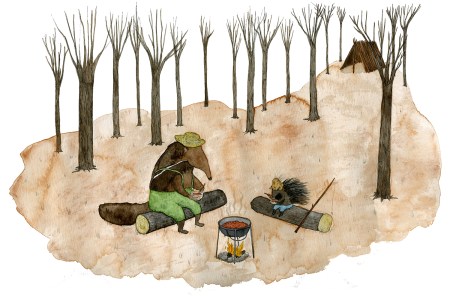

So the badgers could easily bump into the porcupine or the raccoon and they’d all have lunch together (I’m sure this comes from growing up loving Beatrix Potter and Richard Scarry).
Now I document these little moments on a map of the place that they live, which for me is a really fun way to keep them talking to one another, to keep my voice consistent, and it gives my characters a chance to come to life and let me look in on that life from time to time.

After a while in this world, they start to tell me stories instead of the other way around.
- Personal history. I have learned that the biggest cliché, “Write what you know” is one so true. If you search your memories, you’d be surprised at how you can turn it into a picture book idea. I’ve said in previous interviews that my debut picture book, Boats for Papa, came from a flash of inspiration one morning. But it didn’t fall out of thin air.
.
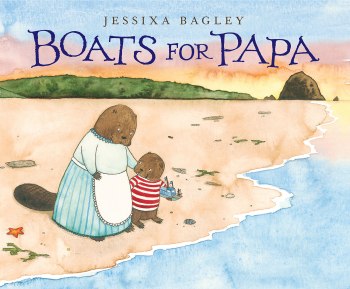
The story of Buckley and his Mama was very much modeled after my own childhood. I was a creative child (aka a busy little beaver) and my mother always encouraged that creativity.
My parents divorced when I was young and my father lived across the country, and passed away when I was 17, so that feeling of absence permeated my life. It wasn’t until I had written this book and it was in the process of getting published that I realized how much from the book was really me and my story. I think that is why it’s been able to move so many people—that honesty came from a very pure place and it resonates with readers. That was something that I didn’t exactly plan, but I know now is the core of why it’s so powerful. So now I try looking to my own past and my own real life experiences for ideas to get me going. Even simple memories can be the foundation for a great story. Staying open to seeing those experiences can be a challenge, but being an artist is about being vulnerable and without that vulnerability you can’t really know who you are or what kind of work you want to make.
I feel like even though these are methods I use to help me generate ideas, I still get stuck and still find new ways of getting ideas moving. Hopefully these inspire you. And if they don’t, read the next blog post—you never know what will spark your creative genius!
Thanks so much, Tara for having me! Good luck to you all!
Jessixa Bagley is a picture book author/illustrator of Boats for Papa, Before I Leave (out February 16, 2016) and Laundry Day (out winter 2017) all published by Roaring Brook Press. She loves hamburgers, tiny watercolor brushes, and repeat viewings of Gilmore Girls. She lives in Seattle, WA with her biggest inspirations—her illustrator husband Aaron Bagley and drooling baby boy Baxter who turned 1 year old the day of this post! Find her online at Jessixa.com and on Twitter @JessixaBagley.
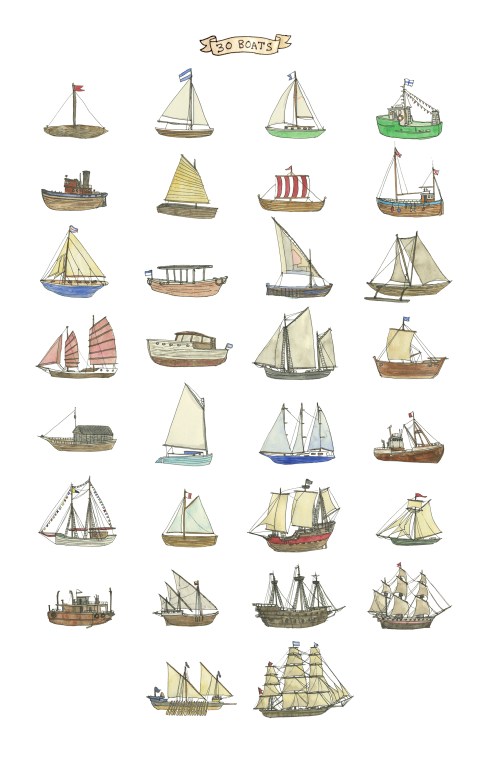
Jessixa is giving away a copy of Boats for Papa and this “30 Boats” poster!
Leave a comment to enter. One comment per person, please.
These prizes will be given away at the conclusion of PiBoIdMo. You are eligible for these prizes if:
- You have registered for PiBoIdMo.
- You have commented ONCE ONLY on today’s post.
- You have completed the PiBoIdMo challenge. (You will have to sign the PiBoIdMo Pledge at the end of the event.)
Good luck, everyone!