You are currently browsing Tara Lazar’s articles.
Say hello to Maria Gianferrari & Becca! (And their bookshelves! Impressive!)

I have known Maria for years now–first as a reader of this blog, then as a jewelry customer (I make earrings and necklaces in my spare time) and now as a fellow author and agent-sister! Maria has one of these rip-roaring breakout careers where she has sold umpteen books in no time and has even landed her first picture book series, PENNY & JELLY! Wow!
To celebrate the release of Maria’s second book in the PENNY & JELLY series, SLUMBER UNDER THE STARS, I asked editor Cynthia Platt and Maria a few questions—and they gave me three books to give away!

Cynthia, many writers dream of landing a picture book series. As an editor, what do you look for in a story that gives it series potential?
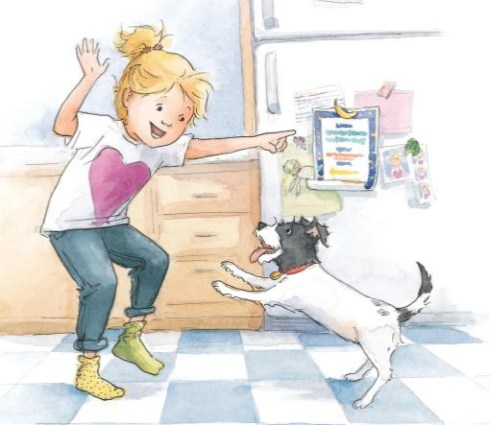
I wouldn’t say that I’m necessarily on the lookout for picture book series as a general rule, but I am always pleased when something calls out for more than a single book. For me, the strength of the picture book character is everything in terms of determining whether there might be series potential. It has to be someone I want to spend a lot of time with—and about whom I think kids will feel similarly. Humor also plays a huge role. No one wants a dreary picture book series (at least I don’t). With Penny & Jelly, I was immediately drawn to Penny’s personality and also to the very warm, very loving relationship between girl and dog. I also loved—from the moment I read the first draft of the first book—the creativity Penny possesses. She’s got such a can-do attitude, and she makes things happen for herself (even if she has to work through a few lists and a lot of craft supplies to do it). So, the story hit a lot of sweet spots for me as an editor.
Was PENNY & JELLY originally pitched as a series, or was it something you decided would be made into a series?
It wasn’t pitched as a series. After reading Penny & Jelly: The School Show, we approached Maria and her agent, Ammi-Joan Paquette, about doing more than one book. Then Maria came up with the brilliant idea of a Slumber Under the Stars theme for the second book.
Maria, did you envision Penny & Jelly as a series when you first wrote it?
I didn’t initially envision it as a series, but I was thrilled that Cynthia and HMH presented me with a two-book deal because they felt that Penny & Jelly were lovable characters with a special bond that they could envision as a series.
Did you imagine what Penny & Jelly looked like? Did you have a role in helping to pick Thyra Heder as the illustrator?
I had a very vague sense of what Penny & Jelly might look like. Since Penny & Jelly were characters inspired by my daughter, Anya, and her canine BFF, Becca, it was hard to picture them any other way than this, my favorite photo of the two besties.

I didn’t have a direct role in selecting Thyra, but Cynthia presented her work to me and asked for my input. Of course, I loved it. I could tell right away she was a dog lover like me when I saw these early Jellys, and I knew she was just a perfect fit to illustrate the Penny & Jelly books!
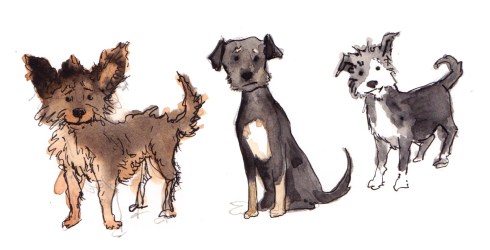
How adorable! I love her doggy design sense! (Is the middle pup available for adoption?)
Cynthia & Maria, thank you for stopping by on the PENNY & JELLY SLUMBER UNDER THE STARS blog tour. And thank you for the three-book giveaway!
Leave a comment below to enter, US residents only, please. Winners will be chosen by the end of the month.
GOOD LUCK!
Before I recap the SCBWI conferences I’ve attended the last two months, there’s a pressing topic that requires outing…a little quirk I have witnessed at every kidlit conference from the dawn of time (or, in my case, since 2008).
FOMO.
Maybe you don’t have a teen in your household and you’re shrugging right now. What the heck is FOMO?
Well, let’s describe the scene.
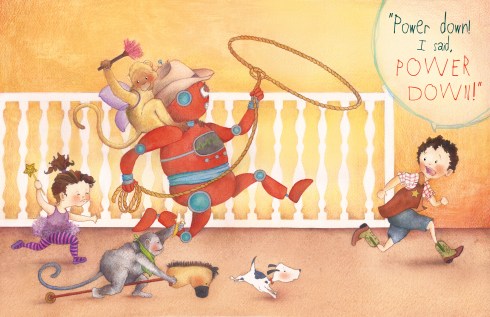
See the new-to-kidlit conference attendee, nervous yet determined, marching around the event carrying a stuffed animal based on their story’s character so people will inquire about it, talking to anyone who will listen to the pitch…which, unfortunately, the attendee hasn’t quite figured out yet.
Witness the cornering of an agent or editor in a hallway, a conference room, the buffet line, or heaven forbid, the restroom stall, being asked if they will read the manuscript, listen to the pitch or “peek” at other work.
See the attendee making conversation about the story and only the story, never asking anyone what they’re writing or even about their family, where they scored that awesome vintage dress, what they do for fun, where they’ve traveled, or anything unrelated to WORK.
You see, the new kidlit conference attendee is gripped by FOMO:
FEAR
OF
MISSING
OUT
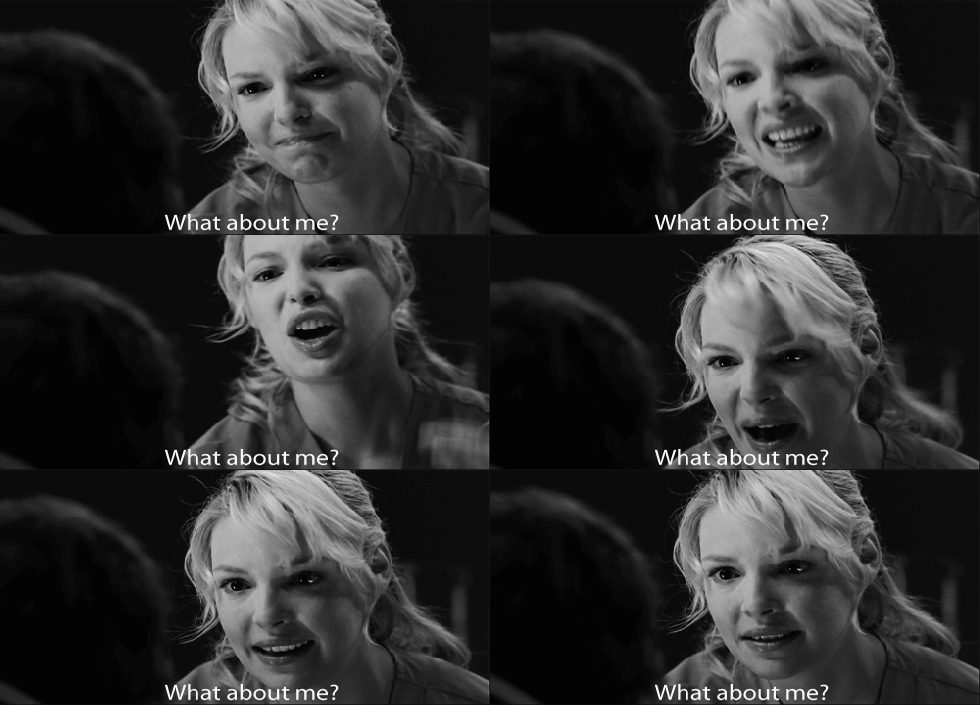
FOMO makes us jumpy, anxious, pushy and, dare I say it, annoying. The person-with-the-manuscript thinks this conference is THE ONE CHANCE to break through, to get the manuscript not only read, but read and LOVED, contracts thrust forward with gusto. They envision a bidding war breaking out right at lunch table 10, pitting Viking against Sterling, swords thrust forward with gusto.
It’s an unflattering portrait I’ve painted, and I apologize. But you see, I too was afflicted by FOMO. I know it so well because I lived it. (I am the first person above with the stuffed animal, just so you know.)
It took me a couple years, and some serious coaching by professional authors, to calm down at conferences, to realize that the lunch table duel just DOES NOT HAPPEN. Yes, an agent or editor may fall in love with your project, but more frequently they fall in I-think-I-like, ask for revisions, and begin a relationship with you. The opportunities happen AFTER the conference.
And remember, relationships can start with something other than A MANUSCRIPT.
Editors and agents are real people, too. They are not these mystical beings who float away to enchanted realms after a conference ends. They are wives and husbands, fiancés, mothers and fathers, lacrosse coaches, knitters, ukelele players, cycling enthusiasts, City Harvest volunteers, Rick Springfield fans and even former accountants who love spreadsheets (these people mystify me). They are multi-faceted, shimmering personalities. They like to sip a glass of wine at cocktail hour and talk about anything other than the books sitting on their desks. Honestly, an editor will remember the person with whom they share a passion for the Amazon rainforest and try to forget the pleading, desperate person who repeatedly asked if they had five minutes to hear a pitch.
FOMO. It can ruin your judgment. It can make you forget how to forge friendships.

Do not fall victim to conference FOMO. Because if you are clamoring, praying, hoping for JUST ONE book deal, I have to warn you—this is not true! Because once that book deal happens, the satisfaction may indeed last a lifetime, but the longing for a NEW book deal circles back again and you think: JUST ONE MORE book deal. The ideas never end. The storytelling never ends. If you are a writer, a creative being, you are hopefully in this for life. Getting published does not change the mission—to pour your innermost being out on paper. Getting published does not fundamentally change your life (unless you get a 7-figure debut deal). Yes, you have accomplished something few people ever do, you worked hard for it, but you are still you. You will want to do it again. You will want to ride this crazy rollercoaster of rejection and self-doubt and discovery over and over.
So the FOMO you feel? It actually never goes away once you are published. The trick is to learn to control it.

Do not let that BAD FOMO MOJO zap you of your creative energy, your imagination, your unique perspective, your force to do good in the universe. Don’t let FOMO make you a BOZO.
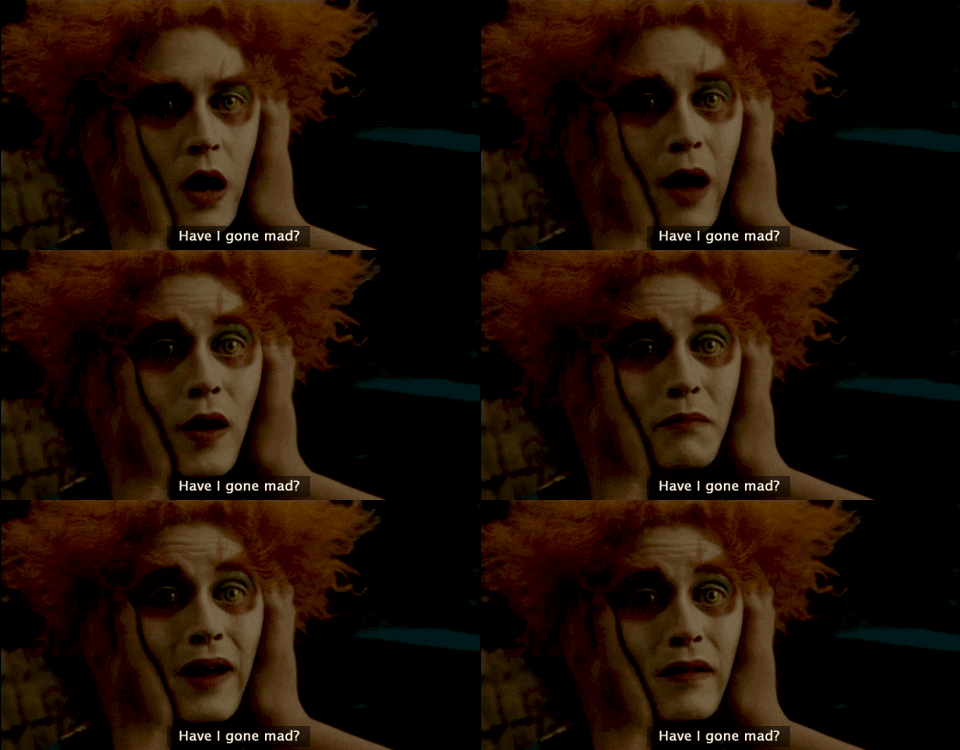
If you are new to kidlit conferences, RELAX. Listen. Learn. Just be you. Don’t fixate on selling the manuscript in your tote bag. Getting published takes years and it is not a race. It’s a marathon, an insanely strenuous yet joyous journey. Sit back and enjoy the run! You are not missing out on anything. You are in the thick of it.

Let me introduce you to one of the hardest working illustrators in kidlit. I have known Wendy Martin for years, and during that time she has been drawing everything in sight and refining her style. Her diverse range spans from mandala coloring books to art nouveau maidens to the bright watercolors of her illustrative picture book debut, THE STORY CIRCLE/EL CIRCULO DE CUENTOS. This charming bi-lingual tale features a determined group of students who discover the power of story.
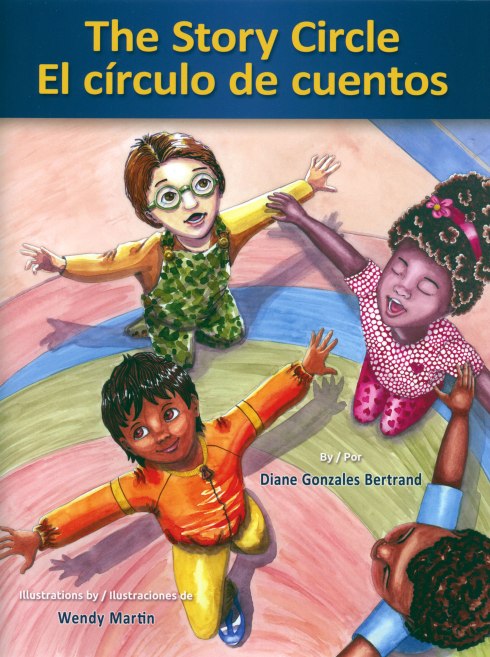
Wendy, were there any unique challenges to illustrating a bi-lingual picture book?
I received the manuscript in English only. According to the paperwork from the publisher, the text would be translated later. Piñata Books has a fairly standard format for their picture books. Both languages of text on one side of the spread with the English and Spanish separated by a vignette, but the art notes I received wanted art to run across the border. In most cases, when I’m doing my thumbnail sketches, I leave room for text while designing each spread. In this book’s case, I had to allow for a bit more than twice the space of the English copy, because Spanish usually has more words. It’s a good thing the text is very short, since my illustrations take up a lot of space.

How have you gone about marketing and promoting this book as an illustrator rather than an author?
THE STORY CIRCLE/EL CIRCULO DE CUENTOS is a wonderful book for classroom usage. But with the release date being May 30, schools have been closed for weeks already here in Missouri. I plan to use the summer months to create a contact list of school resource librarians about coming to area schools to talk about what an illustrator does and how a book is illustrated. I already do this kind of appearance via Skype school visits around the world. The author, Diane Gonzales Bertrand, is an accomplished speaker and teacher. She is promoting the book in Texas at book fairs and local children’s events. She says she is pretty uninvolved in the digital arena, so that’s where I’m focusing my marketing efforts for now. This blog tour is part of that.
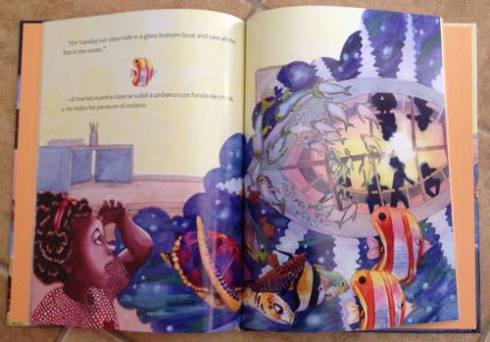
Why are picture books with diverse characters important?
I remember as a child always feeling like an outsider at story time, mainly because the characters in the books were never like me. It’s difficult to be a minority, whether it’s by culture or because of skin tone. The United States is a melting pot, where there are many, many cultures, skin tones, religions, lifestyles, what have you. No child should be made to feel as if their families, their cultures or their race are “less than” any other. If they don’t see kids like themselves, in books, doing the things that they do, in the way they do it, it is harmful to them, as well as to the children outside of that group of people. One of the reasons I was so excited to work with Piñata Books is precisely because their editorial focus is inclusive of many cultures. They do tend to lean toward the population breakdown of the Houston, Texas public school area, but since they are located there, that’s understandable.
I have kids of multiple ethnicities in my made up classroom. I loved giving each one of them a personality. I do that a lot. My characters all have backstory (in my head) as to who they are, and how they’ll act in all my books. They become “real” to me, for the length of the time it takes me to create the book. It’s always a little bit sad when I send them out into the world. Just like a mom sending any of her children off on their own.
 Thank you, Wendy, for sharing your new book–and for giving away a copy to one of our blog readers!
Leave one comment below to be entered in the random drawing for THE STORY CIRCLE/EL CIRCULO DE CUENTOS. A winner will be selected in approximately two weeks.
Good luck and happy reading!
 guest post by Megan E. Bryant
DUMP TRUCK DUCK, my first picture book, is about a crew of construction ducks who build a park. But what most people don’t know is that it’s also the book that built a bridge for me to become the kind of writer I’ve always aspired to be.
When I started writing DUMP TRUCK DUCK, I’d already been fortunate to publish several board books. Conventional wisdom says that it’s hard to sell board books without illustrations attached, but for me, brainstorming and writing board books was fun, it was easy, it was safe. The secret to selling a board book without art is to have a fantastic idea that is tailored to the format—something that can’t just as easily be a picture book; something that a publisher simply can’t resist. It also helps to have series potential or an angle for table placement—seasonal and holiday can be a tough sell for high-priced picture books due to their shorter selling seasons, but lower-cost, eye-catching board books are a natural fit.
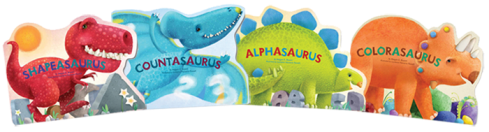
Board books came easily to me, but what about the pages of ideas I had—for picture books, middle-grade series, and YA novels? There were so many other stories I wanted to tell. What was keeping me from pursuing them?
One word: myself.
To make these book dreams a reality would involve several things that scared me: taking big risks with my writing, surviving setbacks, and ultimately facing failure (and lots of it!). When my longing to tell these stories grew even louder than my fear, I realized that it was time to try. I started writing and writing and writing—writing my heart out—and revising until the drafts of various manuscripts numbered into the hundreds. I started querying agents, too, which led to several months of rejection. During this process, I had the idea for DUMP TRUCK DUCK; when I asked my then-three-year-old daughter what she thought about it, she laughed with enthusiasm and replied, “Write that book, Mommy. Write it right now!”
How could I resist?
It took about three months to have a strong, polished draft of DUMP TRUCK DUCK. Since I was compelled to write it in rhyme, I knew that every syllable had to be perfect. Nothing will torpedo a rhyming manuscript faster than uneven rhythm or forced rhymes. All that work paid off; Dump Truck Duck was the manuscript that brought in several offers from agents, including one from Jamie Weiss Chilton, who has been an amazing agent and even better friend for five years now. Jamie loved Dump Truck Duck and couldn’t have been more enthusiastic about it. When we went on submission, I was giddy with excitement.
Then the rejections started rolling in—for four long years.
It sounds egocentric, but I have to admit I was surprised. Weren’t trucks an evergreen topic, beloved by boys and girls? Didn’t the ducks add a unique angle? Wasn’t the rhyme just right? Jamie wasn’t ready to give up, but in my heart I wondered if it was time to face the sad truth that maybe some manuscripts, no matter how hard you’ve worked or how much you’ve believed in them, are not meant to become books.
Then, it happened: The editorial director at Albert Whitman loved DUMP TRUCK DUCK as much as Jamie did; as much as my daughter did. After the offer came in, I walked around in a state of disbelief for weeks. Astonishingly, that was just the start of a period of extraordinarily good news. In four months, we received offers on seven other books, including a chapter book series, a board book series, and my YA debut. Of course, the only reason we were able to sell so many books in such a short period of time is because I never stopped writing. Even during the darkest times, when I was so discouraged it was hard to walk into bookstores; even when I wondered if I’d ever sell another book again. The gift of all those rejections was learning a fundamental truth about myself: I would always write, no matter what. And that is one reason why I didn’t give up, even when common sense would dictate it was time to move on.
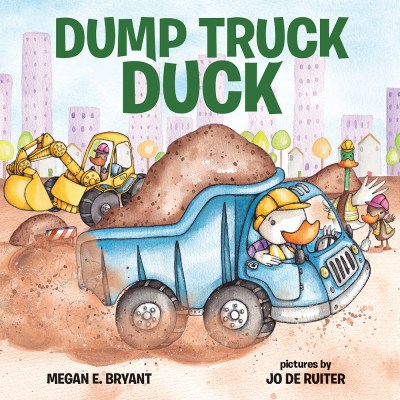
To watch my manuscript for DUMP TRUCK DUCK transform into a book with adorable illustrations by Jo de Ruiter was a joy that defies description. I’m so grateful to everyone who worked so hard to make this book, from Jamie and Jo to the talented team at Albert Whitman. I’ve tried to do my part to promote it by setting up readings and events for children, along with my very first blog tour. This has been a book truly worth celebrating—and celebrate we did, with a fabulous construction-themed launch party!
Children grow faster than books; I was never able to present my preschool-aged daughter with the copy of DUMP TRUCK DUCK she so eagerly anticipated. She’s a big girl now—eight years old and reading independently—and there’s a new preschooler in our lives: my son, who loves nothing more than when his sister reads DUMP TRUCK DUCK to him. Hearing my words spoken in her sweet voice truly makes it worth the wait.
Thank you, Megan! What an inspiring story. And so many more books to come. Congratulations!
Megan is generously giving away a copy of DUMP TRUCK DUCK. A winner will be selected by random at the conclusion of her blog tour. Just leave a comment below to enter and good luck!
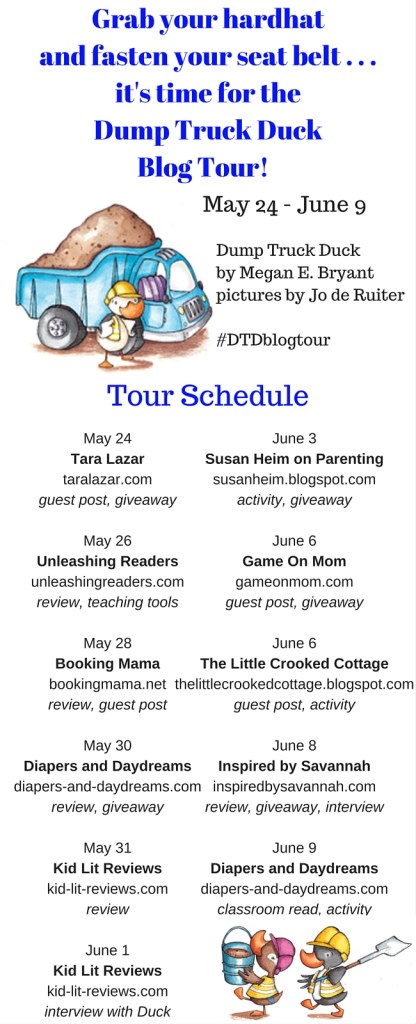
The winner of the GOOD NIGHT, BADDIES giveaway is:
LILLIAN HECKINGER!
Congratulations, Lillian. I will be emailing you shortly.
Thanks for entering and I hope everyone will pick up a copy!
 by guest blogger & singer Deborah Underwood
I’ve been a singer for even longer than I’ve been a writer. But when it became too hard to juggle rehearsals and concerts with my writing work, I regretfully resigned from the chamber choir I’d sung with for nearly two decades.
But I really missed making music. So I had an idea: I’d write and record a lullaby to go along with GOOD NIGHT, BADDIES, my new picture book about all the supposedly-bad fairy tale creatures clocking out and going home to spend a lovely evening together.
Easy-peasy, right?
Here’s what I learned about the similarities between writing a picture book and recording a song.
They both seem simple at first, then completely impossible. But if you keep moving forward, they get done.
My first picture books were total messes. One had six main characters. One had nothing resembling a plot. It took a while for me to understand just how difficult it is to write a good picture book, because I didn’t know what I didn’t know!
Recording was the same way. I naively asked a recording artist friend what I needed to do, and learned I’d need a team of professionals, a recording studio, a bunch of knowledge I didn’t have, and a whole lot of money.
I almost threw in the towel, but decided to ask around first. Did anyone know a sound engineer? Did anyone know of a studio? Or a guitarist, since I’d cleverly written a guitar part I was unable to play?
Luckily, one of the folks I asked was Gunnar Madsen, founding member of The Bobs and a former critique group member. It turned out he has a home studio, he could do the engineering, and he knew a guitarist, Jules Leyhe, I could hire.
Ta-da! Most of the obstacles disappeared—after I did a bunch of research and reached out to people who might help. It was still a hefty expense, but not as much as my friend had predicted.
Both are learning experiences.
Every picture book I’ve written has been instructive—especially the ones I wrote in the beginning. (I don’t write books with six main characters anymore.)
Likewise, I learned a lot making this recording. For example: the guitarist and I were recording in the same room, so if either one of us made a mistake, we had to redo both our parts. A recording studio with separate booths for each musician could have made the process speedier.
Nothing’s perfect.
It’s hard not to want to go back and change things in my published books. But I’ve come to realize that with every book, I do the best I can. If my present best is better than my past best, that’s only a good thing: it means I’ve grown.
That was a hard-won lesson for this recovering perfectionist, and I’m happy it transferred to this new venture. The recording isn’t perfect, but neither am I. We could have spent hours in post-production trying to make every note flawless, but Gunnar and I agreed that the result would be less appealing; I wanted to sound like a human being, not a robot. Who wants to be sung to sleep by a robot? (Hmm, I may have a new picture book idea…)
All in all, it was a great experience. I’d dreamed of recording a song for ages, and it was a thrill to combine, rather than need to choose between, my love of singing and my love of writing.
The song is a free download at deborahunderwood.bandcamp.com. Listen here:
I hope you enjoy it! And please look for GOOD NIGHT, BADDIES. Juli Kangas’s art for the book is gorgeous, rich, funny, and heartwarming—I am one lucky writer! You can get a sneak preview of some of the beautiful illustrations in the trailer, which you’ll find at DeborahUnderwoodBooks.com.
Thank you, Deborah, for sharing your beautiful voice and original composition. It’s BAD! (That’s Michael Jackson BAD, not bad BAD.)
GOOD NIGHT, BADDIES releases TOMORROW but you can win a copy TODAY! You have until MIDNIGHT PST tonight to enter by leaving a comment below.
For years I mistakenly thought that writing was just about words. About particularly poignant sentences. Flourishes of the language. Creating a passage so magnificent, it makes the reader stop and ponder the meaning of life.
Of course, it isn’t just about words. It’s about all the words, together. It’s about the story.
So in pursuit of the best story this week, I had to kill darlings. We’ve all heard the phrase before, but what does it actually mean? What are we bludgeoning to death?
In short, “darlings” are pieces of writing that do not further your story. They are superfluous lines only there because you want to admire their shine and glow. Ooh, sparkly!
The reader should not be jolted out of the story by the beauty of your words. The point is to draw the reader further in, not shove them out.
So what do these little darlings look like?
Sorry, not Kristy McNichol.
These darlings may drag a scene on too long. The point has already been made, but you stick it to the reader one last time in such a witty way. Sorry, kill it.
Sometimes we get so caught up in fun devices like alliteration, internal rhyme and onomatopoeia that we end up with gobbledygook rather than glory. Sorry, kill it.
On occasion, we write jokes that fall flat. Sure, we laugh hysterically but to everyone else they go SPLAT, right in the kisser. Sorry, kill it.
You know that character who magically appears, says one important thing and then leaves? Why? Where’d she go? Is she ever coming back? No? Well then, murder must be committed.
And if we’re writing a story based upon real events, we can feel inclined to include things that actually happened, even if they don’t necessarily add anything but word count. Kill, kill, kill.
Edgar Allan Poe’s “Single Effect” theory suggests that everything in a short story should contribute to an overall emotional theme. Everything you put into the story, he said, should be carefully selected to elicit the desired effect.
And since we’re writing what can be considered super-short stories, we need to be even more diligent about leading the reader down a specific path. Veering off means higher word count—which can kill the story’s publication potential. Sacrifice some darlings and save the whole village!
Super-short shorts may have killed WHAM!
Finally, don’t be sad about killing your darlings. When you have to kill one or two, just refer to these gifs. They’ll make you feel better. (I know they helped me.)

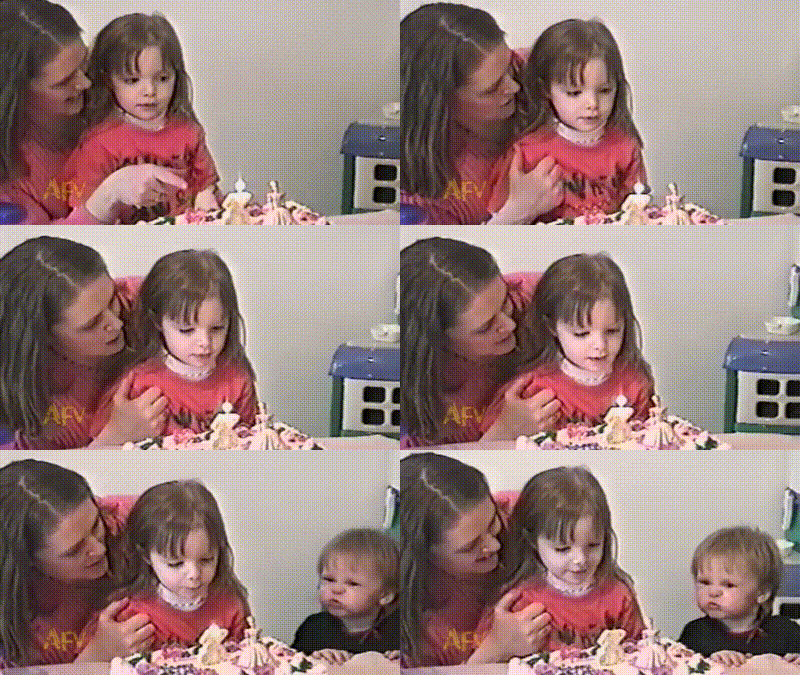
We have a winner for Catherine Bailey and Sarita Rich’s giveaway. Sarita’s daughter Stella did the honors:
.
Congratulations, MELISSA STOLLER! I will be contacting you via email to arrange the prize.
Watching that sweet video makes me want to write a story to make Stella giggle! Consider her cuteness your motivation for the week!
by author Catherine Bailey & illustrator Sarita Rich
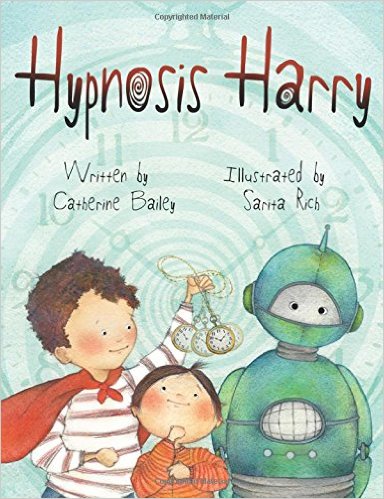
Thank you for hosting us today, Miss Tara. We are excited to be here, and we are excited to celebrate the release of HYPNOSIS HARRY, and we are excited to talk about each other and, well, we are just really excited. So without further ado, here is us interviewing us.
1. Okay, Sarita, Harry’s expressions are some of my favorite moments in the book. Was he, or any of the characters or images, based on your family or home life?
As much fun as Harry was to draw, I really liked having a sister. In an earlier draft, she was older, but I decided maybe a baby/toddler would be funnier, especially on the last page. And I had a (sometimes) cooperative model at home, so that was helpful. I also liked having a cat in the story. I’ve had my share of overweight cats that could squish themselves into tiny cardboard boxes and fall asleep.
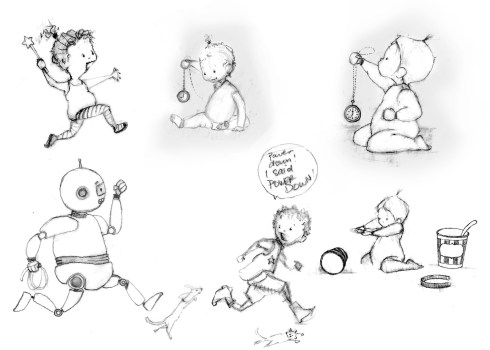
2. I love that background info – especially the bits about the sister and the cat. (I have both.) So what was the most challenging aspect of illustrating Harry, and how did you overcome it?
Timing. I received the manuscript late September 2014 and had to submit a sample spread before October 10. I was pregnant with an October 23 due date and thought I had plenty of time to finish the spread. At my 38-week appointment, my doctor said I could go into labor any day, possibly that very night. “But I can’t! I haven’t finished the spread!” I thought. I sent the file on October 9, and Stella was born October 12. Sky Pony offered the contract shortly afterward, and I had to figure out how to be a mom and an illustrator at the same time. I was a little sleep deprived until June, but when an opportunity to work with editors from like Sky Pony, and an author like Catherine comes along, you say YES and sleep later.
3. I had NO CLUE you were birthing babies during all this. You win the amazing illustrator ward of the year for sure! And you have been equally amazing with the promotional / post-publication support. What unique skills/opportunities do you think an illustrator can provide to/for the marketing of a picture book?
Illustrators have a chance to bring a book to life in many different ways. When you invited me to collaborate on launch party ideas, I learned an illustrator can extend the life of the book way beyond the reading. For HYPNOSIS HARRY, I helped create fun extras like coloring pages, drawing activities, and a craft demonstration. Since we both love giveaways, I suggested that since we couldn’t attend the other’s launch party, that we each donate an item to give away at our respective parties. And one thing I love most about illustrators is seeing a preview of process—a drawing demo, for example–because usually all we get to see is the finished product. When I find a book I admire, one of the first things I wonder is, “How did the illustrator do this?!” Seeing what goes into the creation of a book makes you appreciate the work so much more.
4. I do love giveaways. And your genius craft ideas. And Nutella. But I digress. What part of marketing HYPNOSIS HARRY are you most looking forward to doing?
I have some school visits lined up on April 8th, which happens to be during reading week at this particular school. I’m looking forward to reading to kids and drawing with them and giving them free stuff (bookmarks!).
5. Okay one last deep and insightful question. What was one NO from your parents that you wish had been a YES?
I’m from a treeless part of northern Alaska, and therefore my sister and I could never have a tree house. We had to settle for a ground level clubhouse. One summer we devised the perfect set up of old pallets and scrap plywood, complete with a clandestine hole in the ground in which I deposited empty candy wrappers. At one point, I tried to build a fire inside the clubhouse to destroy evidence of said candy consumption. I made sure to put the fire out completely, etc. but Dad found out and said NO to unsupervised backyard fires. He was especially furious because I had overlooked the fact that our clubhouse was built right next to the 50-gallon oil tank that contained our winter fuel…
That’s hilarious. And also dangerous. I am very glad you did not blow yourself up Sarita. And I am very, VERY glad you are my illustrator. Thank you! Okay, my turn in the hot seat.
1. In hindsight, I’m also grateful for parents who tempered the pyromaniac within so that I could live to meet Harry. What made you want to tell his story?
I read some little online blurb somewhere about a hypnosis demonstration gone wrong – the performer couldn’t snap his audience out of their trance. So I added hypnosis to my list of picture book ideas and forgot about it. A few weeks later I was trying to explain to my three-year-old why she couldn’t wear my wedding dress to school and it hit me – what if she were in charge? What if she hypnotized me and her dad? What would she do?! It would be terrifying, but also funny. Also, when I was a kid, I had a book called something like How To Get Your Parents To Give You Everything You Ever Wanted. That book was definitely a big inspiration too.
2. I love this insight into the inspiration behind the book. Speaking of others being in charge, how do you strike the balance between including too many illo notes and trusting the illustrator?
How do I strike the balance? Um, I don’t. I’m awful. LOL! My early drafts include dozens of art notes. I guess it is just part of my writing process to visualize every image and page turn. Fortunately I have great critique partners, and a wonderagent, who save me from myself. They help me to cut most of the art notes, which is a good thing. It is critical to trust the illustrator, art director, and publisher. They know so much more and do a much better job at that side of things. Let’s just say that if you and I both drew a stick figure, your stick figure would be way prettier.

3. I can see my stick figure getting carried away with clothes and eyelashes but the important point is that YOU are a marketing genius whose marketing plans should be SCBWI conference presentations. So what are the 3 most important things you keep in mind when developing a marketing plan for your picture books?
Audience, Budget, and Feasibility.
Defining your Audience makes you focus your efforts, which makes everything you do – calls, emails, school visits, signings, tweets, etc. – more effective. For example, I know my audience likes books, so bookmarks are a good giveaway (thank you Sarita for those!). Hairy poisonous spiders on the other hand, are not.
I hate to say Budget – but books are a business, like it or not, and I can’t spend a lot of money on items that don’t have a healthy return (even if I really, really want to!).
Feasibility means “Will Catherine actually do this thing or will she wimp out because she’s tired / doesn’t understand it / ran out of time?” For example, I would love to drive to every library within 200 miles and show them HYPNOSIS HARRY and convince them to add it to their collection. But unless I win some sort of babysitting and gas lottery, I can’t. So I’ll tone it down and just drive to every one within 30 miles 🙂 And I will do a lot of outreach online.
4. Those tips are sure to help us maintain sanity. Moving on: what major differences do you see in your marketing strategies for this book vs. MIND YOUR MONSTERS?
The biggest difference is that I can market HYPNOSIS HARRY towards schools because it came out during the school year. Also I now have dozens of school visits under my belt from my first book, MIND YOUR MONSTERS, so I can go back to those contacts. Overall marketing the second book is easier because I have at least some clue as to what I’m doing. But there’s always more to learn!
5. And finally, because I have to know, what was one NO from your parents that you wish had been a YES?
My grandparents had a farm, and on that farm was Molly. Molly was a horse and she belonged to my older sister Sarah Helen. Eventually I wanted a horse too (they really should have seen that coming), but my parents responded with a firm No. Instead my sister was instructed to share Molly with me. You can just imagine how that went. I spent a lot of time trying to ride the barn cats.

Thank you for reading. And there’s more! A giveaway (wheee)! Just leave a note in the comments below and you will be entered to win a Skype consult with author Catherine Bailey and illustrator Sarita Rich. Consider it a tag team critique where we will take a look at your picture book manuscript, and then chat about it with you in person. Well, in “digital-person.” You know what we mean.
Every year the NJ-SCBWI conference holds a Juried Art Show for illustrators. Back in 2013, the theme was “Down the Rabbit Hole”. I strolled the exhibit and stopped in my tracks at this image:
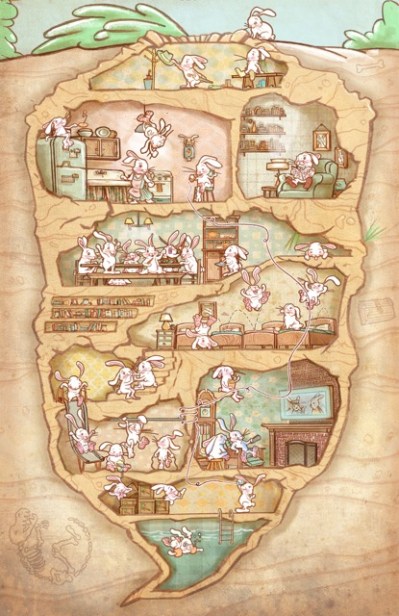
How marvelous is this? It immediately reminded me of Jill Barklem’s Brambly Hedge series, with field mice living in homes carved into the trees.
These bunnies were so busy in every room of their carrot cave, so much motion and expression and general giggly cuteness. Just delightful. The illustration made me smile. I took note of the illustrator’s name, Jason Kirschner, and vowed to seek him out that weekend.
I’m always looking for talented new illustrators. After all, an illustrator makes my words and characters come alive. They make me look good. I want the best artists to break into the business so that one day I might be able to work with them.
I’d like to think that Jason and I hit it off. We became friends. (Note: I did fall at his feet. Literally. But quite by accident.) He won the Juried Art Show in the unpublished category and became noted as an up-and-comer. He soon landed an agent. And I am so pleased that his debut picture book, MR. PARTICULAR, will be published next month…and that he’s chosen to premiere the trailer right here, right now!
.
 Picky kids everywhere, rejoice! Your choosy champion is swinging into action–as long as there’s nothing sticky or gooey in sight. In Jason’s hilarious debut, this discriminating daredevil wants to save the day, but he’s got a few rules and restrictions to work around first. Any kid who pushes peas around his plate is gonna relate.
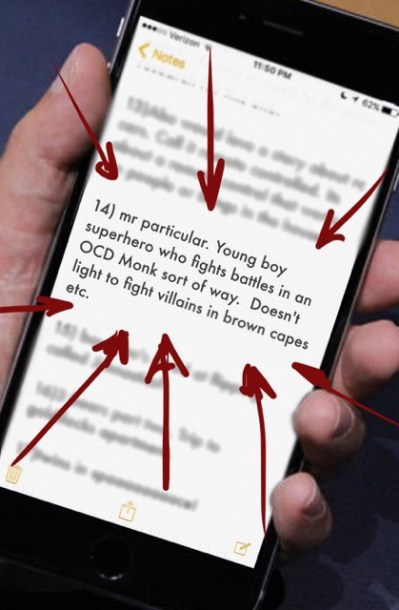
The story is funny and soaked to the core with truths about particular kids. We all know them and their demands. Why it took so long to recognize them in a picture book, I’ll never know. But, luckily, MR. PARTICULAR was a 2013 PiBoIdMo idea!
Here’s the proof:
The other interesting thing about Jason, besides being a former Art Director for Late Night with David Letterman, is that he has twins. And those twins provided the voice-overs for the trailer. I decided to ask the talent a few questions…
Mr. Particular is one persnickety person. How did you prepare for this challenging role?
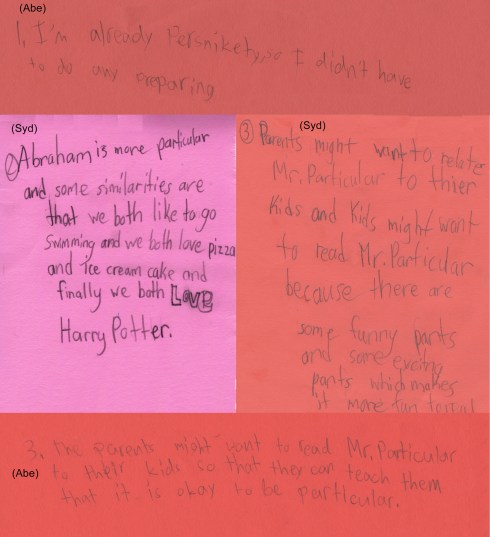
[Abe]: I am already persnickety, so I didn’t have to do any preparing.
Your fans will want to know, as twins, are you anything alike? Who is the more particular of the pair?
[Syd]: Abraham is more particular and some similarities are that we both like to go swimming and we both love pizza and ice cream cake and finally we both LOVE Harry Potter.
Why do you recommend kids and parents read Mr. Particular?
[Syd]: Parents might want to relate Mr. Particular to their kids and kids might want to read Mr. Particular because there are some funny parts and some exciting parts which makes it more fun to read.
[Abe]: The parents might want to read Mr. Particular to their kids so that they can teach them that it is okay to be particular.
Congratulations on MR. PARTICULAR, Jason, and on having such smart and funny kiddos.
Everyone, be on the lookout for this particular picture book on May 10th from Sterling!