You are currently browsing Tara Lazar’s articles.
It’s almost Halloween!
And you know what that means, right?

On Halloween night, the Great Pumpkin will rise out of his pumpkin patch and fly through the air with his bag of toys for all the children! (This is according to Linus, and I’m afraid I can’t vouch for him. Lucy either. You can’t trust those Van Pelts. Just ask Charlie Brown and his football.)
Simon Spotlight has released a lap board book edition of everyone’s favorite Halloween special. I’m “sincerely” thrilled by this big, sturdy book full of nostalgic scenes.


There’s Snoopy fighting the Red Baron, Charlie Brown and his rocks, and smitten Sally blindly following her pumpkin patch Romeo.
This got me to thinking—what’s NOT in this Peanuts classic?
THE PARENTS.
Think about it: the Peanuts Gang always arranges escapades themselves. They produce Christmas plays, serve Thanksgiving meals (with a little help from Snoopy & Woodstock), and generally carry on without adult interference. When there is an adult nearby, we never see them; we only hear a fuzzy WAH-WAH-WAH-WAAAAH from a trombone-like ghost.
As a child, I wanted the same autonomy as Charlie Brown and his friends. I didn’t want to be told what to do. I didn’t want help from an adult. I wanted to create kid-only hijinks. And my brother and I did—unbeknownst to our parents, we hosted a casino and an auction in our basement and profited $18, which was a lot of money in 1979!
But I digress.
I took Schulz’s NO ADULTS ALLOWED format to heart when I became a picture book writer. With rare exception, parents don’t appear in my stories. They’re not necessary. The fun is all kid-led and kid-approved.
In THE MONSTORE, Zach keeps buying monster after monster to spook his little sister Gracie, but never does a parent interject with “that’s a bad idea”. In YOUR FIRST DAY OF CIRCUS SCHOOL, an older brother leads his younger brother through the ups and downs of unusual academia, but never does a parent step in to catch the sibling’s fall from great heights.
When I do picture book critiques, I’ve noticed that some writers bring parents into their stories as a voice of reason. Typically with these lines, I hear the writer themself trying to refocus their character’s attention. I interpret this device as an “I’m not sure what to do here” move. My advice is thus: take out the parent and try another method. Introduce an action that makes the characters realize (or not) their mistakes. Make their world adult-free.
My philosophy stems from the fact that children are constantly being told what to do—by their parents, their teachers, and other adults of authority. A picture book should be an escape from the real world. Another adult admonishment is unwelcome. Let the kids roam free! Let chaos ensue.
And let them figure it all out! You’ll find that those kiddos are pretty darn smart.
Many thanks to Simon Spotlight for supplying a copy of IT’S THE GREAT PUMPKIN, CHARLIE BROWN to a lucky blog reader (US).
Just leave a comment below to enter and a random winner will be selected in November.
Good luck!
by Tamara Ellis Smith & Nancy Whitesides
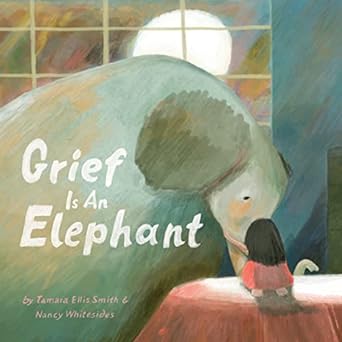
Nancy: Hello, Tara. Thank you! We are thrilled to be here to interview each other about our new book, GRIEF IS AN ELEPHANT, releasing with Chronicle Books this Tuesday.
Tam, I’ve read about your fascinating childhood. Will you talk about it, and your eventual journey to becoming a writer?
Tam: Thank you from me too, Tara! I love your blog and it’s exciting to be here.
Okay, onto Nancy’s question! As a kid, I spent a lot of time—like A LOT of time—pretending. My best friend and I played Little Women. I was Jo and she was Beth. I haven’t thought about that in a long time! We played in this great span of woods for hours. I guess it was kind of a mash-up of Little House in the Big Woods and Little Women!
Imaginary play relaxed me. I felt the same way about reading. And once I was able to write, pens and paper felt even better.
I loved what you’ve shared of your childhood and how important imaginary play was for you. You’ve written this beautiful, lyrical story, GRIEF IS AN ELEPHANT. Please tell us about it.
Thank you for saying that Nancy, but my words are only half of why it’s beautiful and lyrical. You and your illustrations are the other half.
You and I have talked about this a lot—GRIEF IS AN ELEPHANT is the story of our hearts. My son’s friend died, and my friend died, and GRIEF IS AN ELEPHANT came pouring out of me.
Much later, as I was revising the story, my father went into the hospital for a surgery to mend his heart. But the surgery failed and six weeks later he died.
Grief absolutely became an elephant for me then. I breathed differently because of its weight. Megan Devine, a writer and grief advocate I really respect, said, “Loss and grief change our landscape. The terrain is forever different and there is no normal to return to. There is only the inner task of making a new and accurate map.”
GRIEF IS AN ELEPHANT is part of that map. I often talk about how I write to explore questions I have—and isn’t that just like making a map? My biggest hope is that GRIEF IS AN ELEPHANT can help kids make the map they need for their journeys too.
Thank you for sharing your grief experience, Tam. I appreciate you sharing even though it must be painful to talk about it. I also appreciate the quote you shared from Megan Devine. Please talk about your writing process and routine.
I’m a slow writer. And because of the way my life is structured, I have to write before my kids and my other job. That means getting up at 5:15 AM and writing for about an hour. I love it. One of my favorite moments of the day is watching the world get light. Being up then feels magical. Like I’m a part of the team that brings on the day.
I’ve read about successful authors waking up early to have their writing time.
I write for a long time, revise a million times, and then hopefully make a book at the end. I once took a picture of all the drafts of my first novel lined up on my street. The line was endless!
Please talk about your writing hero.
So many writers are heroes, putting their essential truths into the world, even as stories and people and perspectives are being banned across the country. But I’ll name the writer who inspired me to become one. In college I was in a play written by someone I had never heard of—María Irene Fornés. She was a playwright, a director, a feminist. She was someone courageous enough to write in a way that made sense to her. Her word choices, the structures she created—she followed her own organic logic. She made me realize I didn’t have to write like the mainstream writers I knew; that I could write about the things that were important to me in my own way.
You are definitely doing something right, Tam. I know this from reading your work and your letters to me. You are a stupendous writer. If I can only use the word stupendous for one person it would be for you.
Thank you! Now I’ll jump in!
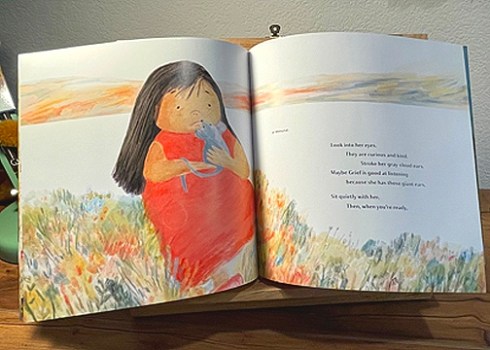
Nancy, will you describe living in the Philippines? You’re a self-taught artist and I wonder what parts of each landscape and culture and energy inform the way you see things and how you create your art?
Living in the Philippines, I remember being a sickly child and teenager, but I still loved to explore nature, climb trees, even swim in the river. I also remember when I was probably three or four, I drew a rudimentary face, and then soon afterwards drew about a hundred little faces all over the walls, as far as my arm could reach. My poor mom.
Your poor mom!
Knowing and living with two cultures informs my art, and I try to draw with curiosity and an open mind.
I incorporate environments I love if the story permits it. An example in our book is the double spread with the overview of the home, the distant hills and sky, and all the animals. This point of view is important to me because I’d seen it quite often as a child when I’d climbed to the very top of my favorite tall tree. I’d seen this landscape and loved looking at it. I wanted to set GRIEF IS AN ELEPHANT in this beautiful world and share this with the children reading our book.
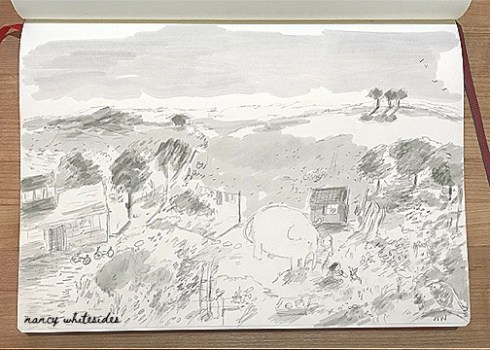
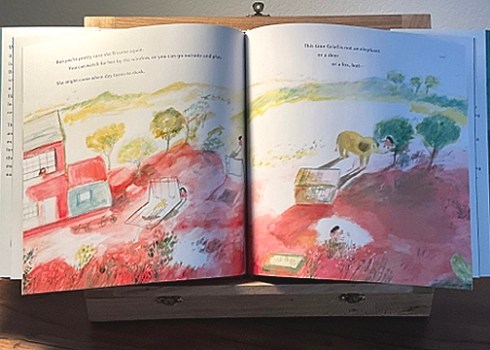
Nancy, I didn’t know that the landscape in that double spread came from your experience. Learning that kind of detail instantly makes that page, and the whole book, so much richer.
Every single time I look at our book, I am overwhelmed with the beauty of your artwork. You’ve told me some parts of your process, like how you wanted to express both a sense of grief and a sense of love in the eyes of the elephant (which you totally succeeded in doing!), but would you talk more about your illustration process?
Thank you so much, Tam. Your words helped inspire me! My illustration process begins with rereading your manuscript over and over while I imagine this world.
Next, I draw sketches, thumbnails, storyboard and a dummy. Lastly, final art—adding paint, color, and digital media.
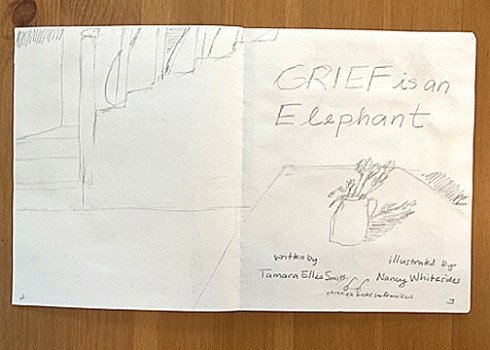
These are more or less the technical steps. The more difficult part is adding depth and emotion, and working to make the physical image come close to what was imagined.
Finally, I value the feedback our editor and art director gave me. Sometimes I thought, “Oh, that looks good.” But no, it sure didn’t. It was nowhere near where it needed to be.
I had the same experience!
Okay, last question. Can you tell us one thing that totally surprised you as you worked on GRIEF IS AN ELEPHANT?
One surprise is how you and I are matched so well including how your words and my art created this beautiful book we love, and how we have similar life experiences. I appreciate you even more.
I was also surprised by how emotional I became while working on our book. I realized even more how much love I have for the person I lost. Grief and love truly are tied together.
Absolute truth.
Thank you so much for having us here, Tara! GRIEF IS AN ELEPHANT comes out on October 24 with Chronicle Books. We’re working on some activity pages and a few other surprises, so check out our websites or Instagram to learn more!
Congratulations on this lovely bok, Tamara and Nancy!
Blog readers, Tamara and Nancy are giving away a copy of GRIEF IS AN ELEPHANT (US addresses only). Just leave one comment below to enter and a random winner will be selected at the end of the month.
The winner of the last giveaway, FIX AND STITCH, is Becki Kidd. Congrats, Becki, and expect an email from me shortly.
Tamara Ellis Smith lives in Vermont with her family. When she’s not writing books for children, she can often be found trail running on a river trail with her friends and dogs. She also hangs out on Instagram @tamaraellissmith and Pinterest @tamaras0259, and her website is tamaraellissmith.com.
 Nancy Whitesides is an author and self-taught illustrator born in Manila, and later moved to the US. Nancy’s art is imbued with colors and emotions, and often features nature and animals. Her work for GRIEF IS AN ELEPHANT was chosen for the prestigious Original Art Show at the Society of Illustrators in New York. Nancy also illustrated SMALL THINGS MENDED, written by Casey W. Robinson, forthcoming from Rocky Pond Books Spring 2024. See more of Nancy’s work at her website nancywhitesides.com and on Instagram @nancyillustrator.
by Barbara Nass
First, let me start by thanking Tara for hosting me and my debut picture book, FIX AND STITCH. Tara was a gift to me. And I mean that literally. When I retired, my work team gave me consulting time with Tara as a retirement gift. I can’t think of a better way to have jump-started my journey into picture book writing.
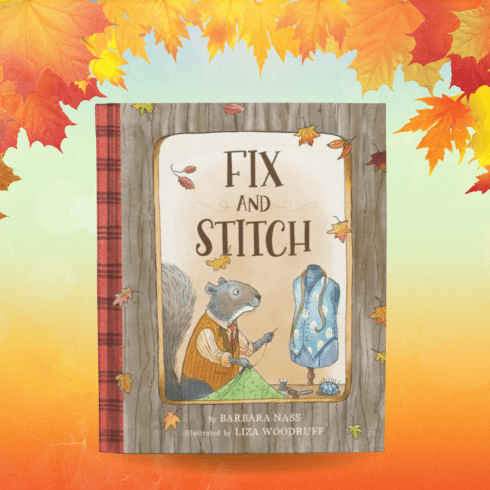
They say “write what you know”. And for a time, I struggled with the notion of writing a STEM story about tech and especially one to inspire young girls into this field. In my previous tech career, I mentored women across my organization and the few (emphasis on few) that were in tech. I also promoted tech careers at St. Elizabeth University as well as Rutgers University. I was all in on developing a tech-related story, but ideas that were picture-book-worthy didn’t come.
Other ideas did come, though. And the one that was the springboard for FIX AND STITCH began with the question of how a porcupine gets its first hug.

That idea could have gone in many directions. But instead, wound up about Squirrel, a creative tailor, who helps solve Porcupine’s problem. But in FIX AND STITCH, Squirrel has his own need. The birds have headed south, the last of the leaves are on the ground and winter is coming. Squirrel must build his winter home before it’s too late.

Instead, he delays, again and again, continuing to help his woodland neighbors, each with their own amusing dilemma. Squirrel just can’t say “no”.
Aha! I did write what I know. Squirrel grew up in a family like mine.
And while this story offers a message of kindness and friendship, what was the message that young readers would take away? I wanted a story about empathy, not self-sacrifice. Revision was needed and an author’s note added opening the door for discussion with children. In fact, I’ve already received notes from parents letting that they’ve had these important conversations after reading the story and author’s note. One even told me that it was quite a meaningful moment with his daughter. This feedback means everything to me. So, while I hope young readers will delight in this story of a clever tailor and his ingenious designs, I also hope they walk away with this life lesson in balancing empathy with attending to one’s own needs. A lesson that quite a few adults have now told me, they wished they had learned at an early age.
I want to thank Karen Grencik and Barb McNally for wanting this story told. And to Liza Woodruff, an amazing illustrator who truly captured the spirit of the story and its characters.
Congratulations on all your success, Barbara!
Blog readers, Barbara is giving away a copy of FIX AND STITCH. Just leave one comment below to enter and a random winner will be selected at the end of the month.
The winner of the last giveaway, MILKWEED FOR MONARCHS (critique), is Ashley Bankhead. Congrats, Ashley, and expect an email from me shortly.
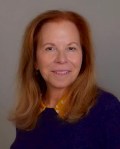 Barbara Nass grew up in Brooklyn, NY. married, and raised her son in New Jersey. There, the family enjoyed hiking New Jersey’s scenic park trails. A woodland habitat she used as the setting for FIX AND STITCH, her debut picture book. A tech executive, whose career roots began in early childhood education, Barbara will forever treasure those moments when her students first learned to read. Barbara now lives in Manalapan, New Jersey. Visit her at BarbaraNass.com, Instagram @barbara.nass.writer, and Twitter/X @barbara_nass.
by Christine Van Zandt
Those early, shut-in days of the pandemic fostered my upcoming picture book, MILKWEED FOR MONARCHS (Beaming Books, 2024). With everyone at home, we escaped to—I mean, we appreciated—our garden a bit more. Flowers and foliage. Bugs and birds. Bare patches calling out for some attention. So, off to the garden center where an “attracts butterflies” sign led us to buy our first milkweed plant. Why not?
Days later, we noticed our milkweed had critters crawling on it. Twenty-seven to be exact. Little caterpillars that would grow into monarch butterflies. We watched as they devoured leaves, buds, even stems. Their escapades, a fun distraction. Counting caterpillars became part of our daily routine.
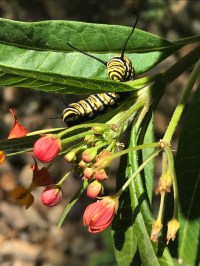
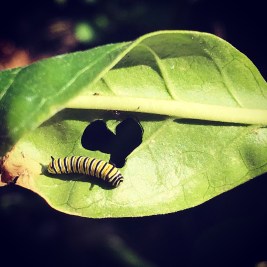
Then, one morning, all were gone!
I Googled and discovered this wasn’t supposed to happen. Toxins in the milkweed plant made the caterpillars taste bad and their bold stripes warned-off predators. (Apparently no one told our local birds and raccoons.)
Without the constant crunching, the milkweed leafed out, bloomed, and a female monarch butterfly found it. The baby-factory was back in business! We learned that monarchs need milkweed—it’s the only plant their caterpillars can eat.
Once our eggs hatched, there were a lot of very hungry caterpillars. (Eric Carle knew what he was talking about.) Back to the garden center for more milkweed. Before long, some caterpillars made chrysalises, then, weeks later, launched into gorgeous butterflies reminding me of my childhood.
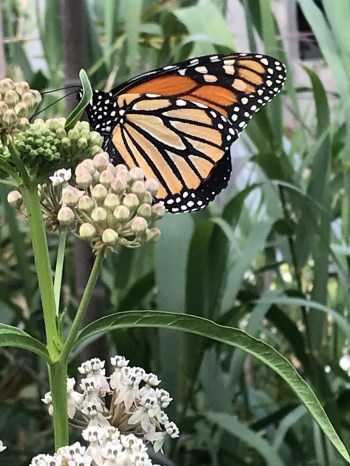

Growing up in northern California, winters brought magical moments of seeing coastal trees blanketed with western monarch butterflies. While the eastern monarch population that overwinters mainly in Mexico has suffered declines, the western monarch has been classified as an endangered species. In 2021, fewer than 2,000 of these butterflies were counted overwintering in California. Their numbers were once in the millions.
At-home pesticide use is a major factor. Gardeners want big blooms and perfect greenery, but spraying or applying systemic pesticides means we’re killing all kinds of insects and disrupting the food chain. Habitat destruction and climate change also take a toll.
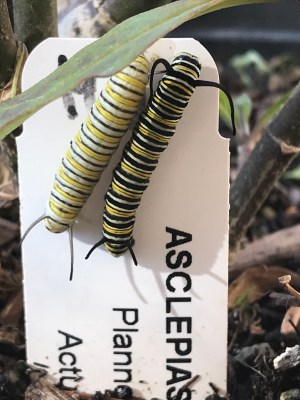
While I watched the butterfly life cycle, I wrote about it, workshopping my manuscript with critique partners. My writing was trial and error: fiction, nonfiction, prose, verse. I read every book I could find about butterflies, and began volunteering for Xerces to gain insight into insects. Then back to revisions.
The manuscript that fluttered to the top was a rhyming poem supported by facts. Spare, lyrical text shows a mama monarch returning from overwintering. We follow one egg on its journey to becoming a butterfly. This engaging read-aloud also has STEM information and fun interactive questions to support classroom or at-home learning.
My first nonfiction picture book, A BRIEF HISTORY OF UNDERPANTS, sold to Quarto Kids unagented (via a Twitter pitch party) and published around the same time that the manuscript for MILKWEED FOR MONARCHS won several top awards through SCBWI. Soon after, I received an offer for representation from the amazing Liza Fleissig at the Liza Royce Agency.
In a whirlwind, Liza sold my manuscript to Beaming Books. Working with their Senior Acquisitions Editor, Andrea Hall, has been a dream. She understood my concern but also my hopefulness and she created a beautiful book. Here’s a first look at the gorgeous cover created by illustrator extraordinaire, Alejandra Barajas!
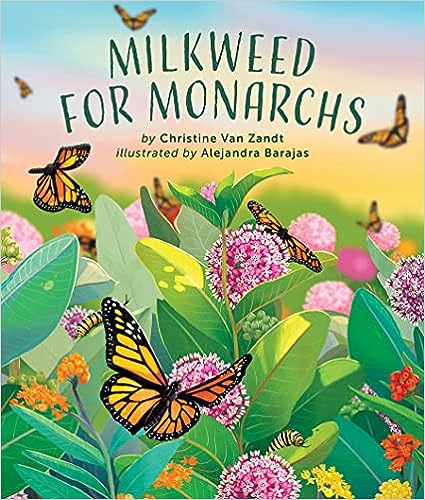
MILKWEED FOR MONARCHS is now available for preorder, for a February 6, 2024 release.
In closing, I’d like to give a big thank-you shout-out to Tara! I appreciate all Tara does for our industry and how her successful books have shown the world that funny female kid’s lit writers really do exist.
Images provided by Christine Van Zandt and Beaming Books.
Christine is giving away a 60-minute manuscript critique of the first 750 words of your book (adult or kid’s, fiction or nonfiction, prose or verse) or a picture book with 750 words or fewer. (No art please.)
Leave one comment below to enter. A random winner will be selected in September!
Good luck!
 Christine Van Zandt is a freelance editor who loves helping other writers realize their dreams of getting their books published. A small-business owner, she founded her company, Write for Success Editing Services, in 2009.
MILKWEED FOR MONARCHS is Christine’s second nonfiction picture book. She lives in Los Angeles with her family and pets. Find out more at ChristineVanZandt.com.
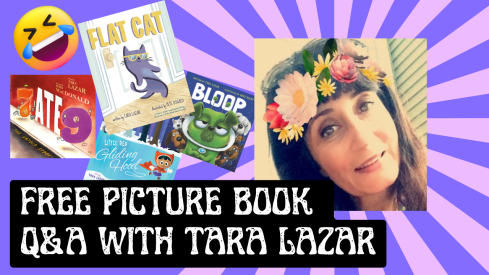
This Sunday, August 13 at 1pm EST, please join me for a LIVE video chat on YouTube. You can ask me anything about writing and publishing picture books, like…
- How do I know my manuscript is ready for submission?
- Should I rhyme my story?
- Do I need a literary agent? How do I find one?
- What does a publisher do to market my book?
- Can I choose my illustrator?
- Does the amount of my advance truly matter?
- What can I do to market my book? What has the biggest sales impact?
- How do I secure school visits?
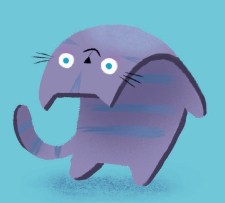 And whatever burning questions you have!
I’ll be on camera, but don’t worry, you won’t be. Just enter your questions in the LIVE chat and listen while I dispense what I’ve learned during my 15 years in the business. Fun and hilarity will ensue!
This will be the 1st session of at least three in support of my newest book, FLAT CAT, illustrated by Pete Oswald, due for release on September 19th.
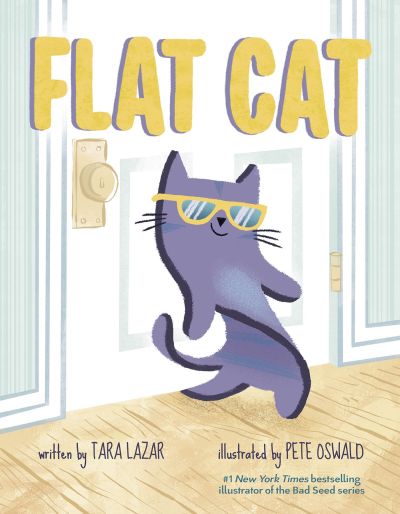
I hope you’ll tell one person about FLAT CAT, ask for it at your independent bookstore, or request for it be carried at your local library. Your support means a lot to me! This is why I enjoy giving back to the writing community. We’re all in this [crazy and difficult world] together!
I’m not who you think I am: “the other writer”.
In writing, there is a pervasive myth of “the other writer.” In this ridiculous tale we tell ourselves, “the other writer” is an omnipotent genius who can write no junk. They never doubt the words on the page. Everything comes easy to “the other writer”: book deals, best-selling titles, accolades and awards, affection and fame.
I’m here to tell you “the other writer” doesn’t exist. (Well, except for Stephen King.)
But really, when was the last time you heard a writer brag about how easy they have it?
If you did hear such drivel dribble out of a writer’s mouth, you’d immediately block that person and label them as a poseur.
So why do we allow ourselves to believe that the flawless “other writer” truly exists?

I think it’s to soothe our tortured brains—it MUST be easy for SOMEONE, right?
Let’s hear what YOU think. Please comment below…and I’ll do a recap post in a few weeks.
(P.S. I don’t think it’s easy for Mr. King, either.)
Given that we’re about halfway through the year, it’s a good time to introduce THE HALF BIRTHDAY BOOK by Erin Dealey, illustrated by Germán Blanco.
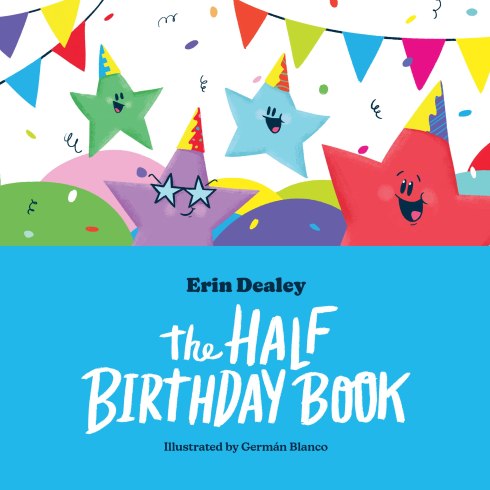
As author Erin Dealey tells it, “In the first few drafts of THE HALF BIRTHDAY BOOK (Genius Cat Books), the Half-Birthday Buddies were gnomes! My editor at Genius Cat Books pointed out (wisely so…) that people either really love gnomes or they hate them. She asked me to rethink who these characters might be.”
OK, so now I know why my own gnome manuscript went nowhere!
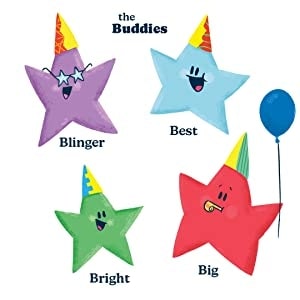 “It was just before Christmas time and the weather was crazy, so I was getting my exercise “jogging” around the house. I happened to pass a star ornament—with a Santa face and hat—on one of our windows, and suddenly I pictured the Half Birthday Buddies with star bodies of different colors! The whole team agreed that this change made the whole book a celebration!
“I love how Germán Blanco brought the Half-Birthday Buddies to life! And when he added “Easter eggs” (½ objects in every spread for readers to find), the book became a fun STEM way to introduce fractions and the math concept of half & whole.”

Erin, we’re always talking ideas here…where did the idea for this story originate?
The Vice Principal at the school where my daughter was teaching 2nd grade had been searching for a book about half birthdays and couldn’t find one. Teachers celebrate 1/2 Birthdays of students with summer birthdays, and those on the big holidays. Usually my answer to “You should write a book about…” is: “What if you write that one?” but something made me check for comp titles, and the most recent books I could find on half birthdays were the Berenstain Bears, and a Max & Ruby (Rosemary Wells) leveled reader! So I got to work.
Thanks for stopping by halfway through the summer, Erin! Best wishes with THE HALF BIRTHDAY BOOK!
by Charlotte Offsay & Abi Cushman
Thank you Tara for having us on your blog today and for agreeing to let us interview one another in celebration of the cover reveal of our upcoming picture book, THE QUIET FOREST! A big thank you to you as well for creating such an inspiring Storystorm event every year—without it THE QUIET FOREST wouldn’t exist! You are a kidlit treasure, and we are endlessly grateful for your support!
[Aww, gosh, I’m blushin’, thanks!]
THE QUIET FOREST is a cumulative picture book in which one mischievous mouse’s mishap quickly snowballs into a chain of outrageous events, causing a whole forest full of animals to have a very loud day indeed! Can the animals now find a way to bring calm and quiet back to their home?
Abi: Charlotte, this is such a fun, clever book. And it’s a Storystorm success story! Where did the idea behind THE QUIET FOREST come from?
Charlotte: Wow, thank you Abi, I really appreciate your kind words! Before I answer your question, I have to say what a treat it is to get to partner with you on this book in particular. I was already a big fan of your hilarious and huggable characters long before editor Catherine Laudone suggested partnering with you on our book–I squealed with delight when she did! I’m absolutely blown away with what you have come up with and I love it even more than I knew I would!
Now, back to your question… Where did the idea behind THE QUIET FOREST come from?
I participate in Tara’s Storystorm event every year in an attempt to mine as many story ideas as I can and fuel my writing throughout the year. Some ideas are concepts or phrases that make their way from one year’s list to the next, waiting for their turn… a.k.a waiting for inspiration to hit. I had been wanting to write a story about spreading kindness for a few years but had never quite found the right way into the story.
After reading a Storystorm post on playing with picture book structure, I wrote: kindness—cumulative structure? on my Storystorm list. One September morning when I was looking for a new writing project to work on, I decided it was time to try a cumulative story about kindness and feature animals as my characters since I had been itching to write an animal-themed picture book! I then pulled every cumulative structure picture book off my shelves and sat down to write what would eventually (after many, many revisions) become, THE QUIET FOREST!
Abi: On top of a cumulative structure, you’ve also incorporated onomatopoeia and alliteration into the story. It’s quite the writing marvel! What was the writing process like for THE QUIET FOREST?
Charlotte: You are too kind! THE QUIET FOREST was simultaneously one of the easiest and hardest books to write—allow me to explain… Writing a cumulative structure picture book has a set structure to it which made a nice frame that felt easier to start from. It allowed me to use the frame even when selecting the animals for the story, as the cumulative structure built, the animals I selected increased in size. Having the animals in place allowed me to see that onomatopoeia would help increase the fun of the read aloud and alliteration even more so. But as I moved on to editing the manuscript, my desire to have all of these pieces in place while creating a story that built logically in chaos became one of the bigger brain teasers I have had to battle in my writing. I needed all the pieces to feel natural and not forced which led to a large number of hours of my manuscript chopped up on my office floor moving pieces around while simultaneously scouring wordhippo.com for a word or phrase that would fit my strict parameters. Writing THE QUIET FOREST felt like solving a puzzle to write and it wasn’t until I saw your brilliant illustrations that it finally felt solved.
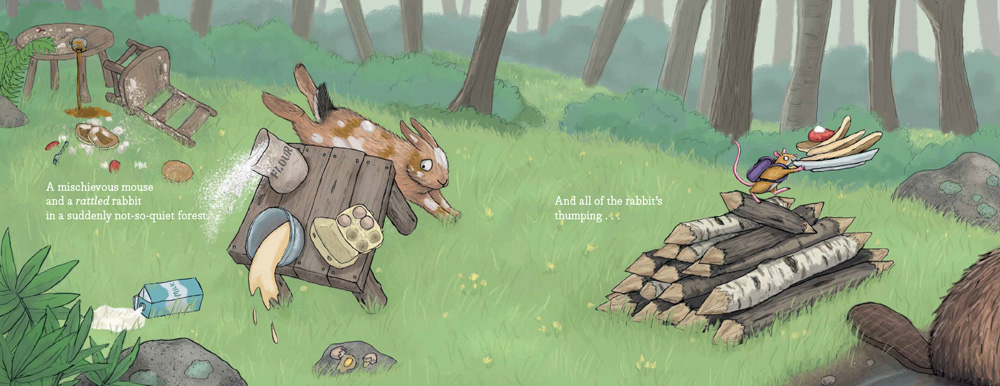
Image © THE QUIET FOREST by Charlotte Offsay, illus. by Abi Cushman (Paula Wiseman Books, 2024)
Charlotte: In the book, we get to see the mischievous mouse swinging into a pile of pancakes, a deer picking flowers, and a moose painting. How did you dream up all of the fun antics for these characters? Where did you draw your inspiration from?
Abi: When I first read your manuscript, Charlotte, I could see the potential for really fun action scenes. You left me room to explore exactly what those animals were doing when they each got interrupted, which was amazing. My first goal was to think of what action could go with each sound word that would be the most visually fun for kids. I wanted to err on the side of going BIG.
So I printed out the manuscript and made doodles in the margins with some possibilities. What goes splat? A tube of toothpaste? A bottle of ketchup?
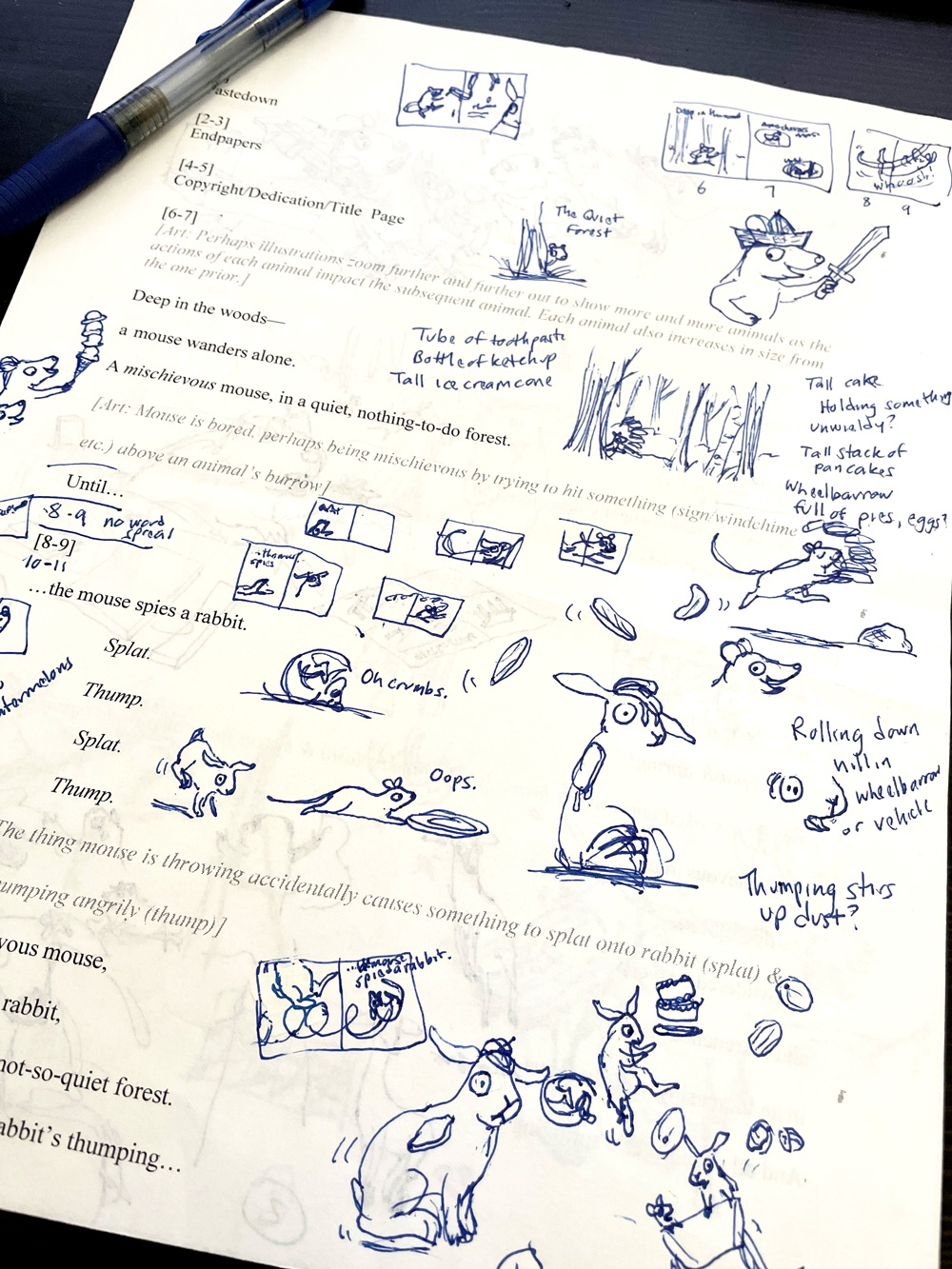
I decided on pancakes because I thought a scene of a mouse flying into a stack of pancakes would be the funniest for kids.

Image © THE QUIET FOREST by Charlotte Offsay, illus. by Abi Cushman (Paula Wiseman Books, 2024)
But once I had brainstormed activities that would be the most fun when they got interrupted, I also had to consider how these activities might come together at the end. This story is so wonderful because just as one mischievous act can snowball into a chain of outrageous events, one simple act of kindness can also spread and change the course of the day. I really wanted to show in the illustrations how each animal’s individual activity at the beginning comes together at the end to contribute to a sense of community.
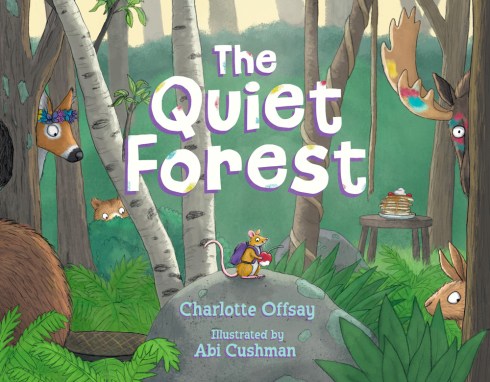
So now, without further ado, we are thrilled to present the cover of THE QUIET FOREST, which was edited by the incredible Catherine Laudone and beautifully designed by art director Krista Vossen. THE QUIET FOREST releases March 12, 2024 from Paula Wiseman Books/Simon & Schuster and is available for pre-order now.
 Charlotte Offsay was born in England, grew up in Boston, and currently lives in Los Angeles with her husband and two children. Through her work, Charlotte hopes to make children laugh, to inspire curiosity, and to create a magical world her readers can lose themselves in time and time again.
Charlotte is the author of The Quiet Forest, illustrated by Abi Cushman (Paula Wiseman Books, 2024), Challah Day, illustrated by Jason Kirschner (Holiday House, 2023), A Grandma’s Magic, illustrated by Asa Gilland (Doubleday Books for Young Readers, April 2022), The Big Beach Cleanup, illustrated by Kate Rewse (Albert Whitman, 2021), and How to Return a Monster, illustrated by Rea Zhai (Beaming Books, 2021).
Learn more about Charlotte’s work at charlotteoffsay.com and follow her on Twitter and Tiktok at @COffsay and on Instagram at @picturebookrecommendations. Charlotte is represented by Nicole Geiger at Full Circle Literary.
 Abi Cushman is the author-illustrator of SOAKED!, ANIMALS GO VROOM! and WOMBATS ARE PRETTY WEIRD. Her upcoming book, THE QUIET FOREST, written by Charlotte Offsay, releases in 2024. Abi has also worked as a web designer for over 15 years, and runs two popular websites of her own: MyHouseRabbit.com, a pet rabbit care resource, and AnimalFactGuide.com, which was named a Great Website for Kids by the American Library Association. In her spare time, Abi enjoys running, playing tennis, and eating nachos. (Yes, at the same time.) She lives on the Connecticut shoreline with her family.
To learn more about Abi and her books, visit her website at AbiCushman.com. If you like secrets, exclusive sneak peeks, wombats, and special giveaways, subscribe to her newsletter.
by Marzieh Abbas
Before I jump into my guest blog post, I want to thank you for having me, Tara! It’s such a pleasure to be here talking about my debut picture book for the traditional US market. Your blog has been a favorite ever since I began writing in 2019.
Now, let’s talk about how A DUPATTA IS… came to be:
Long before I began writing for children, I came across a photograph when my mom was cleaning out her drawers. It was one of us sisters wrapped in a dupatta, an oversized South-Asian scarf, that had been tied like a sari. It was from the time we were visiting Karachi to see my Dadi, my grandma. She always wore saris and loved to dress us girls up in pseudo-saris, using fancy dupattas.
A few years later, she passed away. My father, the youngest of three sons, along with us, moved back to Pakistan to be with her in her last years. A few weeks after she passed, we noticed my dad had been sleeping with her dupatta tucked beside his pillow. He had asked my mother never to wash it, as it held her scent and helped hold her memory close.
Not only did this stay with me for a long time, it was the spark of an idea for my debut picture book, A DUPATTA IS… (illustrated by Anu Chouhan) which releases today, April 11, 2023!
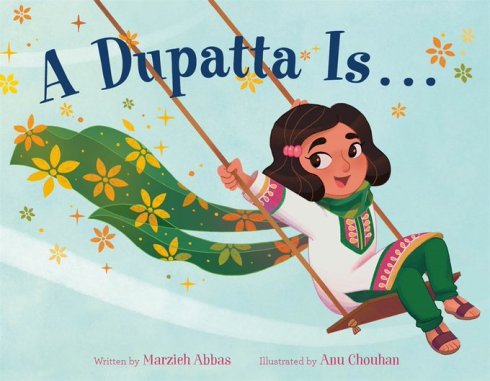
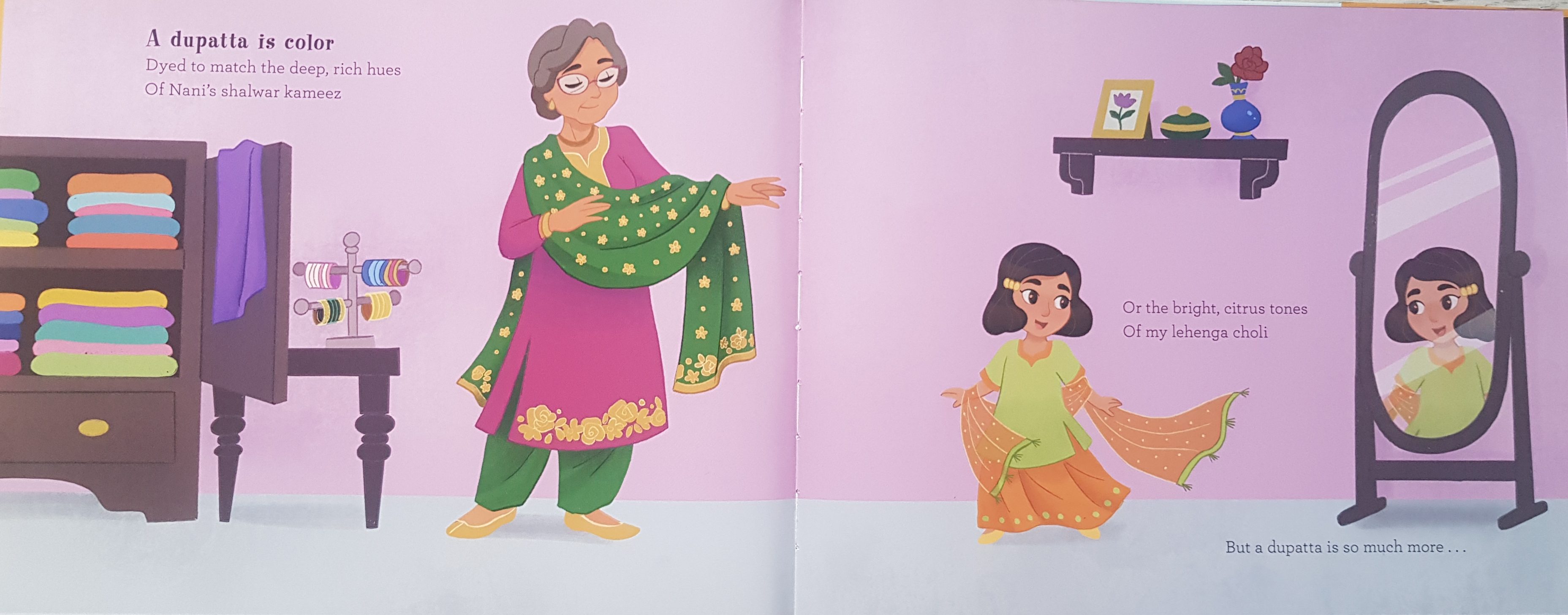
Once Anu started sharing her illustrations, I was moved to tears. Her detailed settings, inspired by her own childhood with her grandma, resembled my Dadi’s home, right down to the bangle stand and wooden cupboard.
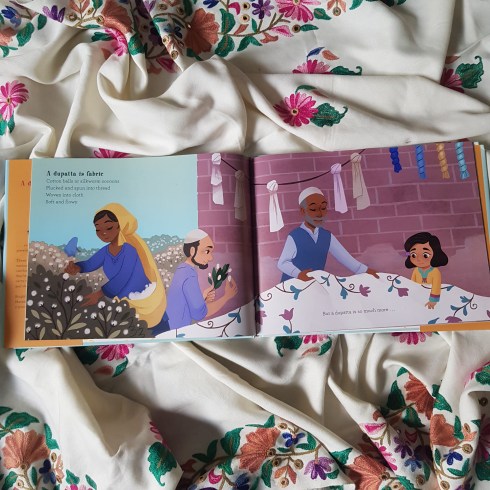
The story came full circle when my mom cleared out a cupboard of my Dadi’s dupattas and saris and sent over one of her favourites for me. It was almost exactly the same as the dupatta Anu had illustrated in her first spread. Have a look! I used it as a backdrop for this shot:
Thank you, Marzieh! What a beautiful story behind your story!
Blog readers, Marzieh would love if you could join her for virtual book launch tomorrow, April 12, 2023 at 10 a.m. EST. You can register here.
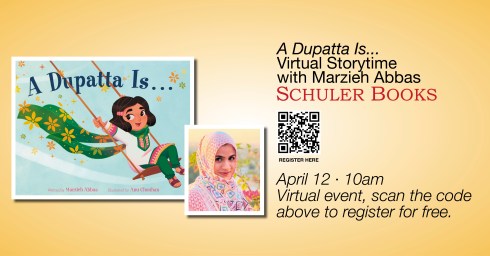
Marzieh is also giving away a 30-minute AMA session!
Leave one comment below to enter. A random winner will be selected in two weeks!
Good luck!
 Marzieh Abbas is a baker-turned-award-winning author. She loves adding magic to her creations- whether that’s a seven- layered rainbow cake or the books she writes for children all over the world. She enjoys learning new skills, jumping rope, sipping chai, and observing nature. A DUPATTA IS… is her debut picture book in the traditional American market. She has several upcoming children’s books including AWE-SAMOSAS (Clarion, 2024), HENNA IS…(Feiwel and Friends, 2024) and YASMEEN LARI, GREEN ARCHITECT (Clarion, 2024). Marzieh is a member of SCBWI and a graduate of the Lyrical Language Lab and Children’s Book Academy. Marzieh dreams of owning a talking parrot someday. But, until then, she lives in Pakistan with her husband and children who inspire her every day. She is represented by Lynnette Novak at The Seymour Agency. Visit her on the web at MarziehAbbas.com, Instagram @marziehabbas_author and Twitter @MarziehAbbas.





 Writing for Kids (While Raising Them)