You are currently browsing Tara Lazar’s articles.
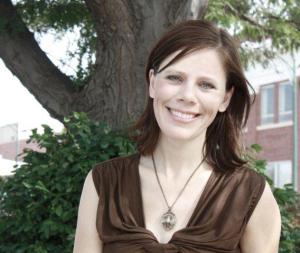 by Tammi Sauer
Most of my pbs begin with character.
Occasionally, however, I go in a different direction and start with setting.
Some of the settings I have used in my books include the following:
- Cowboy Camp
- Barnyard
- Monster Academy
- Pond
- Prehistoric Times
- Royal Kingdom
- Zoo
- Concert Tour
- Oklahoma
- Sea
As much as I loved setting books in these places, I know I should come up with something fresh for the next manuscript. This calls for some brainstorming. I push myself to come up with at least ten new setting possibilities.
Examples:
- Outer Space
- Rodeo
- Petting Zoo
- Parade
- School Science Fair
- Family Reunion
- Fish Tank
- Library
- Road Trip
- County Fair
Once I have a list, I take each place into consideration. Then I ask myself the big question:
What can go wrong here?
If I come up with an answer that is irresistible, I know I am well on my way to developing that next manuscript.
Your turn:
Consider the settings I’ve already listed. Brainstorm a list of ten additional settings. Then ask yourself, “What can go wrong here?” for each one.
Extra credit:
Go to the library or bookstore and grab a stack of picture books. Jot down each book’s primary setting. Who knows? Maybe one of those settings is the perfect fit for your next manuscript.
 Tammi Sauer has sold 12 picture books to a number of major publishing houses: Bloomsbury, Houghton Mifflin Harcourt, Simon & Schuster, and Sterling. One of her latest books, Mostly Monsterly, illustrated by Scott Magoon, was named a Scholastic Parent & Child Best Book of 2010 and won the 2011 Oklahoma Book Award and the 2011 SCBWI Crystal Kite Award. To learn more about Tammi and her books, please visit her online at www.tammisauer.com.
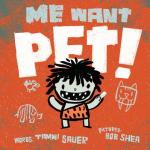
Tammi’s next book, Me Want Pet!—illustrated by Bob Shea—hits shelves March 2012. OOGA! Leave a comment for a chance to win a first edition signed copy when it’s released!
by Elisa Kleven
 I find inspiration in all sorts of ways. Sometimes an image inspires me : the brush-like tail of a lion at the Oakland zoo sparked the idea for THE LION AND THE LITTLE RED BIRD; the sight of a picket fence reflected in a wet sidewalk gave me the idea for THE PUDDLE PAIL.
 Sometimes an experience gives birth to a story idea: my daughter’s reaction to her domineering, sloppy new brother inspired my book A MONSTER IN THE HOUSE; the comforting act of making bread on a gloomy winter day gave me the idea for SUN BREAD.
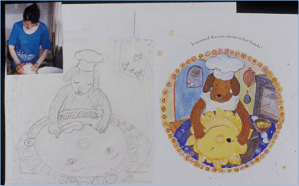 And sometimes stories well up mysteriously, from undercurrents in my life and amorphous but powerful feelings. After I finished THE PAPER PRINCESS, for example, I realized it summed up my feelings about being both a book creator—working away lovingly and privately on detailed pieces of paper (my illustrations and stories) that I later send out into the world to “finish themselves” (that is, be read and reacted to), as well as earlier, raw feelings about having lost my own “creator”, my mother, when I was still a child, and how I went out into the world feeling like it was up to me to complete myself.
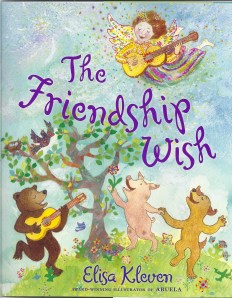
The inspiration for my newest book, THE FRIENDSHIP WISH, falls into this last (amorphous, powerful feelings) category. One of the sources of its inspiration is a quote from Caliban, the monster in THE TEMPEST, who describes a dream about “riches ready to drop upon him, ” and how upon waking, he “cried to dream again.” I love that description of the feeling of loss one feels when one awakens from a beautiful dream—and Farley, the lonely dog in my story, experiences the same intense sensation of longing and loss when he awakens from his dream of a friendly, guitar-playing, pancake-making angel. But other themes in my life welled up into this story as well: I have always been fascinated by angels, and frequently “meet” them in dreams and in art, as Farley does. I also feel that, like the characters in the book, we need to be each others’ angels, because, who knows if any other angels really exist.
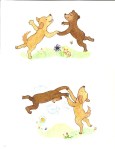
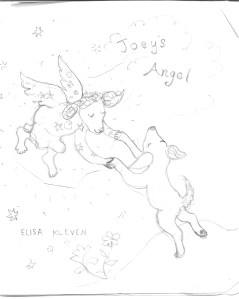
And speaking of angels, I have to add that the book was originally called JOEY’S ANGEL. My publisher wanted to avoid the word “angel” in the title, so I tried on many different titles (e.g.FRIENDS FOR FARLEY; WHAT PUP DREAMED UP) before the publisher settled on THE FRIENDSHIP WISH. At first I had trouble saying the title, because it wasn’t “mine”, but I’m getting to like the whispery, “sshhhh-y” sound of it.
Elisa Kleven has always loved to create imaginary worlds. Throughout her childhood Elisa made miniature people and animals using paper, paint, clay, scraps of cloth, yarn, nutshells , even dried apples. She would lose herself for hours making up stories about these characters, and building intricate settings around them.
Elisa’s childhood passions have now become her career, as she is still creating miniature worlds inside of her picture books. As she did in childhood, Elisa uses paint, collage, and imagination to create characters settings, and stories.
Elisa is the author and/or illustrator of over 30 children’s picture books, among them WELCOME HOME, MOUSE, THE PAPER PRINCESS, THE APPLE DOLL, THE LION AND THE LITTLE RED BIRD, SUN BREAD, A CAROUSEL TALE, THE PUDDLE PAIL, DE COLORES, by Jose-Luis Orozco, ABUELA AND ISLA, by Arthur Dorros, and THE WEAVER, by Thacher Hurd. Elisa lives near San Francisco with her husband, daughter, son, dogs and cats. To learn more about Elisa and her books, please visit her web site: www.elisakleven.com.
Elisa is generously giving away two signed pieces of her work—her San Francisco limited edition giclee print, as well as a print from ANGELS WATCHING OVER ME, by Julia Durango. Please leave a comment to enter and two winners will be randomly chosen one week from today!

 Shhhh.
Now what did you hear when you read that word? Whose voice was it? Was it your mom’s voice? Was it your grandmother’s voice? Was it your own voice hushing your children? So much of our world operates in onomatopoeic sounds: the chirping of the morning birds, the beeping of the garbage truck, the roaring of a car engine, the screeching of the school bus as it comes to a stop…
As a professional storyteller, I actually become better at telling my stories by listening. It is through this simple auditory observation that I find inspiration for my tales. As a picture book author, I become better at writing by thinking of my story in terms of sound. How will this tale reverberate when it is read out loud?
The sound of a baby’s “Wah! Wah!” became a turning point in a recent story I revised. The sing-songy refrains that I have become known for in my books work better when they are released from the page through the read-aloud. In Denise Fleming’s picture book, In the Tall Tall Grass, you hear, “Crunch, munch. Caterpillars lunch.” The sounds become actions. The actions become story.
Watch little boys as they play with trucks and cars. They zoom and they vroom. Listen to preschoolers and kindergarteners make sound effects. Go the playground and take note. You’ll hear the clap clap clap of the girls’ hand games and the thump thump thump of a boys’ basketball game. Even the swingset makes a whooshing sound as the swings take flight.
Today, listen to the noise around you. Write down the sounds, even making them up if there is no known word for what you hear. The kerchink kerchink kerchink of the dryer could lead to a new picture book idea (but don’t you hate it when your family leaves stuff in their pockets?! LOL).
Even if you like to write in the quiet, today is the day to make some noise. Perhaps you will hum, echo, thud, crash, jingle, swish, or clatter your way into a new story.
Listen up. What do you hear?

Dianne is generously giving away a signed copy of Blue Frog: The Legend of Chocolate to a lucky commenter. A winner will be randomly selected one week from today!
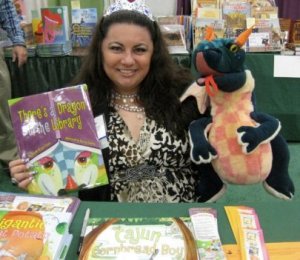
Dianne de Las Casas is an award-winning author of 18 books, a professonal storyteller, and founder of the international literacy initiative, Picture Book Month. She tours worldwide presenting revved-up author visit/storytelling programs, lively educator/librarian training, fun workshops, and inspiring artist residencies. Her children’s books include The Cajun Cornbread Boy, Madame Poulet & Monsieur Roach, Mama’s Bayou, The Gigantic Sweet Potato, There’s a Dragon in the Library, The House That Witchy Built, and Blue Frog: The Legend of Chocolate. She is a founding member of November’s Picture Book Month. Visit her at www.storyconnection.net and follow all the storytelling fun on Twitter @storyconnection.
 I have no new ideas.
None.
No plan. No flashes of inspiration. No idea where to find an idea.
This is not a new dilemma for me.
The longer I’ve been writing, the more successful I’ve gotten, the harder it becomes to find those ideas that get me excited. Sounds counterintuitive, doesn’t it? Shouldn’t it get easier with experience?
For me, it hasn’t. But that hasn’t stopped me from writing. (After all, this is the sweetest job on earth – not only do I get to create something from nothing, a lot of the time that I’m working, I’m in my jammies in my bed.) So, what’s a girl to do? How do you pull a good idea out of the air?
I don’t really know. But Tara invited me to blog so I thought I’d give y’all some possible places to start.
Look for Nuggets, not Multitudes
Everyone knows you can’t just sit down to write a picture book about a chicken and think that’s all the brainstorming you need to do to run with it. Just “chicken” is too generic, too common, too…uninspired. But what if that’s all you have? Don’t you need a complete plot, a big idea…a whole roaster, so to speak?
Let the chicken be your nugget, no pun intended, and build from there. (And who am I kidding? I totally intended the pun. See below. I don’t stop with the puns.)
I started with a chicken nugget once. I hadn’t written a chicken book. Chickens are adorable. Instant winner.
But I quickly realized that I needed more. For someone to give a cluck about my chicken book, I needed to add some garnish. So I started thinking about chickens and what they do. Eventually, I brainstormed about chicks – but there were so many chick books already. Baby chicks, fluffy chicks, chicks and salsa…the list went on and on. All these chicks in all these books, all running wild…
And then it hit me. CHICKS RUN WILD.
 I took my nugget and grew it to a title. And from there, I…well, ran wild with it. Now, let’s be honest, I took this title and then did what writers all over the world do every day: I wrote about what I knew. CHICKS RUN WILD grew into the story of little chicks at bedtime who don’t want to go to sleep quite yet—it could be an autobiography of bedtime with my own children. So, easily, I could advise you to take inspiration from your life—but you get that everywhere, don’t you? Besides, my point is I only got to writing about what I knew after starting with a small nugget of inspiration. I nurtured that nugget and kept it warm and safe until it grew into a fully formed…idea.
What’s in a Name?
OK, let’s shift gears. No more chicken puns. Let’s talk names instead.
Is there anything more immediately suggestive than a character’s name? Think Willy Wonka, or Shrek, or Fancy Nancy—just the names create an image in the reader’s mind. Characters can grow to be iconic – if developed correctly. But you certainly can’t know ahead of time which of your characters will become iconic.
That doesn’t mean you can’t start with character.
The truth is, I think the best place to start is character. When you have an idea for a great character, you need to let him run free (run wild, perhaps?) even before you figure out exactly what that character will do in the story. A strong character will find his story.
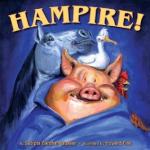 Years ago, I wanted to write a story about a vampire pig named HAMPIRE. A pig with fangs and a Dracula cape. Preferably a vegetarian. But that’s all I knew about him.
It took years—YEARS—to find his story. For a long time, I didn’t have a story for Hampire—but he lingered in my thoughts, waiting for me to figure him out. I had dreams about him, I had nightmares about him—and I wrote draft after draft about him. In the end, he still had fangs, still wore a cape, was still a vegetarian—but everything else about him changed many, many times. And that was OK.
Be Patient
I probably haven’t told you anything here that you didn’t already know, and there’s certainly not anything earth shattering in looking for inspiration as small as a title or a character. But what I want to leave you with is the most important idea about ideas of all:
Be patient.
You can’t force a good idea. You can’t coerce your brain into generating a good idea, nor can you keep working at a bad idea to turn it into a good idea. And, honestly, the more you try to force yourself, the harder it gets to tell the difference between the good ideas and the truly horribly awful ones.
So, be patient. Work on ideas you have, and don’t be afraid to heavily edit as you’re writing. In fact, don’t be afraid of crumpling up a lot of paper and tossing things into the trash—sometimes, the best way to find a great idea is to sort through and dispose of all the bad ideas around it.
I won’t lie to you and say that after dispensing all this advice, I was hit by inspiration and walked away with a great new idea to work on. I didn’t. I still don’t have any ideas for my next picture book. But I also know that when the idea does come, it like won’t be accompanied by a flash of lightning and a gospel choir. It will come from a word, or a phrase, or an image that strikes me and lingers. And that’s where the work begins.
Sudipta Bardhan-Quallen is the author of many, many books for children, ranging from fourteen picture books to over a dozen nonfiction books for young readers. Her picture book Quackenstein Hatches a Family was selected for the California Readers 2011 Book Collections for School Libraries. Ballots for Belva was named to the 2009 Amelia Bloomer List and received an Oppenheim Toy Portfolio Gold Award in 2008 and Tightrope Poppy, the High-Wire Pig was named one of the Best Children’s Books of the Year in 2007 by the Children’s Book Committee at Bank Street. Flying Eagle was a National Science Teachers Association Outstanding Science Trade Book selection for Students K–12 in 2010 and was named one of the Bank Street’s Best Children’s Books of the Year in 2010. Her science book, Nature Science Experiments, was named a finalist for the 2011 AAAS/Subaru Science Books & Films Prize for Excellence in Science Books. And her books Chicks Run Wild and Hampire! are her personal favorites, and just fabulous.
Sudipta speaks at conferences, educator events, and schools across the country, teaching the craft of writing to children and adults. She lives outside Philadelphia with her three children and an imaginary pony named Penny. Learn more about her and her books at www.sudipta.com.
by Kelly Light
 I had written a completely different post here for PiBoIdMo. I attempted to compare the PiBoIdMo experience to my old Zenith console radio. All about tuning in to our own stations. I may yet throw it up on my own blog. I was about to start a drawing for it…
Then I went to The Eric Carle Museum and listened to the epic cartoonist Jules Feiffer talk about creating. After this weekend, it seems unfair to not let others in on his brilliant analogy for his own long career as an author and illustrator.
At the risk of likening myself to his 82 years of creating amazing words and picture; He and I had a moment. He doesn’t know we had a moment. But we had a Fred Astaire moment.
I was watching two squirrels earlier this Fall, as they romped through my yard. The way their feet barely touch the ground. The circled each other, intertwining their tails as they glided from grass, to rock, to tree limb. Their movements so smooth and elegant and effortless. They made me think of Fred Astaire and Ginger Rodgers. So I sketched them.
Back to Jules;
Jules Feiffer grew up in the time when Fred and Ginger danced on the big screen. Just a young boy when the films were new in the cinema, the movies entered his consciousness in a very deep way. He relates those sublime sways and quick steps to his own career as a creative being.
“Fred Astaire made elegance look easy. He made it look easy because he worked at it constantly. He didn’t dance for the applause- he danced to dance. It was his work, it was what he did everyday, it was him. How long was he actually dancing for, four minutes? He put countless hours in for those four minutes on screen.” ~ Jules Feiffer
When Mr. Feiffer sits down to draw, He pours himself a scotch, puts on a Fred Astaire movie—and the music swells… and he dances. Both he and his pen. We look at his drawings and marvel at how effortless they look.
If you are unfamiliar with his work, you can check out Mr. Jules Feiffer’s work here: http://www.julesfeiffer.com/
So I am putting on my top hat, tyin’ up my white tie… brushin’ off my tails for PiBoIdMo with this notion in my head—If you put in the hard work, it will look easy. But it takes that hard work—the hours and hours of continually doing it, backstage, to make it seem effortless, on stage. You have to rehearse, mess up, trip and fall on your face, over and over before you can have your stories go stepping’ out. So revel in the work!
Dance to dance. Draw to draw. Write to write.
Dance like Astaire—on paper.
I am thrilled to give away a print of the dancing squirrels to a dancin’ PiBoIdMo participant! Just leave a comment to enter and we’ll randomly draw a winner one week from today. (Tara’s note: click on the bottom image to see the entire illustration in full size—trust me, you want to do this!!!)

 Thanks to Tara Lazar for the gift of PiBoIdMo. You’ve created the space for us to dance!
Kelly Light is a cartoonist, character artist and illustrator. Her clients include The Walt Disney Co.,Warner Bros., The Jim Henson Co. and many more. She ‘s bringing her own characters to life these days.You can find her online @ her blog http://prettygoodforagirl.blogspot.com/ and on Twitter @kellylight.
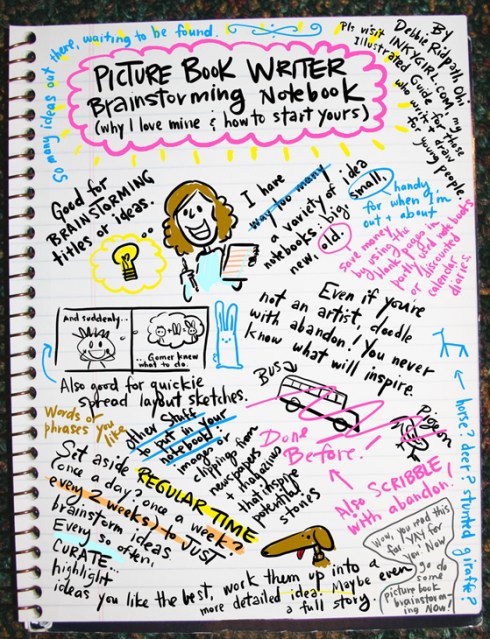
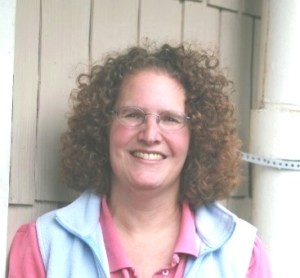
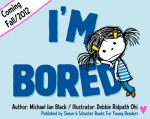 Debbie Ridpath Ohi writes and draws for young people. She is illustrator of I’M BORED by Michael Ian Black (Simon & Schuster Books For Children, Fall/2012) and has a short story in the upcoming teen fiction anthology TOMO (Stone Bridge Press, 2012). Her blog for kidlit/YA writers & illustrators: Inkygirl.com. Twitter: @inkyelbows.
 by Becky Levine
Here you are, participating in PiBoIdMo. All you have to do this month is come up with ideas. Okay, you have to come up with 30 ideas. But still—short, sweet; bing-bang; and you’re there.
There’s a second goal, though, behind these 30 days. And that goal is that, once the month is over, we will all take at least one of these ideas and turn it into a story. Which means, first, writing that story. And then…yes, eventually, revising it.
We could debate for hours whether it’s harder to write a novel or a picture book. We could debate for more hours which is easier to revise. Especially when you’ve got critique feedback about that project staring you in the face.
Sure, when your critique partner tells you to work on dialogue in your novel, you know you’re facing a lot of dialogue over a lot of pages. That’s work. On the other hand, when your critique partner tells you to fix the dialogue in your picture book, you’re staring at ten, maybe twelve words, with which to get it right.
Let’s face it. Revision, any revision, is hard.
But…the thing I love about revising a picture book is actually the thing that seems the toughest—the tiny number of words you have to write with.
When I critique a novel and pass that feedback onto the writer, I tend to talk about the big things that aren’t working yet. I’ll tell them that I think their hero needs a more specific goal in each scene, or I’ll talk about weaving any necessary background information into the action. And then I’ll make this suggestion: Take one chapter and play. Figure out your hero’s goal in one scene, set up some obstacles, and then revise that chapter until you have the pacing and tension just right. What have you done? Well, you’ve successfully revised a scene, yes. But you’ve also taught yourself a lot more about scene structure, and now you can go on to all the other scenes in the story and make them tight and tense and active.
When I first started getting critique feedback on my picture book, I felt overwhelmed in a kind of backward way. I was used to thinking on the bigger scale of a novel, feeling that I had plenty of time and space to understand that feedback and revise around it. With the picture book, all that time and space was suddenly compressed. I felt like a Mime-in-a-Box; every time I made a turn or tried to stretch, I ran into an invisible, but very solid wall.
The freedom came when I realized that, I needed to tackle the revision in the same way I attacked novel rewrites. I needed to take one scene and revise one problem. The only difference was that my one scene would be 150 words, instead of 1,500. Yes, that was a challenge, but it was also doable. If I needed to make my dialogue more powerful, sure, I only had a dozen words to play with, but those words were right there for me to see, in one tiny chunk on one page. Instant feedback. Change one word and see if it makes things better. Nope? Change it again. Yes? Great. Move on to the next. Yes, every word matters (and I do think it matters more than in a novel), but every word also makes a difference. A big difference. And you can see it happen, or not, really, really fast.
And guess what? You know when I said, above, that I recommend revising a novel by working on one problem in one scene, then extrapolating what you’ve learned to all the other scenes in the story? Well, how much easier (and faster) does that become in a picture book? Especially if you’re using a repetitive structure and some repetitive wording? Once you figure out, in your teeny, tiny picture-book scene what isn’t working and how to fix it, carrying that change through the rest of the story can be greased lightning.
For me, it’s become like a jigsaw puzzle, except that each piece has a complete word on it, rather than an unrecognizable shadow or color-blur. Put one right word in its right spot, and you—suddenly and dramatically—see a huge chunk of the picture, and a dozen more pieces fall into place.
Working on a picture book is working in a tight space. But compression catalyzes an explosion, restrictions spur on creativity. The challenge, once you open yourself to it, can work magic.
Which, after all, is pretty much the definition of a picture book.
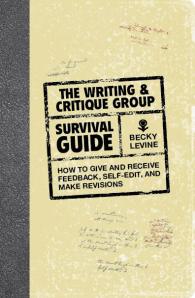 Becky Levine is the author of The Writing & Critique Group Survival Guide: How to Make Revisions, Self-Edit, and Give and Receive Feedback. Becky also writes fiction for children and teens, and finally stepped into the world of picture-book writing (and revising!) last year. She lives in California’s Santa Cruz mountains with her husband and teenage son, who still happily reads the picture books she brings home from the library.
Becky is generously giving away a copy of The Writing & Critique Group Survival Guide. Just leave a comment to enter and we’ll randomly select a winner one week from today. At the end of the month, if you complete the 30-idea PiBoIdMo challenge, you can win a picture book critique from Becky, too! Lucky you!
 by Mary Rand Hess, editor, Story Pie Press
Oh, hi there! You must be a children’s writer, too. I bet you feel like part of a rather special group of kids who pretend to be adults, right? You’re supposed to do adult-like things such as pay the bills, fold laundry, and scrub toilets. Instead, you find yourself imagining finches that perform operas at dawn, or a secret tunnel that leads to an underground zoo of zombies. If only your family and friends knew how important it was to write down these stories before adult-like memory sets in and foils your attempts.
As I was saying, you are special because you have been given the gift of story. And not just any type of story, you have been given the gift of writing stories for children. These stories inspire those future adults who will one day be responsible for our nation and other nations. Does that feel like a heavy burden? Well, it might, but it shouldn’t. We’re not writing about hedge fund fraud, tax cuts, Medicare, and unemployment. We’re writing about things that strike the heart cord, like bravery, happiness, love, fun, sadness, acceptance, and healing. We’re writing stories that every adult, who reads to a child at night, clings to in remembrance of his or her own childhood. Picture books are for everyone, but especially for children, even big children like you and me.
Now let me say, I completely understand you because I sit on both sides of the table, as a writer and editor. I understand the toiling away at words, the mania of wonderful ideas pouring into the mind like a chocolate river, tempting you to abandon all else. And here it is the month of Thanksgiving and you’re willing to risk failure on Turkey Day for a chance to write 30 picture book ideas in a month, one each day…even on Thanksgiving Day. So Cheers to all that we are thankful for this Thanksgiving, including an abundance of story ideas. Just remember to set the timer on the oven.
As you set out to conquer this challenge, keep in mind that as a writer you have one responsibility…tell a good story, a story only you can tell. Words are free. You don’t have to go to your neighborhood art-o-rama store and buy hundreds of dollars worth of word supply. You only have to pay in time, time spent in your story zone with words… thousands and thousands of words…beautiful, descriptive, hungry words. Perfect words that make your readers say, “Please pass the book.” Because at the end of a day, and whether it was a rotten one or an exceptional one, everyone could use a good read, especially one that comes from an excellent picture book. When one reads a picture book, all seems well with the world, right? Add a little chocolate, tea or coffee, and there is no question the world is right. You have survived another day. Children need this sense of comfort, too. They often have heavy burdens that we don’t know about. Being a kid is not always bubblegum and water balloons. A good book proves to a child that knowledge grows from words. And knowledge, as they say, is power. A child needs to feel that empowerment and to live in the shoes of a favorite character. Might a child run away to an island where the Wild Things are gnashing their teeth, and return to find his supper still hot? Unlikely, but a child can tell you what that experience was like in Max’s clawed feet. And that same child recognizes himself in Max, still loved even after getting in trouble. That’s what we strive for as writers, relatable characters…no matter the circumstances.
As an editor, I look for the same things I look for as a writer, characters and situations that inspire me, pulling me into a world I want and need to know about. When I sit down to write a story, I always pick the characters that reside in my heart. As an editor, I want an author to give me a story that’s truly special, one that an author couldn’t say no to when the story whispered, “I’m here. I know it’s not convenient right now, but you need to write me.”
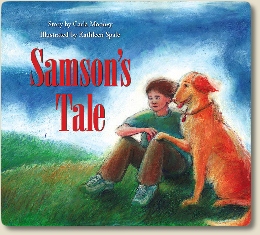 I remember when Samson’s Tale and Good News Nelson came across my desk. Both stories had something undeniable about them, both were stories that only those authors could write. Both were my immediate favorites, made me cry, made me laugh, and when they went off to the focus group, they resonated the same way with those parents, librarians, teachers, and kids. Pure magic…the gift of story that roams in the soul, that doesn’t mimic the next great thing, but instead mimics the beat of the author’s heart and the dance of the author’s own authentic imagination.
Before I close, I want you to imagine, in this magical month of November, that a mysterious tree has appeared at the center of your favorite park (or garden), brimming with interesting colors. These colors aren’t just any old autumn colors, they are personal to you: cadmium red, Paris gray, burnt umber, diarylide yellow, turquoise, the color of love, the color of surprise. Only you know what that tree looks like, as each leaf represents an idea. There are hundreds of those leaves falling, falling into a pile begging for you to jump in. In that pile is the promise of a great story.
So please jump in already, and allow yourself to relish in the freedom of endless story ideas. And remember to write the stories only you can write.
Happy writing,
Mary Rand Hess
Mary Rand Hess is editor at the deliciously scrumptious Story Pie Press. She’s also a children’s author, creative writing and drama teacher, allergy awareness advocate, mixed media artist, and MOM (a title that rightfully deserves to be in all caps).
Story Pie Press is an independent publishing house that strives to produce children’s books that will entertain and empower readers from generation to generation.
Our Mission is to publish great books, printed in safe, eco-friendly venues within the United States. Each book that is published will be associated with a charitable cause. A portion of the proceeds from each book will go to various organizations in an effort to help raise awareness for causes related to education and health.
Our Motto is heart-filled and good for the soul…“baking” stories that will have a positive impact on the lives of our readers, the organizations and charities we support, and the world around us.
 by Tamara Ellis Smith
Here is a joke for you all:
Why did the picture book writer wait and then cross the road?
To get a PiBo Idea!
I do a lot of hanging out within my landscape: small-town rural Vermont. I spend time in the cornfield behind the farm at the end of my block, out on the river trail at the edge of our town park, in the red pine woods, and up the various local mountains nearby. (Okay, maybe not as often up those mountains, but I just climbed one last weekend so it is still fresh in my mind…and in my achy thigh muscles!)
I get much of my inspiration from being inside my landscape.
This has been clear to me for a long time. The natural environment is full of tiny and majestic muses—the trees, rivers, flowers, blades of grass, ferns, rocks, and wind—all of them hold images, voices and ideas within them. I even have a blog about this, called Kissing The Earth, which I created with fellow children’s book writer, Sharry Wright. In it, we explore how landscape inspires writing, and how landscape in its own right can play a vital role in story-telling.
Today, though, I want to share a new revelation about landscape with you all.
So back to that aspiring writer-chicken. The one who waits on one side of the road before crossing. She waits. She sees the blue-purple chicory flowers at her feet. She hears a pair of squirrels chattering in the tree above her. She sniffs in—do chickens even sniff?—the rich, earthy smell of the woods just across the road.
As we continue on with this amazing PiBoIdMo challenge, I want to urge you to cultivate the art of waiting. And specifically, to cultivate the art of waiting within a landscape. As I said earlier, I truly believe that the trees, rivers, flowers, blades of grass, ferns, rocks and wind all hold stories within their ancient and organic roots and leaves and layers and flow. But in order to be privy to those stories, we have to be willing to create a space for them. And that’s where the waiting comes in. Waiting creates that space—a time-space, a physical-space, and a magic-space—and it is within that space that the alchemy of our imaginations and the earth’s secrets come together. Sparks fly, bubbles rise, and the best—oh the best!—ideas burst forth.
Ideas that feel brand spanking new and inevitable all at the same time.
In practical terms, I am talking about a change in perspective. An openness. And the search for the link between the child-within and the child-like quality of the story. Sometimes when I am mulling over an idea for a picture book, or a draft that isn’t quite working, or staring at a blank page all it takes is being quiet and still somewhere outside to make all of that shift. The experience of waiting within the landscape really can bring forth ideas. It also re-ignites that incredible sense of wonder and possibility that playing outside stirred up in us when we were children. And it also creates a sense of gratitude—for the world, for yourself, and for the way we are all connected.
Won’t you join me in the wide and wonderful Out There?
Tamara Ellis Smith has written a middle grade novel and several picture books, all pre-published. Her picture book manuscript, Milo’s World, was a finalist in the 2006 W.I.N. competition. Her middle grade novel won an honorable mention in the 2008 PEN New England Discovery Awards and was a runner up for the 2008 SCBWI Works-In-Progress grant. Tamara is represented by Erin Murphy of Erin Murphy Literacy Agency. You can learn more about her at tamaraellissmith.com and can read more about landscape and writing at her blog Kissing the Earth.
 by Jean Reidy
1. YouTube
Kids say and do the darndest things, right? And so often, they provide tender or hilarious or wonder-filled inspiration for picture books. But why limit yourself to the kids you know. More than ever, proud parents and brilliant marketers are happy to share a little one’s latest escapades. While I’ve never derived a direct storyline from YouTube videos, I do find in them that wacky lens through which to view a kid’s world. Here are some of my favorites:
2. Artist and Illustrator Websites
Three of my six picture books were inspired, in part, by browsing illustrators’ websites. Whether or not a particular illustrator ends up paired with my text, by studying the works of today’s most celebrated artists, I enter an altered state (Twilight Zone!) of visual creativity that triggers my muse. In the process I often discover a tone, emotion, whimsy or character that might just complete my story.
3. Beat Boxing
Whether they rhyme or not, most of my picture books have a distinct rhythm. And every so often that rhythm comes to me before the story. Listen carefully to your life. Do you hear the thump bump of your feet hitting the stairs each time you go up and down? Do you hear the crunch and shush of your shovel in crusty snow? How about the screech and thrum of an old file drawer? Beat box, then play with those rhythms to see if they have a story hidden inside them.
4. The Timeout Corner
Kids adore naughty characters. Whether we’re seeing ourselves or giggling with relief at another’s foibles, we all love stories with a little mischief in them. “Do some time” with a kid in timeout and you might just find a story there. Or think back to your own timeout corner—come on, fess up—we were all there once. What got you there? What were you feeling? Just remember, keep messages light. Because even a little mischief needs to be a fun read.
5. Your Day Job
Okay, let’s face it. Few of us get to take a morning stroll along the beach or dream by the hour under the old oak tree. Instead we might get regular face time with a subway hissing and shrieking during a crowded commute. Or the steely skyscraper out our window. Or the deli man who serves us pastrami on rye. Or a carpool of crack-me-up kids. Or even a baby giggling at the garbage man. Whether your day job is at home or away, it’s those “regular” experiences that often provide fodder for great picture books. Keep your notebook handy!
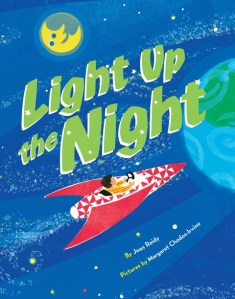 Jean Reidy is the author of the newly-released LIGHT UP THE NIGHT from Disney-Hyperion, which Kirkus calls a “gorgeous, mesmerizingly rhythmic read-aloud” in a starred review.
Her other picture books include TOO PICKLEY!, TOO PURPLEY!, and TOO PRINCESSY! from Bloomsbury.
Please join Jean at LIGHT UP THE LIBRARY, her online auction benefiting literacy in Africa and a library at Musana Children’s Home in Iganga, Uganda. She has something for everyone— including terrific items for picture book writers. The auction runs 11/7 – 11/18 at http://lightupthelibrary.blogspot.com.








 Writing for Kids (While Raising Them)