You are currently browsing the monthly archive for March 2019.
Can you believe it? I finally have the opportunity to announce and congratulate all the daily Storystorm winners! And I could not have done it without the assistance of Urania Smith from KidLitNation.com. So please check her out!

Now, it’s time for my favorite GIF!

No, wait. I think this is my fave…

And away we go!
Storystorm 2019 Winners
Day 1: Cathy Breisacher
Winner: Jennifer Phillips
Winner: Elizabeth Saba
Day 3: Tammi Sauer
Winner: Nancy Kotkin
Winner: Jen Bagan
Day 5: Mike Allegra
Winner: Nancy Rimar
Winner: Gretchen Brandenburg McLellan
Day 7: Jen Betton
Winner: Kellie Nissen
Day 9: Nancy Churnin
Winner: Marty Lapointe Malchik
Winner: Kelly Conroy
Day 11: Shutta Crum
Winner: Carlie Cornell
Winner: Aileen Stewart
Day 13: Ashley Franklin
Winner: Becky Hamilton
Winner:Tina Cho
Day 15: Andria W. Rosenbaum
Winner: Janie Reinart
Day 17: Nina Victor Crittenden
Winner: Carole Calladine
Winner: Kim Pfennigwerth
Day 19: Trisha Speed Shaskan and Stephen Shaskan
Winner: Kim Pfennigwerth
Winner: Marsha Elyn Wright
Day 21: Chana Stiefel
Winner: Johnell DeWitt
Day 23: Julie Segal Walters
Winner: Supermario6 (Dayann9)
Day 25: Alli Brydon
Winner: Katie B
Day 27: Juliet Clare Bell
Winner: Heather Stigall
Day 29: Diana Murray
Winner: Jen Fier Jasinksi
Day 30: Linsay Bonilla
Winner: Laurie Bouck
Winner: Katy Tanis
Five Winners from the Posts of Storystorm Past:
(You will receive books, glorious books, from Tundra and other publishers.)
Tanya Konerman
Janet Al Junaidi
Genevieve Petrillo
Natalie Lynn Tanner
Debra K Shumaker
Post-Storystorm: Laurie Keller
Winner: Donna Marie (Writersideup)
Congratulations! You’re all winners! (But sorry, no chicken dinners to give away.)
I will be emailing you over the next week to arrange delivery of your prizes!
And that officially concludes Storystorm 2019. I hope you’re still brainstorming ideas, though! You can always come back here to taralazar.com to read the posts and get a little extra oomph for your imagination.
See you back here for Storystorm 2020!
Recently, I was sharing with students how writers rewrite and rewrite more, trying to get our books perfect for our readers. A first grader raised her hand and sweetly commented, “Everything doesn’t have to be perfect.” What wisdom from one so young. This is exactly what Badger learned in Badger’s Perfect Garden.
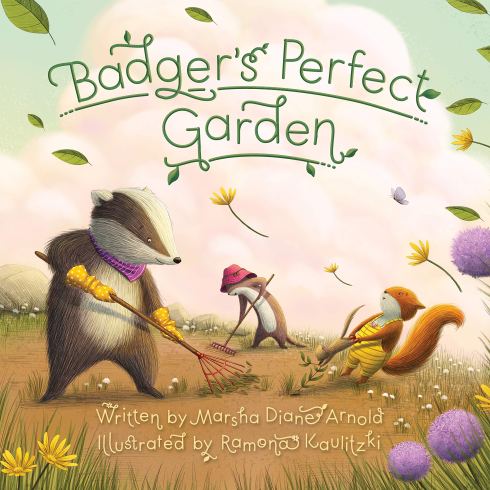
As readers will discover, Badger’s garden might not have turned out as perfectly as his original vision, but it is spectacularly beautiful, thanks to serendipity, Mother Nature, and Badger’s initial work.
Badger is a perfectionist. He had planned long and worked hard for his perfect garden. He had a plan—a garden plan. But sometimes when we hold too tightly to an outcome, things take a course of their own, or in this case Mother Nature takes a course of her own.
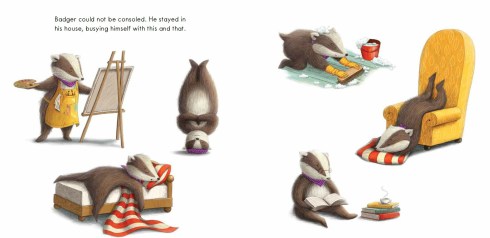
Of course, Badger is devastated when his vision is destroyed. He does what many of us do or would like to do. He stays inside, “busying himself with this and that,” so he doesn’t have to think about his perfect garden ever again!
When Badger’s friends show him a garden surprise, Badger realizes the truth that “letting go” can be a celebration, full of jubilation. Once he lets go of the outcome of a perfect garden, he is also free to let go of worry and to enjoy “a hodgepodge of garden games, jumbly-tumbly dancing, and muffins and mulberry juice.”
Ramona Kaulitzki’s illustration of Badger as he embraces his mixed-up garden shows him caught in a swirl of flowers and vegetables. His expression is one of serene happiness. Indeed, Ramona’s art beautifully captures Badger’s feelings from beginning to end—from hopeful, studious, and excited, to dejected, to that tranquil contentment.

Writers must also learn to “let go” when a publisher purchases their story. They must surrender their story to an editor, an art director, and an artist who bring their vision to the story as well.
I sometimes use art notes in my manuscripts, but Sleeping Bear Press removes all art notes before giving a manuscript to an artist. This is part of the “letting go” and the trusting that authors need to accept. Ramona Kaulitzki understood so much of what I wanted to show. For example, I had written, “Red Squirrel helped Dormouse gather string,” with this art note: Red Squirrel and Dormouse tangle the string. With the art note gone, I prayed Ramona had a similar sense of humor to mine. She did. When the sketches arrived, I saw Red Squirrel and Dormouse tangled in string on the page and the following spread.

There are also times when the artist’s vision is slightly different from the author’s. I had written, “Weasel found twigs to make holes for the seeds,” as my original vision was for a couple of the animals to make holes. But the art only showed Weasel making holes and previously walking just one twig. When I received the art, I simply asked my editor to change the wording from “twigs” to “twig.” Ramona’s art was perfect and it was a simple thing to let go of my illustration vision and an “s.”
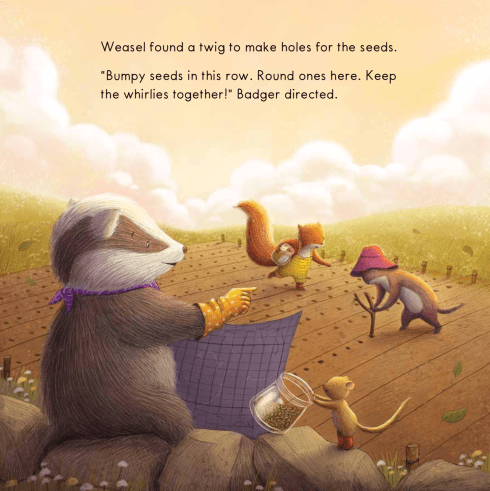
I did a lot of research on seeds for this book; I wasn’t sure how much information I’d use. In case the editor wanted to name specific plants, I kept a list of possible plants for Badger’s garden and images of seeds. In all my research I learned a lot, like the names of five edible burrs. We didn’t use this research in Badger’s Perfect Garden, but who knows in what future manuscript my gathered “seeds” will ‘rearrange themselves,’ just as Badger’s did.
“They just rearranged themselves,” said Red Squirrel.
“If you hadn’t planted them over there, they wouldn’t be here.”
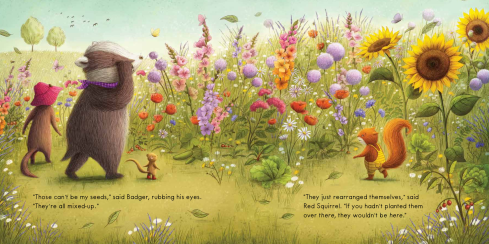
Thank you, Tara Lazar, for inviting me to visit your wonderful website and blog. May all your plantings produce beautiful gardens!
Thank you, Marsha, for blogging today and also giving away a copy of your new book BADGER’S PERFECT GARDEN!
To enter, please leave one comment below. A random winner will be chosen in “April showers bring May flowers.”
Good luck!
 Marsha Diane Arnold’s award-winning picture books have sold over one million copies and been called, “whimsical” and “uplifting.” Described as a “born storyteller” by the media, her books have garnered such honors as Best First Book by a New Author, Smithsonian Notable, Dolly Parton’s Imagination Library and state Children’s Choice awards. Recent books include Galápagos Girl, a bilingual book about a young girl growing up on the Galápagos Islands and Lost. Found., a Junior Library Guild book illustrated by Caldecott winner Matthew Cordell.
Marsha was raised on a Kansas farm, lived most of her life in Sonoma County, California, a place Luther Burbank called “the chosen spot of all this earth as far as Nature is concerned,” and now lives with her husband, near her family, in Alva, Florida. You can often find her standing in her backyard in the midst of dragonflies or purple martins swooping for insects. She can also be found at marshadianearnold.com.
I love picture book biographies. They’re right up there with chewy, chunky chocolate chip cookies. With those first delicious lines, I’m drawn into someone else’s world that reveals what shaped them and why their story is important. Unlike biographies for adults that pack in everything but the kitchen sink, I love picture book biographies because there’s only room for the good stuff. The best stuff. Stuff that allows readers to sidle up to remarkable people, past and present, and wonder what they might do with their own lives. Short as picture book biographies are, writing them can be challenging. Here are my tips for writing picture book biographies:
Who
Deciding who to write about is BIG. If they’re well-known like Benjamin Franklin or Abraham Lincoln, there’s a million books about them already. If you’re determined to write about them, you need to find an intriguing episode of their life that hasn’t been told before. The other option is to write about someone who isn’t well-known, but still has a great story to tell. Whatever it is, it needs to connect with young readers.
How Much
Although you may be tempted to tell someone’s story from the moment they’re born to their last breath—reconsider. Most trade picture book biographies either highlight the time of the accomplishment, or the formative years which led to their accomplishment. Not always. But mostly. The point is, there are options. One great example of highlighting the important moment in someone’s life is Ruth Law Thrills a Nation by Don Brown, one of my favorite picture book biographers. He opened Ruth’s story with these lines:

On November 19, 1916, Ruth Law tried to fly
from Chicago to New York City in one day.
It had never been done before.
There’s no growing up. No wanting to fly. No wondering whether to do it or not. Ruth Law was ready. Making the flight was the story. Page by page, Brown lets us see what happened the day she flew to New York City and the challenges she faced.
A great example of the second approach is also written by Don Brown in his book, Odd Boy Out, Young Albert Einstein. He opened the story with these lines:
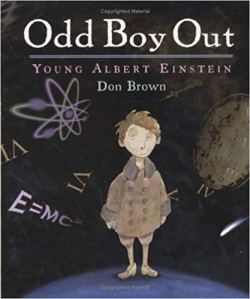
On a sunny, cold Friday in the old city of Ulm, Germany,
a baby named Albert Einstein is born.
It is March 14, 1879.
Why the difference? By starting from childhood, Brown showed readers how Einstein’s brilliant mind worked even at a young age, and how it led to his Theory of Relativity.
Beyond the Facts
Lastly, when you start writing picture book biographies, it’s tempting to stick close to the facts as if you’re on the ledge of a tall building. Stray too far and you won’t be safe. Stray too far, and you can’t cling to the pillar of facts. However, the only way to succeed is to step off into the literary void and find your voice. How do you want to tell the story? Let yourself go and find out. It’s okay. That’s what editors and readers want.
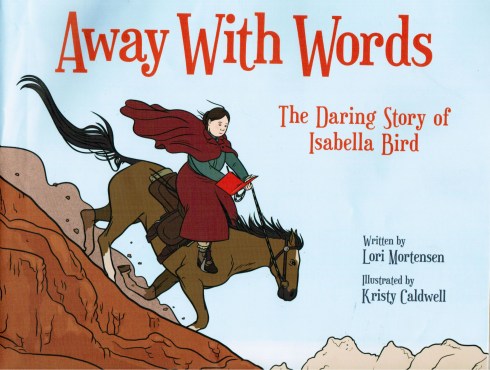
This idea was a turning point when I sold my latest release, Away with Words, The Daring Story of Isabella Bird, about the first female member of the Royal Geographical Society. My first versions were lyrical, but very conservative and I revised the manuscript so many times for my agent, I lost count. Each version was lovely and dramatic, but something was missing. More revisions and rejections followed. In time, I parted ways with my agent and put the manuscript away.
Then, a few months later, I got it out again. I loved Isabella’s story too much to give up on it completely. At that moment, without an editor or an agent waiting for results, I felt a certain freedom to change things up. How did I want to tell her story? When I looked at it again, a metaphor sprang to mind that became the opening heart of the story.
Isabella was like a wild vine
stuck in a too small pot.
She needed more room.
She had to get out.
She had to explore.
You won’t find these words in the research. That’s me, letting go, telling Isabella’s story my way. It made all the difference.
So, the next time you’re writing a picture book biography, remember the good stuff. The best stuff. And treat yourself to a chewy, chunky chocolate chip cookie.
We are giving away a copy of Lori’s new book AWAY WITH WORDS: THE DARING STORY OF ISABELLA BIRD!
Leave one comment to enter.
A winner will be selected at the end of the month.
Good luck!
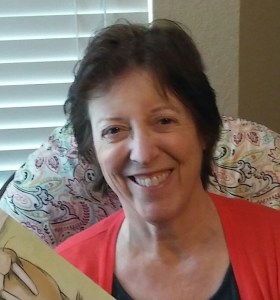 Lori Mortensen is an award-winning children’s book author of more than 100 books and over 500 stories and articles. Recent releases include her picture book biography, Away with Words, the Daring Story of Isabella Bird (Peachtree), about the first woman inducted into the Royal Geographical Society, If Wendell Had a Walrus (Henry Holt), Chicken Lily, (Henry Holt), Mousequerade Ball (Bloomsbury) illustrated by New York Times bestselling illustrator Betsy Lewin, and Cowpoke Clyde Rides the Range (Clarion, 2016) a sequel to Cowpoke Clyde & Dirty Dawg, one of Amazon’s best picture books of 2013. When she’s not letting her cat in, or out, or in, she’s tapping away at her computer, conjuring, coaxing, and prodding her latest stories to life.
For more information about her books, events, critique service, and upcoming releases, visit her website at lorimortensen.com.





 Writing for Kids (While Raising Them)