You are currently browsing the monthly archive for December 2013.
 by
by When I tell people that I have a mechanical engineering degree and that I’m also a picture book author, they look at me like I’m trying to mate two different species. Like I’m part alligator and part butterfly. (That would be one scary insect/reptile.)
But as an engineer, I relied heavily on my creative gifts and as an author I can use engineering skills to organize and tackle writing projects. November and PiBoIdMo were about the creativity. Now in December, let’s use our engineering skills to tackle the what-is-next problem. (Don’t worry. You DO have engineering skills. You just don’t know it.)
When I worked as an airline seat engineer I had to create a bill of material (called more affectionately a BOM). A BOM was used by purchasing to order all the parts needed to create an airline seat—everything from nuts and bolts to cushions to motors. (These were the awesome first class seats that fully recline and offer in-flight entertainment.) I’m suggesting a BOM could also be used to create a children’s picture book.
Let’s look back at our ideas from November. This is our inventory from which we can create a BOM. I like to use a spreadsheet, but you can do the same thing with paper, pen and a straight edge. Make a list of all the characters that sprung to life in November and put them in column A. Then make a list of other components needed in a book: settings, problems, titles, goals, situations, emotions, other, etc. It’s OK if you have fifty characters listed and only five settings.
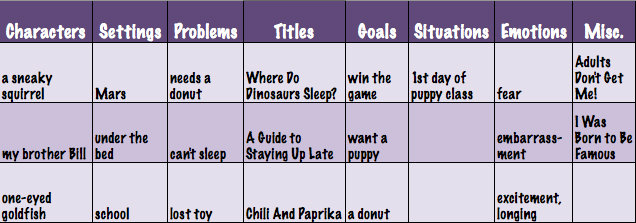
(click to view chart at full size)
Now we have a list of components we can use to build a story. By creating your spreadsheet, you might see that you have a great character and interesting problem that you do not previously consider putting together. Your cookie-loving shark might be the perfect hero to free Mars of aliens.
Or maybe not.
Engineers—like authors—also go through numerous revisions. And every part you need to build your picture book will not be in your inventory list. Your BOM for each story will require the creation of new components. Your goal and your setting may work, but you may need to create a new character (a character not created in November, but in December).
So don’t be afraid to engineer your picture book. In the end, creativity and structure can live happily ever after.

 Stacy was a mechanical engineer for 8 years before becoming a full-time writer. DEAR SANTASAURUS, her first picture book, was released in October from Boyds Mills Press. She has also engineered two other picture books to be published in 2015 by Random House and Knopf. Stacy lives in a messy house in North Carolina with her 3 messy kids, 2 messy dogs, and 1 messy husband. Visit her at StacyMcAnulty.com.

Stacy is giving away a signed copy of DEAR SANTASAURUS and a picture book critique. Leave a comment to be entered.
You are eligible for this prize if:
- You have registered for PiBoIdMo.
- You have commented ONCE ONLY on today’s post.
- You have completed the PiBoIdMo challenge. (You have signed the PiBoIdMo Winner’s Pledge.)
Good luck, everyone!
 by
by Isn’t it fun to hone and revise your hilarious dialogue in your manuscript until it’s just perfect? To give your character another tiny quirk that makes them that much more them? To make sure every little word is important and cut each unnecessary one?
I love details, but they can drag me down too soon.
Most of us have truckloads of ideas now that PiBoIdMo is over. We want to jump into the tastiest one and get writing!
That can be a wonderful way to write a first draft. Find an idea you love for a picture book and jump in headlong. Let the joy of doing your craft show!
But then comes revising, and that’s where the dragging down can happen. I had a bad habit of looking at my first draft and trying to fix the tiniest problems first. I’d fix all my grammar mistakes and look for just the right nuance for every word in each sentence.
I was failing to look at the big picture first: plot and story, a strong or unique concept, character development, an element of surprise, pacing, and so on. Not all of those are right in the first draft. Most, if not all, need some heavy work right away. I was wasting time perfecting tiny details in my manuscripts that needed to change later anyway after I fixed the big problems.
Now I try to look at the big picture first and talk out the major points with my agent before I even write the story. My agent knows the marketplace and can advise me on what might work and what might not before I pour time into a manuscript. You can do that with a trusted writer friend or even by yourself.
When I wrote PENGUIN CHA-CHA, I was figuring out my approach to writing picture books (still am, actually). I knew I wanted to write about dancing penguins, and that was all I had to start. I wrote about penguins dancing in a talent contest, perfected the tiny details, and then realized my story wasn’t unique enough to make it in the market.
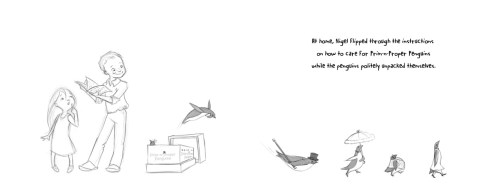
I wrote a whole different story about a brother and sister who bought dancing penguins from an exotic pet store, and again, discovered the big overall problems with the story after I spent loads of time sketching up the story into a dummy. (Since I write and illustrate, I submit my stories as a sketch dummy. If you aren’t an illustrator, you submit just the manuscript to publishers without illustrations—the publisher picks the illustrator.)
My final PENGUIN CHA-CHA book is very different than any of my earlier versions. It’s now about a girl who is determined to jitterbug with the penguins at the zoo after she discovers they’re secretly dancing. Random House published the book a few months ago.
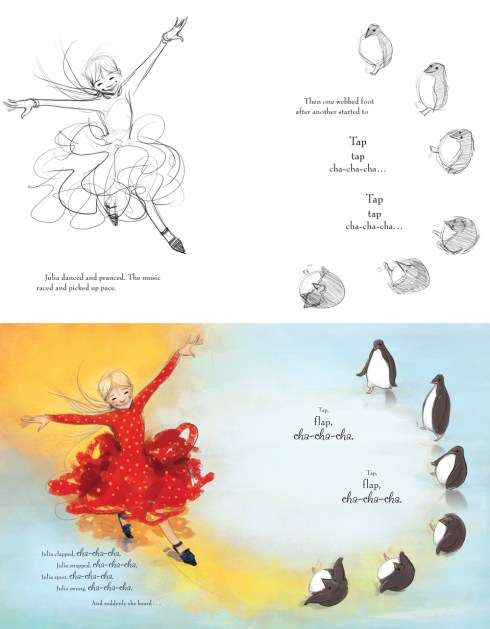
I think these processes were necessary for me to learn, and it was fun working those tiny details, so maybe the time wasn’t exactly wasted.
A lot of illustrators go through this same learning experience. I love drawing faces the most. After all, eyes and facial expressions show emotion and the character’s heart. It’s so tempting to get lost drawing those tiny details on a face before I even plan out the rest of the illustration. If you watch kids draw, they start with the faces too. And then later they realize they should have drawn the face smaller to fit everything else on the page or drawn their character in a different spot.
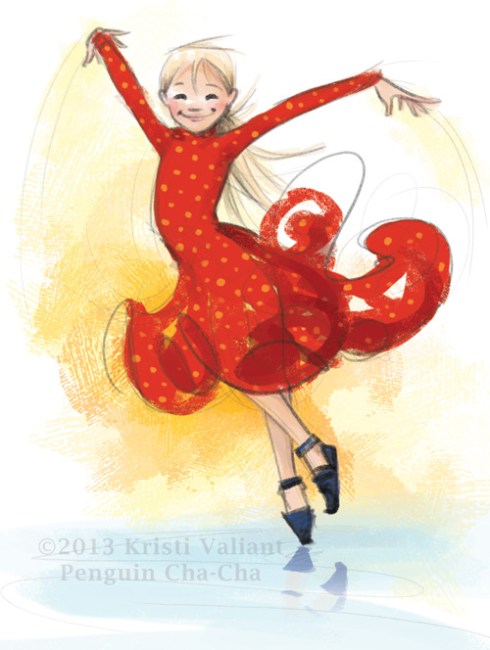
It’s hard to start over with an illustration after you’ve put so much time into drawing the details on the face.
It’s hard to start over with a manuscript after you’ve put so much time into perfecting the written details.
Start with the big picture first. Unless you’re writing and drawing the details just for fun. Then by all means, get lost in those details! And maybe those details will lead to inspire the big picture. In that case, start with the details.
Oh my, we’re all confused now, aren’t we?
So maybe you need to do what you need to do to write your book best. And maybe that’s different than what I do. And that’s OK too.
 Kristi wrote and illustrated the picture book PENGUIN CHA-CHA. She illustrated Danielle Steel’s upcoming picture book PRETTY MINNIE IN PARIS, as well as the Little Wings chapter book series, THE GOODBYE CANCER GARDEN, CORA COOKS PANCIT, and others. Kristi volunteers as the Regional Advisor of Indiana SCBWI and is represented by Linda Pratt from Wernick & Pratt Agency. She graduated magna cum laude from Columbus College of Art & Design with a major in Illustration. She lives in Indiana with her husband, little girls, and a room full of hippos, monkeys and sneaky penguins.
Visit Krisi online at KristiValiant.com or on her blog at KristiValiant.blogspot.com. The penguins do their own dance at PenguinChaCha.com.
Kristi is giving away a picture book critique. Leave a comment to enter the random drawing.
You are eligible for this prize if:
- You have registered for PiBoIdMo.
- You have commented ONCE ONLY on today’s post.
- You have completed the PiBoIdMo challenge. (You will have to sign the PiBoIdMo Pledge by December 3rd.)
Good luck, everyone!
So, you have your list of 30 or more ideas. Now what?

First of all, DON’T STOP. Your mind is fertile right now. This is when most of my ideas come… the week after PiBoIdMo.
The pressure is off, but the brain is still in idea-generating mode.
Take advantage of it. Keep your list in a handy place and add, add, add.

Check your list twice. Then check last year’s list. And the one from 2011. What pops? While some ideas may seem too overdone or too dull, there are likely to be two or three that jump out at you.
Tuxedo-saurus: too fancy
Hip-Hop-a-Saurus: too dancy
Ho-Hum-a-Saurus: a bore
Sashay-a-Saurus: too prancy
Piggy-Bank–a-saurus: too finance-y
Snooze-a-saurus: a snore
Poker-a-saurus: too chancy
Trig-a-saurus: too advance-y
Slobberdon: yes, score!!!

Look at your best options. Do some research. Have they been done before?
Explore. Check Amazon to see what competing titles are out there.
One year I had Panda-monium on my list. Done. Another, I had Dino-snores. Also done. Better to find this out BEFORE you begin.
This brings me to my final point…

Once you’ve got a solid manuscript, shop it to editors and/or agents.
Tyrannosaurus Wrecks was one of my favorite ideas from 2011. I wrote a draft, but wasn’t happy with it and put it aside. Turns out, I was too slow. Someone has now beat me to it!
So, if you have a winning idea, get rocking.
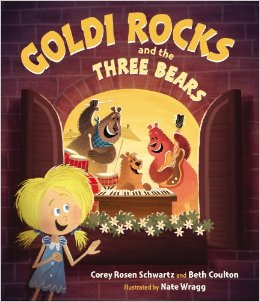
 Corey Rosen Schwartz is the author of THE THREE NINJA PIGS and the upcoming GOLDI ROCKS AND THE THREE
BEARS. Her singing is extremely pitchy, but she does hold Family Idol and X Factor events in her living room.
Corey will give away a signed copy of GOLDI ROCKS & THE THREE BEARS (as soon as it releases on Feb 6th).
This prize will be awarded at the conclusion of Post-PiBoIdMo. You are eligible for this prize if:
- You have registered for PiBoIdMo.
- You have commented ONCE ONLY on today’s post.
- You have completed the PiBoIdMo challenge. (You will have to sign the PiBoIdMo Pledge at the end of the event.)
Good luck, everyone!
BUZZZZZZZZZZ!!!!!
OK folks, time’s up!
November and the 5th annual PiBoIdMo have officially come to a close.

Well, do ya, PiBoIdMo’er?
Do you have 30 ideas?
If you do, you can qualify for one of our AMAZING PiBoIdMo prizes just by taking the following pledge. Put your right hand on a picture book and repeat after me:
I do solemnly swear that I have faithfully executed
the PiBoIdMo 30-ideas-in-30-days challenge,
and will, to the best of my ability,
parlay my ideas into picture book manuscripts.
Now I’m not saying all 30 ideas have to be good. Some may just be titles, some may be character quirks. Some may be problems and some may create problems when you sit down to write. Some may be high-concept and some barely a concept. But…they’re yours, all yours! Give them a big, fat, juicy smacker! SMOOCH!
.
You have until December 3rd at 11:59:59PM EST to sign the pledge by leaving a comment WITH YOUR FULL NAME on this post. PLEASE COMMENT ONLY ONCE.
The name you left on the registration post and the name you leave on this winner’s pledge SHOULD MATCH.
Again, please COMMENT ONLY ONCE. If you made a mistake, contact me instead of leaving a second comment.
.
Remember, this is an honor system pledge. You don’t have to send in your ideas to prove you’ve got 30 of them. If you say so, I’ll believe you! Honestly, it’s that simple. (Wouldn’t it be nice if real life were that straightforward.)
If your name appears on both the registration post AND this winner’s pledge, you’ll be entered into the grand prize drawing: feedback on your best 5 ideas from a literary agent. There are NINE grand prizes! Check out all the agents here.
So what should you do now? Start fleshing out your best ideas! Write them as elevator pitches. Get ready because YOU might be a CHOSEN ONE.
Other prizes include picture books, manuscript critiques, art prints—all the stuff you saw during the month. All winners will be randomly selected by Random.org and announced NEXT WEEK.
And guess what, PiBoIdMo doesn’t end here! From tomorrow through December 6th, stop in for Post-PiBo, which offers daily posts about organizing and prioritizing your ideas.
Plus—you can claim your first prize now: a winner badge for your website, blog or social media site, designed by Joyce Wan. You can make it larger or smaller to fit anywhere. And if you want it on a mug, don’t forget to stop by the PiBoIdMo shop where every purchase benefits Reading is Fundamental (RIF).
Congratulate yourself on a job well done, PiBoIdMo’er. Take yourself out to brunch. Buy a new infinity scarf. Browse a bookstore. Pat your head and rub your tummy. Do what you want, you deserve it.
Go ahead, sign below and make my day! And your month!
And remember, stay tuned for Post-PiBo!





 Writing for Kids (While Raising Them)