BUGS MAKE IT BIG IN GRAPHIC NOVELS…HERE’S HOW
by Aaaron Reynolds & Neil Numberman
(Interior. Aaron Reynolds, a writer of children’s books and graphic novels, is sitting at his writing desk. He’s typing, but suddenly stops when a shadow falls over his screen. It’s a kid, about ten or eleven.)
Aaron: (looking up) Hey.
Kid: Hey. Whatcha doin’?
Aaron: Um…writing. Who are you? What are you doing in my writing room?
Kid: I’m just some random kid.
Aaron: Ah. A random kid in my writing room. Okay.
Kid: Yeah. Act like I’m not here. (pause…Aaron starts to get back to work, but is interrupted) Aren’t you an author?
Aaron: (turning back around) Ignore you, huh? That’s gonna be tricky. Yeah. I write kid’s books and graphic novels.
Kid: Graphic novels? Like comic books?
Aaron: Kinda.
Kid: Whatcha writing now?
Aaron: An article about how a graphic novel gets made, but I wanted to write it LIKE a graphic novel, so that’s what I’m doing.
Kid: But…there’s no pictures. A graphic novel has lots of pictures.
Aaron: Not at first. Not mine anyway.
Kid: What?
Aaron: Seriously. I don’t draw.
Kid: I must have the wrong house then. I thought the dude that lives here makes graphic novels.
Aaron: I do. But I don’t draw them….I write them.
(Kid pauses while he thinks about this, then…)
Kid: That’s messed up.
Aaron: No, it’s not.
Kid: You can’t make a graphic novel without being able to draw.
Aaron: Well, I do. Like my new graphic novel…it’s called Joey Fly, Private Eye…
Kid: Way to work that in there. Nice plug. Smooth.
Aaron: Yeah, thanks. Well, Joey Fly starts out like this. A script, just like this one.
Kid: Just the stuff people say?
Aaron: Mostly. I also write in what I see happening in each scene.
(Kid flops into a big cushy chair and puts his feet on Aaron’s writing desk, makes himself at home. He looks at Aaron like he’s lost his mind.)
Aaron: See? Like that. It’s called “stage directions.”
Kid: Oh cool! Like actions and stuff!
Aaron: Yeah, exactly.
Kid: Do it again.
(Kid gets up, kind of excited now. He’s putting it all together in his head, but then he notices a fresh sandwich on Aaron’s desk. Goes over, lifts the bread…he’s kinda hungry…but decides he doesn’t like tuna. Flops back down in the chair.)
Kid: Hey, that’s awesome how you made me do all that stuff! And I do hate tuna.
Aaron: It’s a script. In the graphic novel, I write the story. I come up with the characters. In Joey Fly, Private Eye, I create what happens, what characters are in it, all that stuff. Then I put it into a story…a script like this.
Kid: But it’s not a graphic novel. No pictures.
Aaron: Not yet. It will be soon. But first, I break it into panels.
Kid: Panels?
Panel
Aaron: Like this. Chunks. How I imagine it will get broken into boxes in the finished graphic novel. This helps me figure out the flow and pacing of the story, helps me cut extra junk that’s not needed, and helps the illustrator figure out how he’s gonna lay out the pictures on the page.
Panel
Kid: Cool. I notice you use lots of words like “gonna” and “whatcha” and stuff. My Language Arts teacher would go nuts on you for that.
Panel
Aaron: Yeah, well… I try to write how people really talk. I think that’s important, especially for a graphic novel. It all depends on the character. Like, Joey Fly says some gonnas, but he also uses lots of detective-y phrases…
Panel
Joey: Life in the bug city. It ain’t easy. Crime sticks to this city like a one-winged fly on a fifty-cent swatter.
Panel
Aaron: Like that. That’s his opening line in the book.
Kid: Okay, that’s pretty funny.
Panel
Aaron: Well, I try.
Panel
Kid: But it’s still not a graphic novel.
Panel
Aaron: Man, for a random kid who shows up in my writing room, you’re seriously pushy.
Panel
Kid: Do you know many eleven-year-olds? We’re all like this.
Aaron: That’s right. Not being one, I forget sometimes.
Panel
Aaron: Well, now that it’s all broken into panels, I give it to my publisher. And once she’s happy with it, she sends it off to the illustrator and he starts drawing.
Panel
Kid: You tell him what to draw?
Aaron: No.
Panel
Kid: You tell him what the characters should look like?
Aaron: No.
Panel
Kid: What do you tell him?
Aaron: Nothing. Most of the time, we never even meet.
Panel
(pause…the kid’s mouth is hanging open.)
Panel
Kid: That is seriously messed up.
Panel
Aaron: That’s how it works. Unless you are the writer and the illustrator (which I’m not…I don’t draw, remember?), that’s how it works.
Panel
Kid: So what happens then?
Aaron: The illustrator looks at it and begins to sketch out what he thinks the characters look like.
Panel
Aaron: Like, for Joey Fly, Private Eye, the illustrator is a guy named Neil Numberman.
Panel
Neil: Hey kid. What’s up? Hey Aaron.
Panel
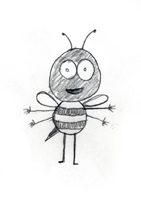
Aaron: Hey Neil. So, Neil might decide after reading this script that you look like this:
Panel
Kid: That’s me?
Neil: Yep.
Panel
Kid: You made me a bug!
Neil: Well, we’re talking about Joey Fly, Private Eye, so I’m thinking in bugs. It’s my job to use my imagination, to come up with my ideas of what Aaron’s characters and story look like.
Panel
Kid: Cool.
Panel
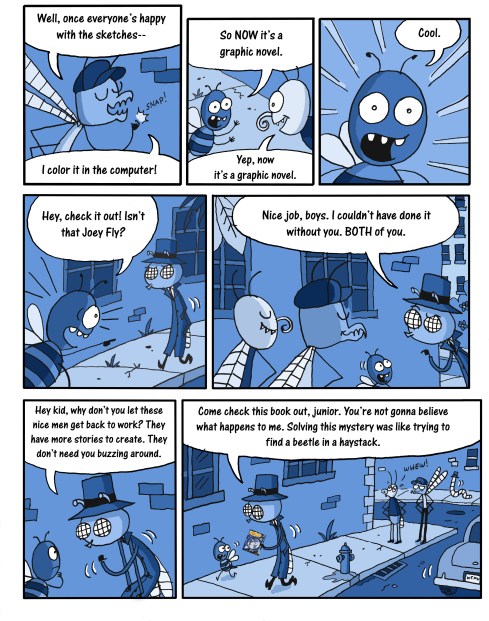
Neil: And as I start drawing and figuring out what it all looks like, Aaron’s story moves away from being a script and I start creating real characters…

Neil: …and pretty soon, I take Aaron’s written words and begin to put them into the mouths of the characters I’ve created.


Aaron Reynolds is a human, not a bug, but he often writes about bugs. He is the author of Chicks and Salsa, Superhero School, Buffalo Wings, and, of course, the Joey Fly, Private Eye graphic novels.
Neil Numberman is a termite currently residing in New York City. Joey Fly, Private Eye is his first graphic novel, but he is also the author/illustrator of the picture book Do NOT Build a Frankenstein.

So there you are, folks. That’s how to make a graphic novel. Thanks, Aaron & Neil. (And Joey & Sammy, too.)
PiBoIdMo’ers, maybe you’d like to approach your next picture book idea in graphic terms. Your story doesn’t have to be a novel to fit the format. Author/illustrator Sarah Dillard penned Perfectly Arugula in this style, with perfect results.
So, how’s it going today?





 Writing for Kids (While Raising Them)
16 comments
Comments feed for this article
November 2, 2009 at 10:50 am
Jim Hill
Wow, that was awesome! I’m going to run out and buy Joey Fly right after I write down my own graphic novel idea o’ the day.
Thanks Aaron, Neil and Tara.
November 2, 2009 at 11:08 am
Auntie Flamingo
Great post! I wondered how graphic novels worked. I think this is something I’m gonna to have to try.
Thanks for sharing.
November 2, 2009 at 1:04 pm
tammi
Panel:
Tammi: This is awesome!
(Tammi pumps fist in the air.)
November 2, 2009 at 2:48 pm
Diandra Mae
Great post! I’ve been toying with an idea similar to this-it’s nice to know I was on the right track!
Day 2 and still going strong. I’m hoping the lag happens way late in the month. 🙂
November 2, 2009 at 5:29 pm
Bonnie Adamson
So cool–thanks to all for a great introduction to graphic-novel creating!
Muttering to herself: Panels, think panels!!!
November 2, 2009 at 5:48 pm
Aaron Reynolds
Hey guys!
The cool thing is, you don’t have to think in panels until later. It’s a beautiful thing that you can just let the story flow through action or dialogue and not even have to overly sweat narration at first. The narration has to be pretty sparse anyway, because you can only fit so much in those little caption boxes. I find that by the time the characters have been talking for a few pages, their side comments to me (the narration) starts to find it’s own voice. And that’s how I think of it…the little side comments they’d say to me that they won’t actually say to each other.
Hey, btw…I’ll be poking around here for the next day or so, and I’m tickled to be part of the dialogue. Thanks to Tara for letting me and Neil hang out!
November 2, 2009 at 8:15 pm
Heather Burnell
I love this post. It’s great to see how a graphic novel is actually done. I will resist my graphic novel writing urges no longer!
November 2, 2009 at 9:17 pm
Debbie
Wow, what a fantastic post. I’m working on a graphic novel right now (just the script, an artist in CA is illustrating) so this is timely for me. Thank you so much for sharing!
November 3, 2009 at 7:43 am
Sarah Dillard
Aww, thanks for the mention! This is so interesting to read a writer’s approach. As an illustrator too, I tend to do it all at once and the graphic novel –or graphic pb I guess– approach feels so natural for telling a story– I so agree with Aaron that the story can just flow..
November 4, 2009 at 5:15 pm
Kelly Fineman
Terrific tutorial, guys!
November 6, 2009 at 8:07 am
jonathan
thanks. I’ve been educated in doing picture books and am now in the process of turning one of my stories into a middle grade graphic novel. I saw somewhere that the manuscript kind of looks like a screen play manuscript.
I’m doing the entire thing, so it’s kind of a molding process. I’m breaking the pages up first, then writing what I want to happen, then breaking that into panels. I want to be loose when it comes to panels because you can choose to lay it out in so many ways. This is a daunting task, good thing I grew up with comics.
November 4, 2010 at 8:57 am
PiBoIdMo Day 4: Joey Fly’s Sequel of Success (and a giveaway) « Writing for Kids (While Raising Them)
[…] year Aaron & Neil taught us how to create a graphic novel with a demonstration from their 2009 debut Joey Fly. Well, the creepy-crawly duo is back and so is […]
November 4, 2010 at 9:37 am
Chrissa Pedersen
Fascinating, for some reason I assumed that a graphic novel was created only by one person. It must be such an incredible experience to see your words come to life through someone else’s interpretation. Thanks!
November 5, 2010 at 8:15 pm
katswhiskers
This is brilliant! I’m coming at it a year later – after Aaron and Neils visit for #PiBoIdMo 2010. LOVE what you’ve done with this!!! 😀
November 6, 2010 at 11:06 am
Day Seven #PiBoIdMo « Kathryn Apel
[…] of Neil and Aaron – check out this fantastic post from last year’s PiBoIdMo Inspirational blog. It is 100% AWESOME – and I can’t […]
October 21, 2015 at 3:23 pm
Darshana
This is fantastic!