by Jen Fier Jasinski

After only three months and six drafts writing SIDEWALK CHALK, I received a critique from a big-name agent that said: “I’m sorry to say that I am drawing a complete blank on how this might be improved.”

I gasped.

I danced.

I queried that sucker.

I got rejected for another three years and fifteen revisions. Ah, publishing.

SIDEWALK CHALK breaks some rules. The most notable being that the manuscript is mostly illustration notes. That early “unimprovable” draft had only thirty-three words of text… and 691 words of art notes! I am an author-only and have taken many writing courses that (rightfully) advise writers to keep art notes spare, only include those that move the plot forward, and always leave room for the illustrator to add to the story.

So, yeah, 691 words of art notes felt like a risk.

But I didn’t cut them. Actually, I ended up adding more. Why? Because so much of my story idea hung in the art. The characters’ actions, not dialogue, tell this story. The setting foreground and background are integral to the plotline. The weather and chalk pile are near-characters that hold the story’s stakes and tension. In short, those heavy art notes served the story. (Importantly, I became assured of this through additional agent critiques, personalized rejections, and Revise & Resubmit (R&R) requests.)

My story was hitting. My text was not.

SIDEWALK CHALK’s premise has a classic, atmospheric tone. I ultimately realized the text needed to match it. R&Rs made this clear as they encouraged me to build the musicality of the text through more onomatopoeia, then later through internal assonance and alliteration.

Eventually, it worked:

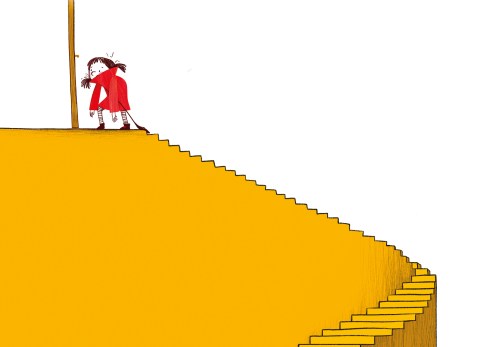
After a box of chalk is plunked on the sidewalk, a shy child watches as neighborhood children come together to—Scribble! Scratch! and Scrawl! –  transforming the plain path into a vibrant storyscape. Just as the child finds the courage to join them—Plip! Plop! Splat!—a storm sends them running, threatening their new friendship and their creation.

SIDEWALK CHALK celebrates creativity, collaboration and community.

I am thrilled SIDEWALK CHALK landed in capable, caring hands at Gnome Road Publishing! Illustrator Lea Marie Ravotti has created a precious neighborhood of kids and even though I had heavy notes, I am so impressed with how she added her own spin and sweet style to the story! I am extremely pleased with the ultimate result (60 words of text and 743 words of art notes for those curious,) and I hope readers will be, too.

SIDEWALK CHALK is now available for preorder where most books are sold, for a September 23, 2025 release.

Jen is giving away either a 30-minute AMA virtual session or a copy of the book (winner’s choice) to TWO blog readers! Please leave a comment to enter and two winners will be randomly chosen at the end of the month! Good luck!


Jen Fier Jasinski spent much of her childhood reading books and imagining new worlds. Unwilling to let go of Story Time, she grew up to become a teacher, mother, and author. Now Jen writes stories with elements of humor, heart, and above all, play. She is the author of My Piano (2023), Sidewalk Chalk (2025), My Violin (2026) and Because of You, I’m a Sister (2026). My Piano earned a starred review from School Library Journal.

When she’s not writing, Jen can be found on the sidewalks of Burke, Virginia running or playing with her kids. 

So as typically happens this time of year, I’ve been sick. So I’m just going to chalk February up to a loss and get to your Storystorm prizes in March. I am still recruiting agents for your Storystorm Grand Prizes, where you’ll receive feedback on your 5 best story ideas, to help you determine which to pursue as manuscripts and submissions.

Speaking of submissions, I am sharing a Flash Fiction story I wrote during the pandemic that I cannot seem to place anywhere, so I am publishing it here instead. This is an original story and I hope you enjoy! (Be forewarned, it’s for adults, not kiddos.)

The Neighbors
©2020-2025 by Tara Lazar

We were forced to write the neighbors about the beast.

Louise and I had promised it refuge in our basement in exchange for sparing our family. It assured us that if we kept supplying it with deer and possum, it would remain sated. There would be no need to torment the town. However, it has spent the last week digging passageways to the other homes.

Our son warned us that a beast cannot be believed, and we should have listened. But you don’t heed the kid with straight-Ds who wears t-shirts emblazoned with “Whoof Arted”. Meanwhile, our daughter, the good child, was devoured a month ago. Once again, our fault for the misplaced trust.

“What shall the letter say?” my wife asked.

“How about this,” I replied, pen in hand. “Dear neighbors, it has come to our attention that—”

“No, no, you can’t begin that way. They’ll think we’re telling them to power wash their vinyl siding again. They won’t read past the first line.”

“Then it’s really their fault if they can’t read a simple letter,” I said.

“Use powerful language, Chester. Write it like your clean-up-after-your-pet notice.”

“I won’t swear again, Louise.”

“Of course not, dear. Just be direct. Like your lawn-mowing letter.”

“I’ve got it,” I said, clearing my throat. “Dear neighbors, a beast has infiltrated our neighborhood.”

“Oh, excellent, darling. But shouldn’t you make it clear that you don’t mean Mrs. Stubbs?”

“Good point. Dear neighbors, an inhuman beast has infiltrated our neighborhood.”

“Wonderful! That’s a fine start,” Louise said. “Shall I make us some tea?”

“Spot on. Writing makes me thirsty.”

We composed a letter both urgent and actionable, without being too alarming. We agreed that Mr. Rasmussen, our eldest neighbor, was too fragile to read such a missive, given that his wife had recently passed, so we invited him to dinner instead. We could deliver the news with hearty helpings of Louise’s pot roast and Dutch apple pie, softening the blow.

*****

“We’ve been meaning to have you over for a while,” Louise said, leading Mr. Rasmussen to the dining room. “We were sorry to hear about Mrs. Rasmussen. What a special soul, volunteering at the hospital all those years.”

“Much obliged, Mr. and Mrs. Smythe. Awful kind of you.”

“Please, call us Chester and Louise. And you remember our son, Devin.”

“Goodness gracious. He’s sure grown! Bigger than his father now.”

An intense growl emerged from deep beneath the house, rumbling through the floor in magnificent waves. We held our collective breath, waiting for Mr. Rasmussen’s reaction. He just blinked and asked to use the restroom.

“Do you think he’s going deaf?” Louise asked. “Does he have nerve damage in his feet?”

“I don’t think he’s diabetic,” I replied.

“Well, if he heard or felt that, he didn’t flinch!”

“Good. Maybe this won’t be so difficult after all.”

We worked through the meal with light conversation and waited until we were warm and satisfied to broach the subject. Some things are better discussed on a full stomach.

*****

“I don’t believe you,” Mr. Rasmussen replied.

“I know this is a shock, but it’s living in our basement and it has carved underground routes to every house on King Drive,” I said. “It will pluck you one-by-one from your beds and devour you complete.”

Mr. Rasmussen crossed his arms. “How come you haven’t been devoured?”

“It got to Penelope, the poor dear.” Louise dabbed a napkin under her eye.

“I see,” said Mr. Rasmussen, leaning back. “I still don’t believe you.”

“My God, man! This is no time to be a contrarian!”

“Chester,” Louise said, placing a hand upon my forearm, “we said we were going to be calm and gentle with our guest.”

“Right. My apologies,” I said in a soft tone. “Please understand. This beast is a serious threat.”

“Let’s go see it, then,” said Mr. Rasmussen.

“Pardon me?”

“You’ve got a beast in your basement. Let’s take a look.” He pushed his chair back and stood up.

“I don’t think you comprehend the gravity of this. Going down there is dangerous. I wouldn’t advise it.”

“Hell, I’ve got a lawyer. He advises me, not you.” Mr. Rasmussen started toward the cellar door. “Let me see this thing. I’ll decide for myself if we should run for the hills.”

I blocked his path. “Mr. Rasmussen, I strongly urge you not to open that door.”

He reached for the doorknob and I reacted on a primal level, pushing both hands against his chest, sending him flying backward.

“Chester!” Louise screamed.

Mr. Rasmussen landed with a thwack, slamming his head against the tile floor.

The clamor of the disturbed beast rattled beneath us and the floor seemed to breathe.

The beast galloped up the stairs, thrashing against the walls, snarling and spitting, emitting a brutal heat. Twisting and heaving, it screeched with a sickening sharp note that sounded as if all eternity’s nightmares had joined forces. Then in a flash it dissolved into a tar-like puddle of infinite depth. The liquid bubbled and boiled and from within its abyss emerged a plump, grandmotherly figure with yellow-white hair.

“Mrs. Rasmussen?!”

“You remember my wife, Gertie,” Mr. Rasmussen said, rising, his bashed-in head dripping blood. “Surprising, given you never had us over for supper.”

“Oh, Gerald,” Mrs. Rasmussen slapped at her husband playfully. “Be nice. The Smythes were kind enough to let me stay in their roomy basement.”

“I hope they kept you comfortable, sweetheart.”

“Yes, quite! But I must apologize for the teenage girl. I’m afraid I got carried away that day.”

Mr. Rasmussen proffered his arm and the elderly couple strolled across the living room to the front door, trailing tar and blood.

“Now then,” he said, turning to us, “maybe next time you’ll think twice before sending us another rude letter. We’ll power wash when we damn want to power wash and not a moment sooner.”


The End
©2020-2025 by Tara Lazar

by Heidi EY Stemple

My new book begins, The night before play rehearsals began, Janie couldn’t sleep.

It is now just days before my new book comes out, and like Janie, I can’t sleep. Not because I am nervous. Like Janie before the play, I can’t sleep because I am excited! I know. I know. I am not supposed to pick a favorite book. This one is, in fact, my 42nd published book. But, the subject of this book does mean it is just a little more special than the others. But, don’t tell them. I don’t want their feelings hurt! Little Janie grew up to be Jane Yolen—my mom, author of close to 450 books, mostly for children, including the Caldecott winning OWL MOON and the NYT best-selling HOW DO DINOSAURS series. It’s her origin story. It’s about her first big success as a writer. And it’s as true as anyone could write a story about someone who tells stories for a living. So, while I filled in some fuzzy details to make a book, it all hangs on the armature of the stories she has been telling me for years.

While it is clear now that my mom was always going to become a writer, there are many things that happened in her past that helped make that eventuality a reality. Firstly, her parents allowed her free access to all the books in the house. She read widely, even stuff she was too young to understand. She always credits this literary freedom as the beginning of her love of stories—especially fairy tales, adventure stories, anything Arthurian, and Alice In Wonderland. This free access to books also, she says, broadened her vocabulary and made her reach for new and interesting words and language at a very young age.

Another aspect of her early childhood as a writer that was important to add into the story was her teacher, Mrs. Jiler. “She was one of the very best teachers I ever had. She was wonderful. I don’t even think she knew how wonderful she was.” When I asked what made her the best, my mom didn’t hesitate. “She listened to the children. She encouraged us to be smarter and better. I think that how I teach writing now has a lot to do with how Mrs. Jiler ran her classroom. Everyone had a chance to do their very best—to do something great.”

And, wow, did she do something great.

What’s it feel like, trying to honor the woman who is considered America’s Hans Christian Andersen (“Hans Jewish Andersen,” she corrects) with a picture book about her? Daunting. But, it helps that she likes it. In fact, I first read the manuscript to her when she was recovering from surgery. I hadn’t told her I was working on it, so it was a complete surprise. After a page or two, she smiled and said “I’m little Janie!” When I finished, we talked about the details that I had fleshed out from pure imagination. She told me about Mrs. Jiler and more about her neighborhood. She confirmed things and recited all the names of her classmates, some of whom made it into the book. I removed the stuff I made up and added in real facts.

I presented the manuscript to editor Yolanda Scott at Charlesbridge. She seemed to like the idea when I handed it to her (yes—a physical manuscript!) but, recently I asked her what she really thought. I’m not sure I was prepared for her answer!  “I thought—oh no—a family anecdote. What are the chances it’s a picture book?” Thankfully, Yo didn’t stop there.  “My second thought once I read it: Wow—a family anecdote that makes for a great picture book story about becoming a writer! Written by one accomplished writer in tribute of her accomplished writer-mom! The marketing campaign wrote itself for this one.” This is exactly why I chose Yo as my one and only submission.

On to the revision… The hardest part of writing this book was the revision. My mom has been making me revise my work since I was in elementary school. I am, to be sure, an experienced revisor (revisionist?). I consider it my superpower and lecture on the process. But, in this book, I got stuck. I tried. I worked with Yolanda’s astute notes. I struggled. I made changes. I kicked the wall. I cried. I talked to my friends and critique partners. Then, I did the smart thing—I talked to my mom. I said, “I can’t do it. I don’t think Yo likes the book. I think she is sorry she bought it. She wants an entirely different book.” And my mom said—wise woman that she is—“talk to Yo.”

I emailed Yo and said “I don’t think you like this book. I think you wish you didn’t buy this book.” She called me within 10 minutes. Yo is wise, too. She said to me, “Heidi, this is revision. It’s supposed to be hard. But, this is a book about someone you love, so it’s even harder. I love this book and readers will love this book. You’ll get it.” I love surrounding myself with smart women. After that, I did get it.

When Madelyn Goodnight agreed to illustrate the book, I sent her pictures of my mom and of New York City in the 1940s. I even found a picture of the building my mom lived in. We counted the windows. Yo said of choosing Madelyn as the artist, “Maddie’s art is stunning and we loved her work in Traci Sorell’s Powwow Day. She’s lovely to work with, and I had a feeling she’d bring the historical backdrop of Manhattan in the 1940s to life in way that would engage today’s readers. Maddie is a member of the Chickasaw Nation, and as a publisher I’m committed to bringing Native voices to market, not only for books with Native content. I’m so pleased with the visual look of the book and can’t imagine another art style doing it justice.” See—smart women.

And now it’s a book!

Did I mention I’m excited?

How does my mom feel about this book? It comes out on her birthday, February 11, and we are celebrating with two birthday party book launches—first on pub day at The Silver Unicorn Bookstore (Acton, MA) and then at High Five Books (Florence, MA). I hope she feels honored.

My favorite “Jane-ism” (which is what her students call nuggets of wisdom she spits out without even thinking) is this:

“The storyteller in me asks: what if?  And when I try to answer that, a story begins.”

So, what if I wrote a book about my mom as a child…

It’s where her story began and the book begins.

Love you JY!!

~xoxoHeidi


Heidi EY Stemple is giving away a 30-minute AMA session. Leave one comment below to enter!

Good luck!


Heidi didn’t want to be a writer when she grew up. In fact, after she graduated from college, she became a probation officer in Florida. It wasn’t until she was 28 years old that she gave in and joined the family business, publishing her first short story in a book called Famous Writers and Their Kids Write Spooky Stories. The famous writer was her mom, author Jane Yolen. Since then, she has published more than thirty-five books and numerous short stories and poems, mostly for children.

Heidi lives and writes on a big old farm in Massachusetts that she shares with a dozen deer, a family of bears, three coyotes, two bobcats, a gray fox, a red fox, tons of birds, and some very fat groundhogs. Once a year she calls and counts owls for the Audubon Christmas Bird Count. Find her online at HeidiEYStemple.com and on Instagram @heidieys.

by Jena Benton

Now that you’re done with Storystorm and have fistfuls of ideas, I bet you’re wondering what to do with all of them. I like to sift through those jewels once a month until something sparkles at me. That is usually the story that becomes my rough first draft of the month (I try to write at least one new picture book manuscript every month). But let me caution you on one thing (which might seem obvious): don’t let your ideas become set in stone. They don’t need to be perfect little baubles you never adjust. Let me explain.

It was through a Storystorm idea and my writing process that I actually stumbled into my very first published picture book.  And when I say stumbled, I do mean it was definitely NOT a straight line to success.

I have been faithfully participating in StoryStorm annually for so many years now that I’ve lost count. Let’s just say it was back in the “good old days” when it had a much different name and happened in November. In January of 2019, there was a brilliant graphic reshared from 2013. (See it here (it’s huge)!

One of the idea prompts (i.e., #4) was to think of your most embarrassing moment. This was the first idea gem of my book. I instantly remembered when I was in Elementary school, and I performed on stage (possibly for the school’s talent show—details are fuzzy). My dad had helped me to memorize a poem by my favorite poet for this event and I was excited to share it.  I think I may have even started to recite the poem on stage, BUT when I saw all those faces staring back at me, I froze in sheer terror.  I never finished the poem and I’m pretty sure someone had to come and get me off the stage too.  Thinking back on that event, I wrote a draft about a Talent Show contest, but … today there are no prizes for school talent show contestants.  And when everyone wins there isn’t any conflict.

Was the idea broken?  It had certainly lost its luster. How in the world did I fix that? Then I examined the idea in a new light and it sparkled once more.  I wondered if I could change the setting.  What animal character would need to be “on stage” to perform in front of others?  The answer hit me as clear as a ray of sunshine: a rooster crowing!  They perform daily!  But what if it was a young rooster trying to crow like his dad.  And what if he also suffered from stage fright the first time he had to perform in front of all the farm yard animals?

I wrote another draft of this very concept, full of chicken-y facts I had researched. I revised it a few times until it flowed smoothly, then showed it to an illustrator friend of mine.  She read it and was brave enough to tell me it would never sell. There were too many barn yard stories already out there with a similar plot. My idea once again lost its shine as if I had dropped it in the mud. I realized she was right. Maybe that idea was a dud. But I stubbornly didn’t want to give up on my little rooster.

So once again, I picked up my idea, dusted it off, and really examined it under a microscope. This time I asked myself why?  Why did I write a story about chickens in the first place?  I don’t own any chickens. I never grew up on a farm. I wasn’t a huge collector of chicken paraphernalia. Why had I researched and written a story about them? Then I remembered two things at the same time.

First, I remembered the amazing number of roosters and chickens I had seen on my honeymoon in Hawaii on the island of Kauai.  There, more than on any other Hawaiian island, were SO many wild chickens they were called “jungle fowl.” While visiting there, my husband and I had stopped at an overlook to get out and admire the ocean view. We were astonished to see our car immediately surrounded by so many hens with their chicks in tow that we weren’t sure we could leave (they were even under the car!). When I thought about that event and how all those chickens had come running, I realized it was because a rooster had crowed.

The sparkle was now a stunning blaze of light! Then I thought about what else I needed: to raise my stakes. What if my rooster wasn’t on a farm, but was living free in the wild? What if instead of being called to feed when the farmer came, a wild flock was being called by the rooster when a car stopped just in case there was food? Bingo! Now the gleam was practically a spot light.

Second, I remembered this excellent Storyatorm post on marketability from 2018 by Tara Luebbe.

One of the things Tara Luebbe asked in her post was “are there any [specialty stores] you can envision your book fitting into?” Thanks to many previous trips to Hawaii where I had collected picture books published by a small local press, I knew that there was. Now the idea was sparkling so brightly it was practically a light house beam!

I revised my story from a barnyard to the outdoors in Hawaii, changed my rooster’s name to Kauai (my inspiration), raised the stakes, and voila!  I had the perfect story for a small publisher in Hawaii, Island Heritage Press. My book KAUAI’S CALL was published May 2024.

What did I learn?

  1. Don’t be afraid to do a massive revision by asking yourself what could change. Examine those ideas in a new light.
  2. Keep going with your idea generation; sometimes ideas need to change to shine better.

If you take one of your sparkly ideas and write it, but your story doesn’t quite work, ask yourself what can I change? If I try it with a different character, does it work better? If I try it with a different setting, does it finally click? Etcetera.

I’ve written quite a few crazy ideas in my StoryStorm notebook that have been like the magical gemstone Alexandrite. By day they can look a beautiful green, and if I only looked for that surface level story, I might miss its other beauty. Because at night, it might shine a purplish red if I looked at it in another light. Don’t be afraid of letting your ideas change. Sometimes that’s where their real beauty can hide.


Jena Benton is a writer and illustration, plus she’s the SCBWI Illustrator Coordinator for the region of Alaska. She lives in Anchorage, Alaska now with her husband and two kitties. Visit her at JenaBenton.com.

Jena Benton is giving away a picture book critique to celebrate her Storystorm success! Just comment once below to enter. Good luck!


The 2025 Storystorm Pledge is now closed.

If you’ve been participating in Storystorm all month, you’ve been generating riots, riches and reams of ideas!

Luckily you don’t need reams of ideas to “win” the Storystorm challenge. You just need 30 of them!

When you have 30 ideas, you can qualify to win one of the AMAZING Storystorm Grand Prizes—feedback on your best 5 picture book ideas from a kidlit agent! (List to be announced.) This year there will be at least 5 grand prizes, and hopefully more!

SWEET!

In order to qualify for a Grand Prize, your name must be on the registration post AND the pledge below.

If you have 30 ideas, put your right hand on a picture book and repeat after me:

I do solemnly swear that I have faithfully executed
the Storystorm 30-ideas-in-January challenge,
and will, to the best of my ability,
parlay my ideas into picture book manuscripts.

Now I’m not saying all 30 ideas have to be good. Some may just be titles, some may be character quirks. Some may be problems and some may create problems when you sit down to write. Some may be high-concept and some barely a concept. But…they’re yours, all yours!

You have until February 7th at 11:59:59PM EST to sign the pledge by leaving a comment on this post.

PLEASE COMMENT ONLY ONCE.

The name you left on the registration post and the name you leave on this winner’s pledge SHOULD MATCH. However, when you comment, WordPress also logs other info that allows me to recognize you, so don’t worry if they’re not exact.

Again, please COMMENT ONLY ONCE. If you make a mistake, contact me instead of leaving a second comment.

Also, please know that sometimes WP puts your comment into a queue that I must moderate and approve, so it may take 24 hours (or more) for your comment to actually appear.

Remember, this is an honor system pledge. You don’t have to send in your ideas to prove you’ve got 30 of them. If you say so, I’ll believe you! Honestly, it’s that simple. (Wouldn’t it be nice if real life were that straightforward.)

Before you sign, you can also pick up your Winner’s Badge!

There are winner’s mugs and hoodies you can purchase at Zazzle.com/store/storystorm (note the “and all I got was this lousy mug” is now up). All proceeds go to The Highlights Foundation. If there’s other SWAG you want, I can add it to the shop…just ask!

Now…are you ready to sign?

Then GO FOR IT! Let’s see your name below!

And, CONGRATULATIONS!

I have questions.

Musical notes are named after the first seven letters of the alphabet—A thru G—but when we learn to play the piano, we begin at Middle C. Why? Why not Middle A?

Odd questions like this may keep you up at night, and, they demonstrate an unyielding curiosity. This is an excellent quality to possess as a picture book author. It keeps us akin to our young audiences, who are asking the perennial “WHY?” questions about blue skies and 8pm bedtimes.

There are things around you right now that you don’t fully understand. What are they? What have you always wanted to know more about? Chances are, others want to learn about those things, too.

Why do dogs bark and cats meow? Why are clouds fluffy? Why do I need to use soap in the bath?

Children learn about their world by living, breathing, and reading.

Of course, no one knows ALL the answers. But you—you can certainly fill in some blanks.

Speaking of blanks, I hope your Storystorm journal is now filled with plenty (maybe even a plethora) of story ideas to keep you motivated and writing through this year. The goal of this month’s challenge is to compile at least 30 story ideas, and if you haven’t, today is the time to explore your curiosity and expand that list.

I will post the “Storystorm Pledge” tomorrow, which you can sign to affirm that you indeed have 30 ideas. You’ll be able to pick up your “Winner” badge and show it off. Then, of course, we will distribute the prizes. (Although having 30 story ideas is a prize in itself, right?)

I hope 2025 turns out to be your most creative, prolific year yet.

by Anna Raff

“Wooo-hooo!”

That’s a direct quote from yours truly, the moment I read an email from my art director, offering me the opportunity to illustrate a new picture book by the fantabulous Tara Lazar—our Storystorm Grand Poobah. One glance at the title ”PARTY ANIMALS” and I knew I was going to love it.

I’d illustrated around 15 picture books at this point, with each one being near and dear to my heart. Cue my fellow kidlit creators out there who understand—with the amount of time that goes into them, you’d better feel connected! Yet for me, it felt viceral with Tara’s hilarious story. This was a book I knew I’d have a ball with—visualizing the world of these quirky characters in a way that, hopefully, readers would return to again and again.

Sometimes, it’s the stories that we feel closest too that can morph into something difficult. We assign so much importance to getting things just right, it can feel crippling. I’m no stranger to moments of panic in my work—it’s pretty much been happening my whole career. To be honest, I consider it an intregal part of my process now. After a while, I’d learned to compartmentalize it. But wow…I really wanted this book to be great. Cue the panic!

Inevitably, when I sat down to sketch PARTY ANIMALS, my ideas were flat and obvious…the absolute opposite of a party. Clearly, my usual “take a walk and it’ll be better tomorrow” tactic was not going to cut it. This project demanded more of me, a different approach.

Full disclosure, I am not much of a sketchbook keeper. Sketchbook acquirer? Yes…to the point of obsession. As a kid, I used to collect stickers, but never used them. (Anyone remember Wacky Packages?) I’m very much the same way about sketchbooks now. I keep thinking, one of these days I’ll find the sketchbook of my dreams that will transform me into a sketchbook user extraordinaire. It took me a while to figure it out, but now I accept that I’m more of a sketchbook note-taker, list-maker than a sketchbook sketcher. And that’s okay!

To get myself out of my state of panic, I settled on creating detailed dossiers for the Party Animals. (I liked the word “dossier”, since it implied lists over sketching…that work would come later. Also, it sounded sneaky.) Instead of jumping into thumbnails or character sketches and studies, I focussed on their back stories and motivations, listing everything that came to mind about them.

I started by asking myself questions. What made them tick? Did each animal have a special ability or obsession? For instance Beatrix the elephant is an expert baker. “What sort of bakes does a Party Animal make for the fabulous, oddball house parties in Tara’s text?” I wondered. (Btw, my favorite is the brain cake from the thinking party.) And what does an elephant wear to a party like that?

Or take Phoebe, the rock star musician. What instruments does she play? And if a party demands it, what could she find around the house to incorporate into her party playlist?

In the end, I wound up with a detailed encyclopedia of content that I could go back to again and again as I built the pages. A lot of it made it into the book—plenty of it did not. But all of it helped me visualize their world and calm me down. Much like a method actor might immerse themselves in a character, the dossiers got me to think like a Party Animal. And most of all, it got me out of panic mode…out of my own way.

Anna Raff is an award-winning illustrator of many books for children, including PARTY ANIMALS, IF I WERE A KANGAROO, and YOU MAKE ME SNEEZE! Her book THE DAY THE UNIVERSE EXPLODED MY HEAD was a Kirkus Best Book of the Year and New York Public Library Best Book. Anna is on the faculty of the MFA Illustration program at the School of Visual Arts, and lives in New York City, surrounded by party animals. Visit her online at AnnaRaff.com, on Instagram @annaraff and BlueSky @annaraff.bsky.social

Anna Raff is giving away a 30-minute virtual classroom visit via Zoom. 

You’re eligible to win if you’re a registered Storystorm 2025 participant and you have commented only once below.

Prizes will be distributed at the conclusion of Storystorm.

by Shari Becker

For so many of us, January represents an opportunity to reset. We make all kinds of promises to ourselves: I’m going to get more sleep. I’m going to eat more vegetables. I’m going to read more books. I’m going to finish that manuscript that’s been sitting on my desk for two years.

Of course, if you are one of those people who can make such resolutions and keep them, I applaud you.

I, however, am not such a person.

I am the person who joined a different gym every new January, declaring that this would be the year that I would really commit to getting healthy. But while the gyms changed, the outcome was always the same. I’d work out regularly for three months, and then I’d stop. A kid would get sick. I’d get sick … or tired. I’d have too much work that day. It might be raining outside, and no one wants to work out wet. Right?

One day I met a new neighbor at the dog park, and we hit it off immediately. We both loved the arts. We both loved our dogs. Our girls went to the same high school. We commiserated and laughed over our shared lack of executive function in our own lives. Since neither of our dogs were actually well behaved at the dog park, we decided that we would walk together twice a week, up and down the hills of Brookline, MA.

We did. For years. Those regular walks inspired me to set up similar walking dates with other friends. I realized that not only did I enjoy these power walks, but they were creating a structure in my week that allowed me to accomplish even more than I’d imagined.

I know, I know … Why is she talking about exercise during Storystorm?

I learned something really important from having an exercise buddy. I am someone who is more accountable to others than I am to myself–about some things at least. I really struggle to put aside and protect time for me— for the things I love and the things I NEED to do.While I have called myself a writer since the mid-1990s, you will not be surprised when I tell you there were many, many years when this writer simply did not write. I took care of kids. I did laundry. I grocery shopped. I worked. I picked up the phone every time my parents, my in-laws, or friends called during my writing time. I skipped writing time because I answered work emails or because I was on social media.

I could beat myself up about my lack of discipline. I’d be lying if I said I never did over the course of all those years. But knowing yourself and knowing what you need to create a thriving writing practice is empowering.

I need accountability.

When I have accountability, I can accomplish exciting things.

When I began Write Now!, a free, online writing accountability group for Whale Rock Workshops, I created it for myself as much as for others. I know so many writers who struggle to get in the chair when life pulls them in a million different directions.

We run our accountability groups for two and a half hours, three times a week. Everyone takes turns setting a goal for the day. We write quietly, side-by-side, and then we come back together to check out at the end.

I have been more focused on my writing in the past 4 years than I was in the previous 15. Our community of writers keeps one another accountable. We are connected. We root and cheer each other along whether a writer is completing a draft or whether a writer feels despondent over a rejection. We show up because we know there are people counting on us to be there. Counting on us to do the work so that they can do the work, too.

So as January 2025’s Story Storm comes to an end, I congratulate you. You have just participated in a month-long idea generation practice with two thousand of your fellow children’s writer friends. You have ideas with which to go forth and create.

Now, I encourage you to ask yourself what you need to maintain this momentum as you move into February. What kind of scaffolding do you need to put in place for yourself? If it is accountability you seek, find a friend or join a group like Write Now!. Block the time you need in your calendar, make it non-negotiable, and hold yourself and your writing buddy (ies) accountable.

It works. I promise.

Happy writing.

Shari Becker has been writing and creating content for children and teens for over 25 years. She began her career developing branded content for Nickelodeon and Disney-owned properties, and today she is the founder of Whale Rock Literary Workshops.

As an author, Shari writes picture books and novels. Her books have been named Junior Library Guild Selections, Bank Street Best Books, and have received starred reviews. Her latest picture book, TAKING TURNS WITH TURTLES: A Rescue Story, comes out March 2026 with Groundwood Books. Visit her at ShariBecker.com.


Shari is giving away one voucher for any 90-minute workshop at Whale Rock Workshops.

You’re eligible to win if you’re a registered Storystorm 2025 participant and you have commented only once below.

Prizes will be distributed at the conclusion of Storystorm.

by Emily Peace Harrison

In the realm of children’s literature, rhyming picture books hold a special place in my heart. It is just something about the lyrical flow of rhymes that stimulates creativity and imagination. My mom loved Dr. Seuss, and she must have read every one of those books to me a hundred times. As a child, when I was having difficulty in school, my mom would make up rhymes and songs to help me learn. The repetition and rhythm helped me remember and retain the lesson—the melodies never failed to capture my attention. It is no surprise that my debut picture book, “I’d Rather Be Me”, is full of infectious rhyme and repetition.

In many ways, writing a rhyming picture book is similar to writing a song. You’re thinking about rhyme, rhythm, and lyricism. You’re imagining the artistic effect that you want the words to have—the way they’ll wash over the reader and evoke a certain feeling. So, naturally, the first step in my writing process is to turn to music. And for me, silence is distracting, which might also have something to do with growing up as the youngest of five children in a house full of glorious chaos; there was always some type of noise to compete with.

However, many authors struggle with rhyme and meter, and querying a rhyming manuscript is a difficult task. But whether you are writing a rhyming picture book, a YA manuscript, or a science fiction novel, music and rhythm can be the catalyst you need to jump start your writing.

For most of us, music evokes emotion. Old songs trigger personal memories, transporting us back to another place and time. I remember at my son’s wedding reception, the DJ played a song that sent me straight back to high school. At that moment I was 16 again; shopping for the perfect dress before the high school dance, making plans for a group dinner beforehand, and letting loose with the freedom that only a teenager experiences.

A teacher recently shared with me a technique she uses in the classroom to help her students find inspiration to write. The teacher selects music for the entire class to listen to and instructs the students to focus on the sounds the instruments are creating and the mood of the music. One of her favorites is the FANTASIA soundtrack. While listening, the students brainstorm adjectives and adverbs to describe the mood of the music. They then use that list of words in their stories. I immediately went home and listened to the FANTASIA soundtrack – great stuff for picture books!

Music has the ability to move us—our memories and our imaginations. Here’s how you can channel that power into inspiration for your writing:

PLAY A SONG. Turn on the music that you love. Listen carefully.

  1. How does the song make you feel? Focus on the mood the song sets – joy, sadness, love, regret – write something that conveys that emotion.
  2. What do the lyrics make you think about? Do the lyrics tell a story? Try to expand on that or give it a new twist. Perhaps the lyrics give you a portrait of a character. Maybe the lyrics take you back to a time in your past; write about that memory or experience.
  3. What kind of story would use this song as a soundtrack? Imagine the story you are about to write will be made into a movie and this is the soundtrack. Use the song to envision a movie-worthy plot or character.

TODAY’S CHALLENGE:

Play a song, any you choose.
Let the music be your muse.

  1. Choose a song for inspiration. Listen from start to finish keeping the above questions in mind (play the song as many times as you need on repeat!)
  2. Write for fifteen minutes about whatever the song inspires you to imagine.

Music is a universal language.  No matter what mood you want to create, there is a melody out there that can inspire it!

Emily Peace Harrison is a children’s book author and has worked in higher education administration for nearly 20 years.  Her award-winning, debut picture book, I’D RATHER BE ME, was published in September 2024 (Belle Isle Books). Emily’s picture books, filled with beautiful illustrations and heartfelt characters, aim to inspire confidence, foster empathy, and promote self-esteem in young readers. When she’s not at her day job or crafting rhymes for her stories, Emily likes nothing better than spending time with family and friends. Visit her at EmilyPeaceHarrison.com and follow her on Instagram @emilypeace50

Emily Peace Harrison is giving away 3 copies of I’D RATHER BE ME to 3 separate winners.

You’re eligible to win if you’re a registered Storystorm 2025 participant and you have commented only once below.

Prizes will be distributed at the conclusion of Storystorm.

by Amanda Davis

“It was only when my time and energy to create
were severely limited that I realised
how central they were to me as a person.”

~ Lucy H. Pearce, author of Creatrix: She Who Makes

Hello Storystormers!

I’m so excited to be back on Tara’s blog and grateful to share my latest ponderings on the creative process. This post isn’t so much to inspire us during the creative process but to get us thinking about how we approach it. What do we do BEFORE we begin? How can we clear the brain clutter? The noise and the distractions that sit heavy in our brains as we sit down to create.

If you’re anything like me, I usually sit down to write or draw with my mind being pulled in various directions. With a limited amount of time to accomplish an unlimited amount of tasks and to do’s. My brain is filled with clutter, and I often have a hard time prioritizing and getting started. I default to my inbox and emails because it’s easy and convenient. Forgetting how central it is for me to authentically harness my creativity and flow.  With this limited mindset, how is there space to create? How can there be room for inspiration to enter? To take root?

I found this to be especially true while working on my latest picture book, SOMETIMES STORMY: A STORY ABOUT FINDING CALM AND STAYING SAFE WHEN SOMEONE YOU LOVE DRINKS TOO MUCH, which is my author-illustrator debut, releasing with Free Spirit Publishing/ Teacher Created Materials this fall.

*sneak peek of near-final cover used with permission from Free Spirit Publishers

The story was inspired by my childhood experiences living with a father who struggled with alcohol use disorder and recognizing a lack of contemporary, age-appropriate books to turn to on the topic. SOMETIMES STORMY provides an empathetic exploration of this ‘storm’ and highlights ways for children to cope with the challenges of a situation that is often out of their control.

I’m currently working on the final art for this book and each time I sit down to create, my mind is filled with clutter. Some is book related clutter like, is the story and art good enough? How will readers respond? Will anyone buy the book? Where do I start on my final art? What would my dad think about me writing the story? (he passed away when I was twelve) And some unrelated clutter like, what’s for dinner tonight? Am I doing enough with my toddler? Did anyone walk the dogs? Did I make that doctor’s appointment for my aging mother? The list goes on. Life is busy. I take all this clutter with me each time I sit down to create-leaving little space for creativity itself.

What’s your process when you sit down to write? What’s your mindset? Are you feeling ready to create? Or do you have what feels like a million other To Do’s and tasks running through your brain…pulling you away from your creativity?

As we enter the new year, we often hear talk about clearing away the clutter from the year prior. Organizing. Starting fresh with clear goals and intentions in mind. What if we took this same approach every time we sat down to create? What if we took time to clear the clutter and make space for our stories to seep through?

According to the book, Mindfulness for Creativity by Danny Penman, mindfulness and meditation practices enhance three essential skills for creativity: divergent thinking, which opens our mind to new ideas, improved attention, which makes it easier to process the usefulness of those ideas and lastly, the fostering of growth and resilience in the face of failure and setback, which we creatives know a lot about! Research also shows that just ten to twelve minutes of mindfulness/meditation a day can help boost creativity. There’s hope!

For today’s post, I’d like to put this research to the test by trying a meditation on creativity to help us clear our mind before we start to write or illustrate.

First, get out some paper and pencil and make note of the following:

  1. What gets in your way of creating? How many of these things are in your control?
  2. What is your purpose and reason for creating?
  3. How are you feeling right in this moment?

 Now, find a comfortable seat.

Settle in.

Close your eyes.

Take a couple of deep breaths in and out.

Notice how you’re feeling right now, in this moment.

Scan your body starting at the crown of your head.

Imagine your mind space opening up.

Letting go of all the things that get in the way of creating.

Let them drift off.

High above you.

Out of view.

Relax and release as you scan down through the rest of your body.

Observe what is.

Release them all with the breath. Notice, accept, and release.

Keep your eyes closed, take another couple deep breaths in and out.

Repeat these phrases in your head:

  • BREATHING IN: When I create, I am connected to myself.
  • BREATHING OUT: I will surrender to the scene, to the words that come through me.

Take a deep inhale, filing your body with the peace of this moment and with your exhale, release your creativity into the world. Bring your hands to your heart.

  • REPEAT TO YOURSELF:  I AM READY TO BEGIN!

Gently open your eyes and notice.

How are you feeling now? Make note of this in your journal. Does your mind feel just a tad more clear? Is your body more calm? Are you ready to begin your creative journey? 

You might not feel much different after just one time of trying this and that’s okay. It takes practice. But next time you rush to your creative corner, I ask you to pause. Reflect. Are you really ready to begin? Could you take a few minutes, a few breaths to clear the clutter and make harnessing your authentic creativity central to your practice?

  • YOUR CHALLENGE: For the next week, each time you sit down to create, try the above meditation. Repeat the mantras. See if you notice any more space in your mind for inspiration, focus, and ideas. Can any of these ideas be a seed for a story?
  • BONUS--declutter your physical work space as well and you might notice an extra boost in creativity!

Good luck and Happy Meditating!

Source: Can 10 Minutes of Meditation Make You More Creative

Amanda Davis is a teacher, artist, writer, and innovator who uses her words and pictures to light up the world with kindness. Amanda is the author of the award-winning picture books, 30,000 Stitches: The Inspiring Story of the National 9/11 Flag (illustrated by Sally Wern Comport), and Moonlight Memories (illustrated by Michelle Jing Chan).  SOMETIMES STORMY is her author-illustrator debut, and she has three more unannounced picture books on the way. Learn more about Amanda on her website and on Instagram, and BlueSky.

Amanda Davis is offering a 30-minute Career Consultation via Zoom.

You’re eligible to win if you’re a registered Storystorm 2025 participant and you have commented only once below.

Prizes will be distributed at the conclusion of Storystorm.

Like this site? Please order one of my books! It supports me & my work.

FLAT CAT is the winner of multiple state book awards, selected by kids!

Enter your address to receive this blog via email.

Join 14.5K other subscribers

My Books

Blog Topics

Archives