You are currently browsing Tara Lazar’s articles.
 I’m lucky to be good friends with several very important book reviewers.
Like my neighbor, Ashley.
At 3:47 PM each Monday through Friday, as we wait at the bus stop for the big kids to come home, six-year-old Ashley recounts the books read aloud in her first grade classroom that day.
Don’t let the pigtails fool you. You thought Kirkus was tough? You haven’t heard Ashley.
But last month, Ashley bestowed her first starred review:
“It-was-an-old-book-about-a-monkey-who-was-eating-spaghetti-and-the-monkey’s-friend-wanted-to-play-with-her-but-the-monkey-didn’t-wanna-play-because-she-was-eating-spaghetti!”
“And it was really, really good!”
My mouth hung open.
I knew that book.
I loved that book—back when I had pigtails.
Thumbs clumsy with excitement, I fumbled my way through an Alibris search on my phone.
“That’s it!” said Ashley. “Order it!”
I did. And the waiting (and whining) began.
For days, cries of “But why isn’t it here yet?” echoed around our neighborhood.
“Be patient,” said Ashley.
“No,” I pouted.
But finally, the package arrived.
I ran to the bus stop.
I tore open the padded mailer.
And there it was:
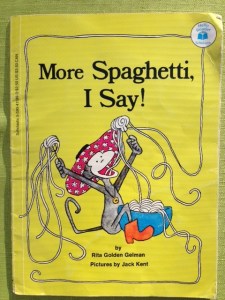
MORE SPAGHETTI, I SAY! by Rita Golden Gelman, illustrated by Jack Kent (Scholastic, 1977).
“Read!” commanded Ashley.
We plunked down on the curb. I opened the cover—and two wires in my brain connected.
It had been *mumble mumble mumble* years since I’d held a copy of this book, but suddenly, I remembered the words before I read them.
I remembered the pictures before I saw them.
And I remembered how they worked together.
Humor. Friendship. Rhythm. Repetition. Brevity. The power of the page turn. The fun satisfaction of a mirror story.
All the elements I try to use in my own writing.
And this was one of the places I’d learned it first.
“Wow,” I whispered.
I couldn’t wait to write that night.
Ashley smiled. “Told you it was good,” she said.
So, awesome writers, as you seek inspiration this month while creating the books of the future, don’t forget to revisit the books of your past, too!
Now if you’ll excuse me, I’m off to get a little writing done before making dinner.
We’re having spaghetti.
Ame Dyckman LOVES picture books. Sometimes she’ll even put them down long enough to write one of her own: BOY + BOT, illustrated by Dan Yaccarino (Knopf; 2012); TEA PARTY RULES, illustrated by K.G. Campbell (Viking; Fall, 2013), WOLFIE AND DOT (working title), illustrator TBD (Little, Brown; TBD).
Ame lives in New Jersey with her family, pets (including a demanding-but-adorable squirrel named Willie) and book collection. Visit Ame at amedyckman.com, or on Twitter @AmeDyckman, where she Tweets “PB book reviews and random goofy thoughts.”

Ame is giving away a signed copy of BOY + BOT plus SWAG—bookmark, sticker, “Affirmative!” bracelet and mini Frisbee! Comment on this post AND complete the challenge to be entered (you’ll be asked to take the “PiBo Pledge” on December 1st to verify you have 30 ideas). A winner will be randomly selected in early December. Good luck!
 In past PiBoIdMo posts, I’ve encouraged you to…
This time around, I want to focus on structure.
Just like houses and dinosaurs, every story needs an underlying framework.


Most of my books follow the Classic Picture Book Structure:
- MC has a problem
- MC faces obstacles that escalate
- MC encounters a black moment in which things can’t possibly get any worse
- MC figures out how to solve the problem
- MC grows/changes by the book’s end
My latest book, PRINCESS IN TRAINING, is an example of this.
Behold!
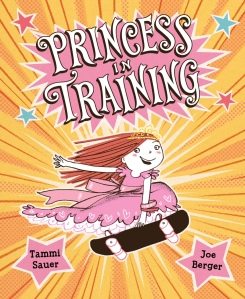
Princess Viola is great at skateboarding and karate-chopping, but she’s lousy at the royal wave, walk, and waltz. The king and queen are not pleased. What’s a princess to do? Attend the skill-polishing Camp Princess, of course. In the end, it’s a good thing Viola is made of tougher stuff. Who else will save the day when a hungry dragon shows up?
This is how the Classic Picture Book Structure works with PRINCESS IN TRAINING:
- Princess Viola Louise Hassenfeffer has a royal problem. She is not an ordinary princess and the kingdom is unhappy about it.
- Princess Viola faces three obstacles at Camp Princess (she is unable to properly master the royal wave, royal fashions, and royal dancing).
- A hungry dragon shows up at Camp Princess.
- Princess Viola uses her unique skill set to save the day.
- Princess Viola may not be an ordinary princess, but she is deemed the darling of her kingdom anyway.
Although the Classic Picture Book Structure is my super-favorite way to frame a story, there are a variety of other options. Below are many of them along with some examples.
Circular:
The story’s ending leads back to the beginning
If You Give a Mouse a Cookie; When a Dragon Moves In
Concept:
The story focuses on a single topic or category
All the World; Kindergarten Rocks; Hello Baby!
Cumulative:
Each time a new event occurs, the previous events in the story are repeated
My Little Sister Ate One Hare; I Know an Old Lady Who Swallowed a Fly
Mirror:
The second half of a story echoes what occurred in the first half of the story
Old Bear and His Cub; Boy + Bot; A Sick Day for Amos McGee
Parallel:
Two storylines are taking place at the same time
The Dog Who Belonged to No One; Meanwhile Back at the Ranch
Reversal:
Character and/or plot is portrayed in a way that is opposite from the norm
Bedtime for Mommy; Children Make Terrible Pets; Little Hoot
This month, I’m challenging myself to come up with at least one story idea for each of those frameworks. C’mon, groovy PiBoIdMo people. Who’s with me?
Tammi Sauer has five picture books debuting in 2012: Me Want Pet!, illustrated by Bob Shea (Paula Wiseman/S&S); Bawk & Roll, illustrated by Dan Santat (Sterling); Oh, Nuts!, illustrated by Dan Krall (Bloomsbury); Princess in Training, illustrated by Joe Berger (Houghton Mifflin Harcourt); The Twelve Days of Christmas in Oklahoma, illustrated by Victoria Hutto (Sterling). She recently sold two books at auction to Houghton Mifflin Harcourt. The idea for one of those books—The Farm that Mac Built—sprang from her 2011 PiBoIdMo Idea List. It has a cumulative structure. Ooh.


And another “ooh” for you: there’s a PRINCESS IN TRAINING prize pack waiting for a lucky PiBoIdMo’er who completes the 30-ideas-in-30-days challenge. Comment on this post AND complete the challenge to be entered (you’ll be asked to take the “PiBo Pledge” on December 1st to verify you have 30 ideas). A winner will be randomly selected in early December. Good luck!
 “NOW SEEDS, START GROWING!”
Frog came running up the path.
“What is all this noise?” he asked.
“My seeds will not grow,” said Toad.
“You are shouting too much,” said Frog. “These poor seeds are afraid to grow.”
“These poor seeds are afraid to grow.” Wait… seeds can be afraid to grow? I didn’t know that. I wonder if that is my problem. Are you talking to me too, Frog? Can stories be afraid to grow, too?
Maybe I am shouting too much: Now ideas, start GROWING—what will the critique buddies think? what will mr. agent, ms. editor think? what will bookstores, kirkus, random readers on goodreads think? what if I never, never have a good idea again? OMG! that really could happen! please, please, ideas—GROW, GROW, GROW!
Help—TOAD—I can’t stop the shouting! Where are you? What would YOU do?
Toad read a long story to his seeds.
All the next day Toad sang songs to his seeds.
And all the next day Toad read poems to his seeds.
And all the next day Toad played music for his seeds.
Then Toad felt very tired, and he fell asleep.
Oh! These all sound like easy things to do… thank you Toad, I will do them! I will read stories and poems and play music. And then maybe I will also look at art, and walk in the woods and stop on the footbridge to play Poohsticks. And then plant things, bake things, make things… make anything but books.

And then finally, I will lie on the couch and stare out the window, until… until there is no more shouting and it is quiet… except for some birds (what’s the gossip today, guys?), and a couple of squirrels (hey, what is the problem out there? stop bickering!), and my cat, Milo, snoring.
I will try all of these things because I have read, and read over many times again, FROG AND TOAD TOGETHER by Arnold Lobel, so I know that in “The Garden”—spoiler alert!!!—once Toad stops shouting, his seeds really do grow in the end. Hopefully, if I’m quiet and patient too, my ideas will stop being afraid to sprout, and if I have a good one—hooray!!—I will jot or sketch it down right away. And then, at last, I can reward myself by taking a lesson from the next chapter of Frog and Toad: “Cookies”.
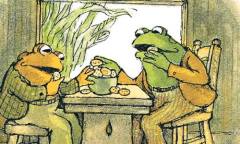 Toad baked some cookies.
“These cookies smell very good,” said Toad.
He ate one.
“And they taste even better…”
Hey, did you have an idea today? Well then, have a cookie! And by the way, what do you do, to coax your ideas to grow?
Once-upon-a-time, Deborah Freedman was an architect, but now she prefers to build worlds in books. She is the author and illustrator of SCRIBBLE and BLUE CHICKEN, and THE STORY OF FISH AND SNAIL, to be published in June 2013, by Viking. Follow her adventures at Writes With Pictures or on Facebook and Twitter @DeborahFreedman.
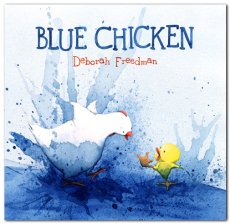 And lucky you, it’s time to win something AGAIN! Deborah is giving away a signed copy of her book BLUE CHICKEN!
Just comment to be entered (one comment per person).
A winner will be randomly selected in one week.
Good luck!
 About two and a half months ago I decided I was going to start running. I had a few reasons for this decision;
- I was getting fat.
- I didn’t feel great about the way I looked.
- I had seen one too many pictures of myself at various author events from weird angles with more than one chin.
So I bought some cheap running shoes and decided to start running when my kids went back to school after summer break. Keep in mind that I’ve never been a runner. Not when I was a kid, not in high school, not ever. I’d see people running down the street and think that they were crazy. Running was never something that wanted to do but I was determined to give it a try.
My kids started school on August 14th and, as planned, I started running. I use the term “running” very loosely here as I was doing more walking than running. I would run as far as I could until my lungs were screaming and my legs were burning and then walk. Run. Walk. Run. Walk. Rinse and repeat. On and on until I had completed thirty minutes. (Around two miles.) At the end of my first run/walk I was pretty sure that I was going to die. My legs were sore and throbbing but I had taken the first step towards a leaner, happier me.
The next day I woke up with sore legs but I still went out running. Run. Walk. Run. Walk. At this point I had no idea that I was supposed to take days off between runs. (This was all new to me.) I was determined to stick to my new goal regardless of the pain. So I hobbled along running and walking for two weeks straight with only the weekends off to rest.
After two weeks of running I reached a point where my legs were super sore. I could barely sleep at night. I knew I needed to take some time off to let my muscles recover. The funny thing is that I didn’t want to take a break. Even with my legs screaming for relief I loved running. I loved being outside listening to the music on my iPod and I felt really great emotionally. I had a deep sense of accomplishment and I was starting to see some results when I got on the scale. But I knew if I wanted to keep running I’d have to take some time off and let my legs recover.
Lucky for my legs I had a six-day book tour of San Francisco the following week. It would be the perfect time for a break.
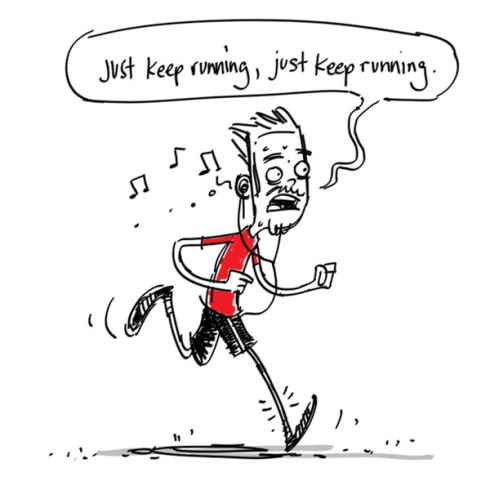
When I returned from San Francisco I jumped right back into running. My legs felt better but it wasn’t long before they began to hurt again. After some online research and talking to friends who run I came to the conclusion that maybe it was my shoes. So I went to my local running store and twenty minutes later I left with the most expensive pair of shoes that I’d ever bought in my life. The salesman said that they would help absorb some of the impact and give my legs more support. The next day I took the shoes out for a test run and they worked. My legs weren’t near as sore as they had been previously. Success!
At this point I’d been at it for about a month. My legs weren’t hurting quite as bad as before but they were still a little sore. I did a little more research and discovered that it’s a good idea to do some cross training between running workouts. So I dusted the cobwebs off my ten-year-old mountain bike and hit the bike trail. Riding my bike between running workouts made a huge deference. It gave my legs a day between runs to recover and I was still able to get in a good workout every day.
I really had no idea what I was doing when I started this whole running thing. I just figured it out as I went. The important thing for me was to just keep at it. To make myself get out of bed every day and either run or bike. It didn’t matter how fast I went, it only mattered that I was doing it everyday or almost every day. I would after all take the occasional day off to rest or to sleep in. I hadn’t completely lost my mind.
The funny thing is that the more I worked out, the better I felt, and the better I felt the further I pushed myself to go. I went from running short spurts and walking, to running three to five miles at a time without stopping. I started biking 18 miles on my bike and I felt amazing. Now, every day I go out and I challenge myself to go a little further or a little faster. I go to bed at night looking forward to getting up the next morning and running or biking. It’s crazy. It’s been two and half months since I started and I feel happier and less stressed than ever before. Oh, and I’ve lost twelve pounds and counting. No more extra chins.
Some of you reading this may be asking yourself at this point, “What does this have to do with writing picture books?” Good question. Here’s the thing, no matter what you want to do in life it all starts by taking a step. A single step.
That step may be taking a class or starting to draw, or in my case starting to run. It can be anything. You just have to take the step. The more steps you take the easier it will get. Along the way you may step in a puddle or two, or get injured (rejected) and that’s okay. Just take some time off to clean yourself up and recoup.
Then when you’re ready, take another step, and another. After a while your steps will get faster and a lot easier, and before you know it you’ll be running. You’ll be pushing yourself to go further and you will be feeling better. You’ll be happier. Who knows, maybe some day you’ll even run a marathon or two. All you have to do is just keep running.
James Burks started out working as an artist in the animation industry for various studios including Disney, Warner Brothers, and Nickelodeon. Projects he has worked on include the Emperor’s New Groove, Atlantis, Treasure Planet, Home on the Range, Space Jam, the Iron Giant and the television shows Wow Wow Wubbzy, Ni-hao Kai-lan, the Dinosaur Train and Fan Boy and Chum Chum.
He currently spends his days taking care of his two kids, running/biking and writing/illustrating his own books. His first graphic novel for kids, GABBY AND GATOR, published by Yen Press, was a Junior Library Guild selection and a 2012 CTA Read Across America title. He also has a picture book with Carolrhoda entitled BEEP AND BAH, a graphic novel with Scholastic/Graphix called BIRD AND SQUIRREL ON THE RUN, and he just finished illustrating a book for Simon & Schuster called THE MONSTORE written by Tara Lazar which will be out in June 2013.

James is giving away a signed digital print of this friendly witch and best friend. It sure is as sweet as Halloween candy!
Just comment to be entered into the drawing (one comment per person).
A winner will be randomly selected in one week.
Good luck!
 I’d like to share with you a little something I’m going to call “the sidle-up effect.” Here’s how it happens.
I’m outside having a picnic with my family, including two rambunctious little boys, E and O. Editor that I am, I’m excited to give them a “haven’t seen you guys in a while” present. It’s a book.
Now, this book happens to be a particular new favorite of mine: THE OBSTINATE PEN by Frank Dormer. However, it’s a beautiful day, we’re in the park, and I’m up against some formidable opponents: scooters, sticks, dirt, and peanut butter & jelly. As you can imagine, despite two extremely polite thank you’s, this gift does not receive the desired effect of elation and awe.
Well, fine. I should have anticipated this. But I still want to show this story a little love. So I sit down and begin to read the book aloud to myself. “Uncle Flood unwrapped his new pen and laid it on the desk…”
Barely perceptibly at first, the effect starts to take effect. First comes the quiet patter of sticks dropping to the ground. Then the faint squeak of scooter wheels coming to a halt. Next, two small figures edge into my peripheral vision. And then, all of the sudden, as I approach the part where the pen sticks to the wheel of Mrs. Norkham Pigeon-Smythe’s automobile, O is in my lap, and E is draped uncomfortably over my shoulders.
We proceed to read the book four more times.
I love enthusiastic young readers as much as the next editor/agent/writer/illustrator/reader/person (and for their mother’s sake, I should add that E and O are among that group—I just caught them on an afternoon ripe with distractions). But if a book promises to both captivate the eager crowd and achieve the sidle-up effect among the more stick-and-dirt-inclined, that book is an automatic winner to me.
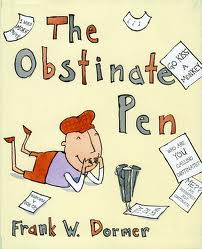 THE OBSTINATE PEN is the perfect example of such a winner because it has something for everyone. It’s wildly creative and uproariously funny. It features dimwitted adults and a shrewd, worldly young hero. And it’s totally unique: it makes me think, “Now how in the world did he come up with that?”
The books that wow editors are the books that bring something new to the table—that wriggle their way into your head so you can’t stop thinking about them for days. You might grab my attention with a real and endearing character; striking, lyrical language; a hilariously honest voice.
Maybe it’s a creative, fiery little girl who brings the spark to a classic tale of friendship, like Kelly DiPucchio’s CRAFTY CHLOE. Or a text so simple, beautiful and poetic that it leaves room for a whole new world to unfold in the illustrations, like Mary Lyn Ray’s STARS (illustrated by Marla Frazee). Or a soft song about eggs filled with so much personality (“I do not like the way you slide, / I do not like your soft inside, / I do not like you lots of ways, / And I could do for many days / Without eggs”) that it sticks with you straight through from childhood to adulthood, like Russell Hoban’s BREAD AND JAM FOR FRANCES. Ok, maybe that last example is a little specific, but you get the gist (it’s one of my all-time favorites).
And maybe it’s because I work in children’s publishing, but in my opinion, there’s nothing in the world that sticks with you like a picture book. Think about your favorite book when you were little. Why do you still remember it? The most special of special characters, voices, stories—they all contribute to this warm little nugget of childhood that you’ll carry around with you forever. You can’t create that by hitching a ride on the big, flashy, commercial, book-selling train of the moment. You create that by pulling your inspiration directly from that spot, by reigniting that spark from your childhood and writing from your heart.
As an editor, I’m looking for a picture book that I want to sidle up to. One that, if you caught me playing with sticks in the park, would have me—well, maybe not in your lap, but at least draped uncomfortably over your shoulders.
Achieve that, and I promise you, those sticks won’t stand a chance.
Emma Ledbetter is an editorial assistant at Atheneum Books for Young Readers, an imprint of Simon & Schuster. She sidles up to picture books, chapter books, and middle grade novels with fresh, sincere voices, humor and heart. Upcoming projects she has edited include THE BACKWARDS BIRTHDAY PARTY, a picture book by John Forster and legendary singer/songwriter Tom Chapin, and the fantastically wacky middle grade novel THE CONTAGIOUS COLORS OF MUMPLEY MIDDLE SCHOOL by Fowler DeWitt. Follow her on Twitter @brdnjamforemma.
Emma will be donating a picture book critique to a lucky PiBoIdMo participant who completes the 30-ideas-in-30-days challenge. A winner will be randomly selected in early December.
 I can’t believe it’s already November! PiBoIdMo, 12X12 and Picture Book Month are all in full swing, proving that the venerable picture book has merit and value. It is because of because of you, writers and lovers of picture books, that we have reason to celebrate! So I begin this post with a thank you. Thank you for your passion and commitment to picture books.
Now on to the subject of my post. The Space Between. It sounds like some ethereal place that might exist in a Lois Lowry book but it is a very real place that exists, especially in picture books. Joe Wos, a friend who is a cartoonist and curator of the Toonseum in Pittsburgh, Pennsyvania, once taught me about “the space between” in comic strips. It’s that blank space that exists in between each comic box. What is so important about The Space Between are not the words before and after it, but the words and actions that are left unsaid.
I thought about it. As writers, we all rely on The Space Between without even realizing it. In novels, you’ll see two passages divided by a set of asterisks. The moment you see it, you know moments, actions, and words have passed, all shrouded in The Space Between. The writer leaves it up to you to decipher what happens between one scene and the next. The device is also used in movies. Movement from scene to scene relies on The Space Between to create a smooth transition.
So how does this fit into writing picture books? For picture book writers, The Space Between is the page turn. It is the breath or the pause between pages. It can be dramatic and full of suspense, ushering the next bit of action in the book. Eric Litwin’s New York Times best-selling book, Pete the Cat does this so brilliantly that listening audiences automatically chime in the answer when the page is turned.
The Space Between can also be subtle and gentle. In the nearly wordless picture book, Goodnight Gorilla by Peggy Rathman, the device is used ingeniously. The Space Betweeen becomes the thread that ties every scene together, creating a story so seamless, you don’t even notice what is not shown. On one page, the zookeeper’s wife wakes up. On the next page, she is on the lawn, walking the animals back to the zoo. What happens in between needs no explication.
The Space Between can also be intentional. Stories that are poems have a natural break between stanzas such as those in Dr. Seuss books. In the book, Z is for Moose by Kelly Bingham and illustrated by Paul O. Zelinsky, The Space Between is used to create deliberate tension. Moose vies for a spot in the alphabet and Zebra is the referee trying to corral Moose and keep him from ruining the procession of letters. At one point, Zebra says, “No! Now, move off the page.” The page turn reveals whether or not Moose moves and what his next antics might be.
The next time you are reading or writing a picture book, think about The Space Between. Think about the words and actions you commit to paper as well as the ones you don’t. Think about that pause, the breath that is the page turn. What does your “space between” say?

November is Picture Book Month!
Read * Share * Celebrate!
 Dianne de Las Casas is an award-winning author, storyteller, and founder of Picture Book Month, who tours internationally presenting author visit/storytelling programs, educator/librarian training, and workshops. Her performances, dubbed “revved-up storytelling” are full of energetic audience participation. The author of twenty books, her children’s titles include The Cajun Cornbread Boy, Madame Poulet & Monsieur Roach, Mama’s Bayou, The Gigantic Sweet Potato, There’s a Dragon in the Library, The House That Witchy Built, Blue Frog: The Legend of Chocolate, Dinosaur Mardi Gras, Beware, Beware of the Big Bad Bear, and The Little “Read” Hen. Visit her website at diannedelascasas.com. Visit Picture Book Month at picturebookmonth.com.
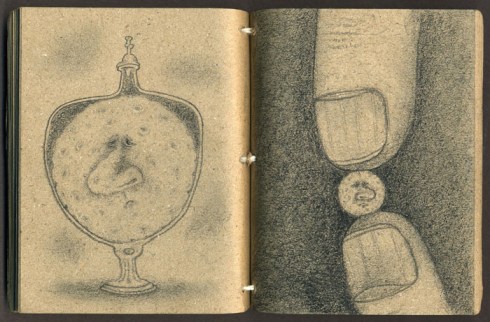
For me, it all starts with accepting the sad truth that I have no idea what I’m doing. I’ve published a handful of books over an armload of years and I still haven’t a clue how to write or draw anything approximating a viable picture book. None. When you’re as lost as me, a step in any direction is a total stab in the dark.
The second thing I try to remember after accepting being completely lost is that, much to my eternal chagrin, I will never write or draw like William Steig or Arnold Lobel or Esphyr Slobodkina or Rosemary Wells or Leo Lionni or Tove Jansson or Roger Duvoisin or Lane Smith or Ellen Raskin or you or my six-year-old daughter or anyone. Trying to write or draw like someone else makes me feel not only lost, but hopelessly lost. Hopelessly lost is the worst kind of lost.
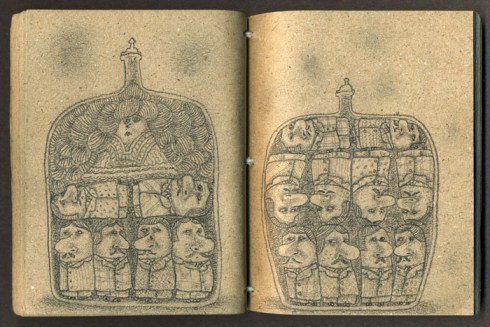
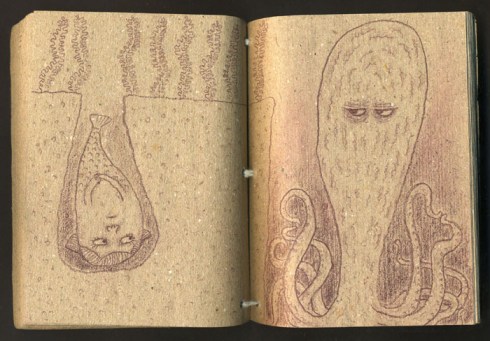
When I’ve dispensed with the formalities of pretending to know what I’m doing or that I will ever successfully pull off being anyone other than me, I take out my pencils and a current favorite pad and let the only brain I will ever have tell me what it’s thinking. It has been chewing over bottles for years. And people in bottles. And mulling over hairdos of late. And mustaches. And mermaids with mustaches and hairdos. And seaweed. And tubeworms. And coral. And deep-sea hydrothermal vents. I have no idea how to draw deep-sea hydrothermal vents. And sunken treasure chests. And gumball machines. And balloon vendors. And people with no arms who don’t seem to care that they have no arms because they are stuck in bottles. And that we never have enough cookies in the house. Or enough batteries. Cookies and batteries and toilet paper should just regenerate themselves before you’ve had the misfortune to realize you’re out of them….but they never do, do they?
It’s generally easier to see when someone else is lost. Or when someone else is trying to write or draw like someone other than themselves. Or when someone else is having fun. It is harder to see yourself having fun because the very act of seeing yourself do so takes you out of the experience of having the fun you were having before you went ahead and ruined it by having a meta moment about what you were doing. Which is no longer having fun. It is thinking about having fun. Which is not as fun…no matter what you think. It just isn’t.
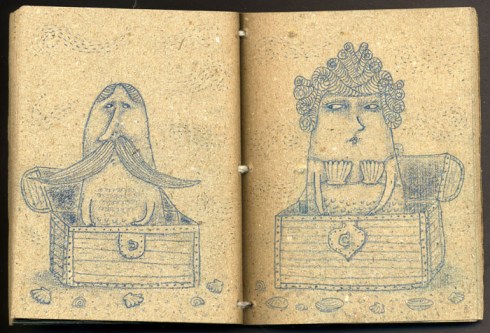
For me, the key to embracing my lostness, in the not-hopeless fun-having way I try to embrace being lost, is by trying to be present. What does that mean? I’m not entirely sure. It think it feels like not worrying about which direction I’m going because there is nowhere else but here. Where the skin ends and the scales start or a tail now curves or shells start gathering on the sea floor. It feels like not worrying about being as funny or wise or poetic or brave or dexterous as anyone else. It means not realizing that the last Oreo disappearing in my greedy maw at this very moment is the very last delicious thing in the ENTIRE HOUSE.
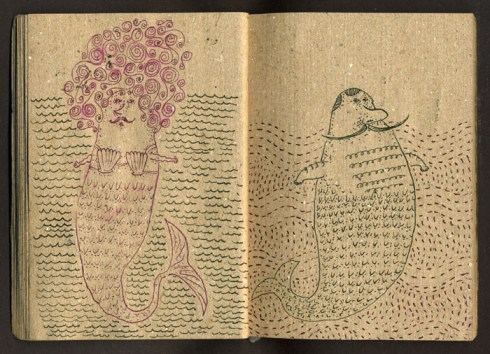
It doesn’t matter. I’m drawing scalloped-shell mermaid brassieres. Or merrily tracing chest hair. Or bottling the moon. Or realizing I can also draw with the green fountain pen I’ve previously been afraid to use. Even the red one. Yes…THE RED ONE! There is no one telling me I can’t use the green or red pens other than me, is there? They’re my pens for god’s sake. When was a “Pencils Only Rule” ever voted in as a Constitutional Amendment? There is no federal mandate forcing me to draw my characters in profile either (wait…there isn’t?). And congress has yet to make me learn foreshortening. Or write about things I don’t want to draw in profile…or foreshorten.
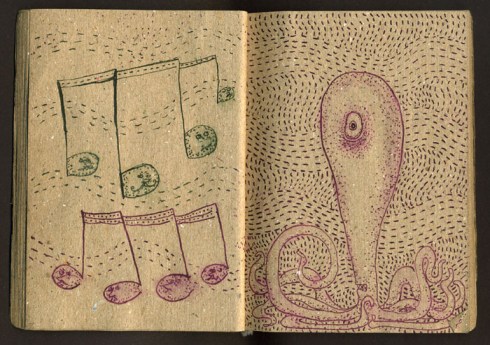
Life, Liberty and the Pursuit of Front-View Happiness! Woo hoo. Look at me. No hands. No clue where I’m going. I’ve got all of later today and tomorrow and the rest of my life to work up a healthy froth over not knowing how the heck I’m going to turn anyof this flotsam into a book or that the flashlight in the “emergency drawer” doesn’t work. Right now not even Theodore Geisel could be having more fun than me.
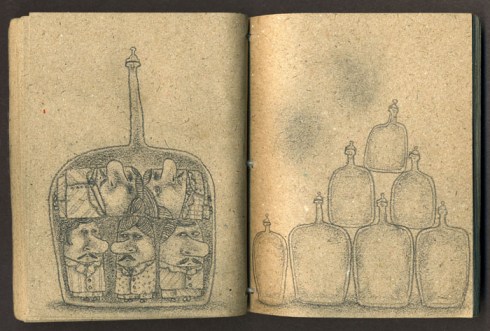
Fun…and regenerative toilet paper…and C batteries… and fresh Oreos… and mermaid bras… and chest hair… that’s just what the doctor ordered!
There are much more potent prescriptions out there. I’ve read them here on PiBoIdMo. It’s sick how smart and generous and talented you people are. And by sick I mean inspiring. I may be incurably lost, but I know enough to leave the dispensing of real medical advice to those of you who actually know what you’re doing. I’m a fruit-flavored chewable guy. If it tastes too bitter going down, I can’t ask you to swallow it either.
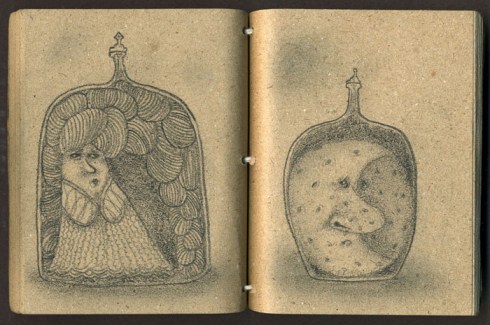
Learn more about the inexplicably incomparable (Tara’s description) Robert Weinstock and his books (like I’M NOT and FOOD HATES YOU, TOO!) at his website, CallMeBob.com.
 I have always been competitive. Maybe it’s because I have 4 sisters and 2 brothers, which meant we did things like thumb-wrestle to see who would get the last bowl of Sunday Cereal…or battle it out in Easter Day relay races that required rolling eggs across the carpet with our noses. Or maybe it’s because my parents fell in love on the basketball court, where everyone said that if Patty really liked Harold, she would let him win. Well, she really did like him. Forty-years-together-and-counting-kind-of-liked-him. But she didn’t let him win. So I guess you could say it’s in my blood.
Is it any wonder then that I jumped at the chance to be a part of PiBoIdMo when I first heard about it in 2010? A challenge, you say? 30 ideas in 30 days, you say? Sounds hard. I’m in!
Know what else sounds hard? Marathons. Lucky for me, November is a month chock-full of ‘em, and I’ve got a husband who likes to run ‘em. (I’ve run a half-marathon, and that was hard enough for me, thank you very much!) So when November 5, 2010 rolled around, this is the idea I wrote down:
Marathon Mouse. Story of a mouse who lives in NYC right under the start line and decides that it is his life’s dream to participate in the NYC marathon.
What I quickly figured out about PiBoIdMo was that it wasn’t necessarily coming up with the ideas that was the hard part. But the sifting and sorting of ideas to figure out which were studs and which were duds??? That was the tough part. Once the challenge was over, I tried writing a couple of other stories first…ones that I deemed more commercial, more worthy of an agent’s or editor’s attention. But I soon realized that the story I really wanted to write was the one about the marathon. In the 2 years since my husband had taken up distance running, I had been in search of a picture book about the sport that I could share with my children. I was looking for something that reflected the early mornings, the intense training, and the roadside cheering that was now a part of our family culture. And I couldn’t find one, because one didn’t exist.
 So I wrote it.
And I liked it.
It travelled with me to my critique group, as well as to our regional SCBWI conference. And it was there that I first heard the objection that followed this manuscript around for quite some time: “…but kids don’t run marathons!” Okay, fair point. Kids don’t run marathons.
BUT.
Anyone who has ever been to a marathon knows that you will find yourself absolutely, without exception, knee-deep in kids…walking the course, holding cherished homemade signs, and searching the crowds of runners, hoping to catch a glimpse of their mom or dad, aunt or grandpa, teacher or friend. Kids may not run marathons, but they are an ever-present part of the running community. And that was the reason that I persevered through 26.2 miles of discouragement, and believed in my story.
Mercifully, there was an editor out there from Sky Pony Press who believed in my story too. And now I have had the wonderful privilege of experiencing my children’s delight as they turn the pages of Marathon Mouse…because, although they have never actually run a marathon, it is in those pages that they see their experiences reflected. And they love it.
Write the stories that you want to write. As the ideas fly off your fingertips and onto that spreadsheet this November, make note of the ones that spark something in your heart. They may not always be the obvious choices. They may not always scream commercial appeal. But one of them just might be the story you were meant to write.
And now if you’ll excuse me, it’s day one of PiBoIdMo, and I’ve got an idea for a story about a girl named Patty…and a boy named Harold…and the jump shot that launched an unending love…
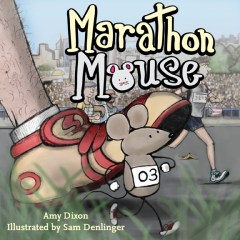 Amy Dixon grew up as one of seven siblings, so the only peace and quiet she ever got was inside a book. Once she had her own kids, she rediscovered her love for picture books at the public library. It was the one place she knew all four of her kids would be happy . . . and quiet. She writes from her home, where she lives with her four little inspirations and her marathon-running husband, Rob. Check her out at amydixonbooks.com.
 Everyone has their own notion of what a picture book is. Lots of illustrations, lots of color. And, of course, lots of smiling happy kids reading (usually in front of a fireplace on a snowy winter afternoon, drinking hot chocolate while the chocolate lab snores…ok, maybe that’s just me).
Scary and creepy? Not so much.
But, as today is Halloween, it’s time to look at the darker side of the picture book. Amazon has 369 results for ‘scary picture book’ with 35 of them rated for ages 0-2. Yes, 0-2! Another 169 are for ages 3-5. Picture books! Scary ones! Now, of course, the scares aren’t quite what you’ll find for an older reader but everything from monsters (THE MONSTORE, for example…with a tip of the blogging cap to my host, Tara Lazar) to ghosts (A VERY SCARY GHOST STORY) and even mummies (Yes, mummies: WHERE’S MY MUMMY?) have been appearing in picture books for decades now and it’s long past time to appreciate the scary and creepy!
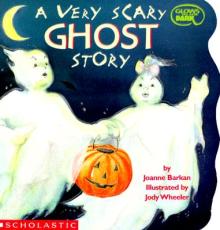
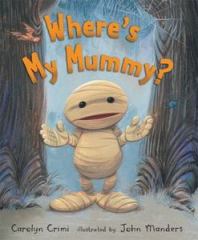
Hopefully no one is now picturing Twilight For Toddlers (I’d trademark that but…no) but there is, indeed, a market for picture books that may not be as light and fluffy as the rest. With 30 days in the upcoming PiBoIdMo, you might want to spend a day or two brainstorming towards the darker end of the spectrum. The goal of the creepier picture books obviously isn’t to scare a child, but to introduce them to the shadows in a fun, friendly way, making the frightening familiar and, therefore, safe.
Spend a day of PiBoIdMo remembering your own childhood, those nights when the last thing you did at night was to ask your mom or dad to leave the hall light on, or to lay down with you for a moment or two, or to look in the closet or under the bed in a ritual game to drive away the monsters. Those are memories that generations share, we all were children once, wanting that light on…and, as we read to our own children, we share those moments with them so that they’ll have similar memories.
Writing a scary or creepy picture book for children is much like that hall light, scaring away the monsters under the bed or the ghosts in the attic or the witch in the closet with pictures and words. For the next 30 days, as you try to generate ideas for PiBoIdMo, don’t be afraid of the shadows, instead use them to create puppets on the walls of your imagination…the world needs more scary and creepy picture books.
No sparkly vampires, please. Well, actually, now that I think about it…
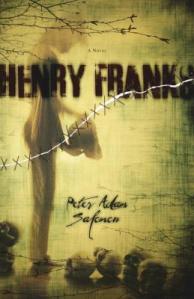 Peter Adam Salomon graduated Emory University in Atlanta, GA with a BA in Theater and Film Studies in 1989.
He has served on the Executive Committee of the Boston and New Orleans chapters of Mensa as the Editor of their monthly newsletters and was also a Judge for the 2006 Savannah Children’s Book Festival Young Writer’s Contest. He is a member of the Society of Children’s Book Writers and Illustrators, the Horror Writers Association and The Authors Guild and is represented by the Erin Murphy Literary Agency. His debut novel, HENRY FRANKS, was published by Flux in September 2012.
Peter lives in Chapel Hill, NC with his wife Anna and their three sons: André Logan, Joshua Kyle and Adin Jeremy.
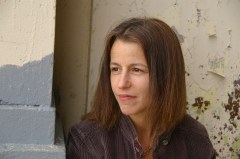 I started writing for kids over a decade ago and soon started meeting other people who also wrote for kids. When they talked about how they had so many ideas and not enough time to write them all, I secretly wished I could pinch them. A really mean pinch—a tiny bit of skin squeezed and twisted brutally between thumb and forefinger, the kind of pinch my sisters and I used to give each other when we were furious.
Too many ideas was not the kind of problem I had. I didn’t have enough.
A decade later, I’ve learned that picture book ideas come to me when I’m supposed to be working on a novel. I’m proud of my subconscious for being so clever. In the past few months, when I was supposed to be toiling on a middle-grade novel, I’ve written drafts of three picture books.
 Two were from PiBoIdMo 2011 ideas. The one I finished, FIRST GRADE DROPOUT, went out on submission and sold in two days. That’s a first for me—a quick sale. My PiBoIdMo success story.
If you felt like you were moving well beyond your comfort zone when you signed up for PiBoIdMo 2012, please know that you are not alone. I’m not very good at public writing events. I don’t generally participate in such things—my process is more private-feeling and works on its own clock. But last year I decided to give it a try. In the end, I really liked the way PiBoIdMo pushed out the walls to provide a bigger creative space for me.
And if, in the early days of November, you find yourself worrying about how lame your ideas are or how you have no idea how to get from that idea to a finished manuscript, take heart. It took time for my PiBoIdMo ideas to marinate. If I had started writing FIRST GRADE DROPOUT immediately after jotting down the idea last November, it would have been awful. My PiBoIdMo idea was, I now know, more like half an idea. It was what happened in the book. It took nine months of my brain silently working away to figure out how to tell that story. In this particular case, the how was more important than the what. (I’d tell you all right now, but that would be giving away the punch line years ahead of pub date.)
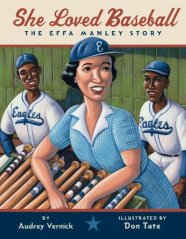 I’m participating again this year, even though I’m supposedly hard at work on finishing up this novel. PiBoIdMo still scares me. I just know that on one (or more) of those days, when I can’t think of anything new, I’m likely to steal from myself to pad out the list—dig up old ideas that didn’t work to give them some new attention. (I did this last year. Shhhh. Don’t tell Tara.)
But on those days when I run into a writer who has so many ideas and not nearly enough time, well, it’ll be nice to think of my overstuffed PiBoIdMo file. I won’t gloat though, as that’s just awful for those suffering through an idea drought. And I really hate being pinched.
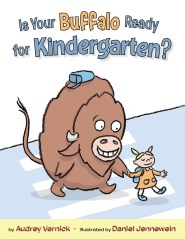
Audrey Vernick is the author of six picture books, including IS YOUR BUFFALO READY FOR KINDERGARTEN?; SO YOU WANT TO BE A ROCKSTAR; and BROTHERS AT BAT; as well as the middle-grade novel WATER BALLOON. Her next picture book, out in June, is BOGART AND VINNIE: A Completely Made-Up Story of True Friendship, with EDGAR’S SECOND WORD following after that. A two-time recipient of the New Jersey Council of the Arts Fiction Fellowship, Audrey lives in a house full of inspiration: one husband, one son, one daughter, and two dogs. She blogs about writing buddies at Literary Friendships.





 Writing for Kids (While Raising Them)