You are currently browsing Tara Lazar’s articles.
Congratulations to the 444 PiBoIdMo participants who completed the 30-ideas-in-30-days challenge! (That’s about 59.2% of you!) You’ve soldiered through a month stuffed with superstorms, turkeys and Black Friday to emerge triumphant!
So the moment has arrived—the GRAND PRIZE WINNER announcement. Four lucky winners will be paired with a kidlit agent who will review your FIVE best picture book ideas. You are encouraged to write your five best ideas up like jacket copy or a marketing pitch, a short paragraph for each story. You will have until December 10th to do so, so get right on this!
You will receive an email from me with further instructions. If you do not receive this email by midnight tonight, please contact me and I will resend.
So without further ado…
.
Congratulations, CAROL BREEDLOVE!
You’ve been paired with Ammi-Joan Paquette of Erin Murphy Literary Agency.
.
Hooray for LISA SCHNELL!
You’ve been paired with Teresa Kietlinski Dikun of Prospect Agency.
.
Squee, SUE FRYE!
You’ve been paired with Susan Hawk of The Bent Agency.
.
Confetti and donuts, KATHY CORNELL BERMAN!
You’ve been paired with Marietta B. Zacker of Nancy Gallt Literary Agency.
.
If you didn’t win one of the grand prizes, don’t worry! There are more winners to be announced on December 9th and 10th, including all of the prizes announced during the daily guest posts. They include signed books, original art, and picture book critiques.
And remember, everyone’s a winner because you have at least 30 ideas—some of which will no doubt become manuscripts. Those manuscripts WILL land some of you agents and yet others publishing deals. So get ready for a fantastic year ahead! I am sure that 2013 will bring us more PiBoIdMo success stories than ever!
Once again, THANK YOU for participating. I couldn’t do this without the enthusiasm of the kidlit community. The camaraderie of this group continues on Facebook, so if you never joined our community there, do so today. We’ll continue to chat about ideas and picture book writing through to PiBoIdMo 2013!
Plus, we still have a couple more days of Post-PiBoIdMo…
 Congratulations, writers!
Thirty picture book ideas is a lot.
A Costco-size lot.
Plenty to wrap up this year with satisfaction and kick off the new year with energy, inspiration and confidence.
But, why stop at plenty?
Go ahead and multiply that 30 by at least three.
I’m serious!
Because here’s a best kept secret: Ideas are expansive, not limited.
Each idea you spun over the month of November is now fodder for a story told in 1st person or a story told in 3rd, a story told in past tense or a story told in present. Each idea might play out in a story told in rhyme or a story told in prose, a fictionalized piece or one that is God’s honest truth through and through.
Our picture book ideas don’t come with a set of parameters we must follow-or-else. Instead, they come with a set of possibilities that are ours to play with. Sometimes, when a first or second or fourth draft of a manuscript kind of sucks, we make the mistake of thinking the idea sucks. And that’s that. Out it goes with the trash, never to be seen again. But really, it’s entirely possible that it just needs to be told in a different way, poured into a new shape, unwound with new language.
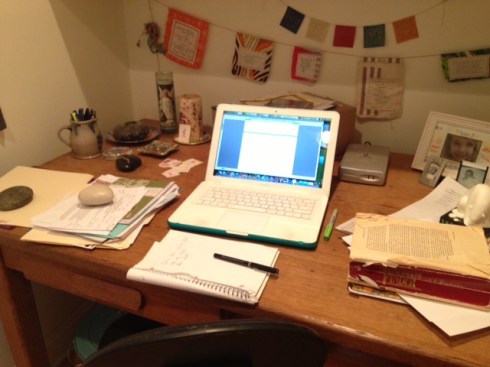
My messy desk where I write gadzillion versions of everything!
I’ve rescued more than a couple of apparent flops by telling the story from a different point-of-view, or pulling it out of rhyme, or changing the tense. And the beauty of picture book manuscripts? They’re short enough that you can try all of these variations of shape and style without aging yourself by years.
So carry on, you powerhouses with 90-some ideas at hand. They should keep you good and busy for awhile…
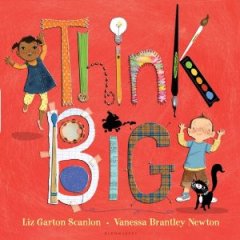 Liz Garton Scanlon is the author of the highly-acclaimed, Caldecott-honored picture book ALL THE WORLD, illustrated by Marla Frazee, as well as NOODLE & LOU, illustrated by Arthur Howard, A SOCK IS A POCKET FOR YOUR TOES, illustrated by Robin Preiss Glasser, and THINK BIG, illustrated by Vanessa Newton. HAPPY BIRTHDAY, BUNNY, illustrated by Stephanie Graegin, will be released on January 15, 2013. Liz is an assistant professor of creative writing at Austin Community College and the mother of two daughters. To learn more, visit her web site at LizGartonScanlon.com.
 So, my fellow PiBoIdMo participants, by now you have a list of tantalizing picture book ideas practically bursting off the page (or screen if you keep them on a computer). What to do?
Here is a novel idea. How about if you select your favorite ideas and write some picture book drafts? Get some of those ideas out of your head so they can one day be out into the world.
It seems like it would be easy to write loads of PBs now that you have that list of ideas, but it isn’t—especially if you go it alone. I know because last year at this very time, I was looking at my list of ideas from the 2010 PiBoIdMo and realized I had only written one manuscript from that list in 2011. How could that be possible?
There were two things missing for me: motivation and accountability. The community (from PiBoIdMo) was there, but I feared we’d all disperse to the four winds after November. So I got this crazy idea to challenge myself to write one picture book draft a month for each month of the year in 2012 and decided to invite people to join me. Thus 12 x 12 in 2012 was born.
I had no idea then that 400+ picture book writers would come together in this common mission, nor that we would become the tight-knit community we are today. I expected to run it casually for one year and then move on.
But I can’t end 12 x 12 after one year.
Because 12 x 12 doesn’t belong to me—it’s for everyone who loves picture books, wants to write them, and needs a cheering section for both the good times and the bad times. It’s to give writers, who have burning questions in the middle of the day and need an answer RIGHT NOW, a place to turn and to learn. It’s become more than a writing challenge. It’s a global family of writers who have the pluck to write in what could be the most challenging genre on earth.
My friend and fellow 12 x 12’er Tim McCanna recently made this phenomenal video to promote the challenge. His opening lyrics are thus:
So you wanna be a picture book writer?
Then ya gotta write picture books. (Well, duh!)
And yer gonna need a bucket load o’ bright ideas
For titles, plots and hooks.
Thanks to Tara and PiBoIdMo, you’ve got your bucket load of bright ideas. Are you ready to try to write a draft every month in 2013? Registration won’t open until next week, but you can sign up for the 12 x 12 mailing list so you’ll be ready when it does. In 2013 there will be three participation levels to choose from, including one that will enable participants with completed, polished manuscripts to submit to an agent or editor each month.
So, did I write 12 picture book drafts this year? No, I didn’t, but I did write 6 so far and there are still 3 weeks left in December! I’m not very good at math, but already that’s 5 more than I wrote last year. Plus, I completed major revisions on existing manuscripts and even got a publishing contract for one of them. So I am very pleased with my results. If you read some of the testimonials from other participants, I think you’ll see that they’re happy with their results too.
I hope to welcome many of you who completed PiBoIdMo into 12 x 12 in 2013. We are a friendly bunch, and we’re all in this together!
Thanks again to Tara for being the inspiration, not just for PiBoIdMo, but also for 12 x 12. The picture book community continues to grow and thrive as a result of her generosity and hard work.
Julie is generously giving away a FREE “Little GOLDen Book Level” membership in 12×12 for 2013, which includes, among many other features and benefits, the chance to submit to an agent or editor each month and bypass the slush pile! A winner will be selected from those who have commented on this post *and* completed the challenge. The winner will be chosen next week. Good luck!
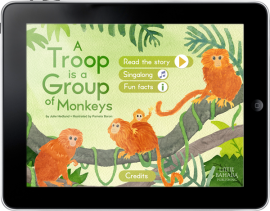 Julie Hedlund is a Picture Book author and Freelance Writer. Her first book, A TROOP IS A GROUP OF MONKEYS, will be released as an interactive storybook app for the iPad in December 2012 by Little Bahalia Publishing. Julie is the founder and host of the 12 x 12 in 2012 picture book writing challenge, a monthly contributor on Katie Davis’ Brain Burps About Books podcast, and the creator of Julie Hedlund’s Template for Storybook App Proposals. Julie will fulfill a lifelong dream in 2013 by leading the first annual Writer’s Renaissance retreat in Florence, Italy.
 When I was a child, I had a reoccurring nightmare. I was on a field trip with my third grade class in a large grassy area with a huge tree in the middle. All the kids were following the teacher across the field and under the shade of the tree. I wasn’t a very popular child, and I was in the tail end of the line.
As I passed under the shadow of the tree, I noticed a large hole in its roots. At that moment a fierce bunny sprang out of the hole and grabbed me, pulling me down into the hole with it. I tried to call out but to my dismay my voice had gone silent.
Needless to say I woke up in tears and a cold sweat.
I still have dreams where I’ve lost my voice. Words fail me.
What a terrible place for a storyteller to find herself.
I’ve never considered myself a writer or a wordsmith. I do love words though. Their history, the way they sound, how when strung together in an organized fashion they can open up the universe to those who read them. So when I approach a picture book, I see pictures first. I write down what I see. Then comes the hard part of making the words sing. Because that’s what words in a picture book need to do.
 You’ve stuck it through November and have a list of 30 ideas. If you have lists like mine, most of the ideas are stinkers. I’ve been doing PiBoIdMo for more than a few years now, and I do see recurrent themes on my lists. Maybe you also have repetitive ideas on your list. No matter. We’re storytellers. Take those ideas and get visual!
As an artist, I work on picture and text together, creating a dummy. Even if you aren’t a professional illustrator, you can use the framework of the dummy to really make your story shine. And your words sing.
For several years at #kidlitart, with my co-host Bonnie Adamson, we held the Picture Book Dummy Challenge. A lot of the people participating came directly from Tara’s PiBoIdMo. (#Kidlitart chat is on hiatus until Bonnie and I have more time to devote to it again. We’re both busy making lots of dummies!)
A picture book is a partnership of words and images. As word counts drop, the illustrations have to carry more of the story, and things like page turn in the text have to be concise.
This is where a dummy becomes a most excellent tool.
A dummy will tell you if:
- Your story is strong enough to carry through a 32-page book.
Since word counts have been dropping over the last decade to close to 500 and sometimes even less, it is hard to tell if you have a book on your hands (as opposed to a magazine story.) When a manuscript is laid out in a dummy you have visual clues to show you where your story needs more action, drama or dialogue.
- There are enough action scenes for 15-20 images.
An illustrator’s job is to take your manuscript and enhance the story you have written. If you only have a few scenes, this will be downright challenging. Think about your favorite picture books. Does the character move through time and space from the beginning of the book to the end? Or does the character stay in the same place for the length of the story? When a manuscript is laid out in a dummy you have visual clues to show you scene changes. There need to be scene changes.
- The page turns (or the breaks between action) are interesting enough to keep the reader moving to the next page.
In novels there are chapters. Usually the end of the chapter is written in such a way that you want to keep reading. There could be a cliffhanger or some sense of tension in that chapter end. Whatever it is, you feel compelled to get to the next chapter and find out what happens. You care what happens. You can’t wait to find out what happens. When a manuscript is laid in a dummy you get visual clues on your “chapter endings” to show if your page turns will propel the story forward.
- There is too much visual description in your text.
Five hundred words is not a lot to tell a story with a beginning, middle and end; to include a story arc and achieve character growth. The last thing you want to do is talk about red hair and green eyes, or blue sky and orange sunlight. Leave that to the illustrator. Save your words for things that can’t be seen. When a manuscript is laid out in dummy you get visual clues on your descriptions. Are you using precious word count to describe something seen?
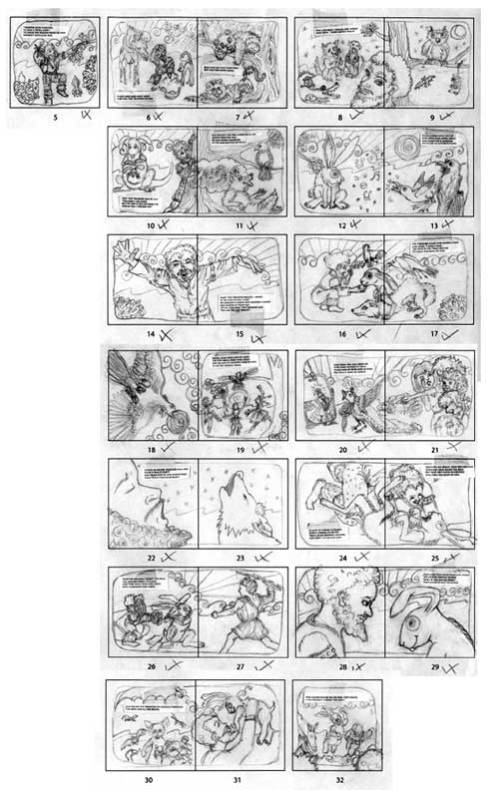
All my books start as tiny scribbles. Even if you’re not an artist, you can scribble your ideas down, can’t you?
Here is the thumbnail layout for one of my books, RABBIT’S SONG by S.J. Tucker.
I also refer you to Tara’s post on picture book dummies (which Tara says is the most popular page on her site, so you know it’s an important tool!).
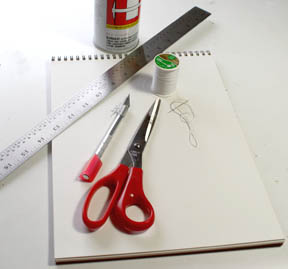
Once you have your scribbles down, you can make a little booklet. It never ceases to amaze me what a difference having a physical dummy makes in visualizing where your manuscript needs some attention.
 I’ll be giving a way a copy of my e-book “How to Make a Picture Book Dummy in 9 Easy Steps” to one lucky commenter. So let me know how you plan to take your 30 ideas and make them into amazing stories! A winner will be selected in one week. Good luck!
.
A transplanted New Yorker now living in Missouri, Wendy Martin has been working as an illustrator for 25+ years. She earned a degree in Fashion Design from the Fashion Institute of Technology, then continued her art education at the School of Visual Arts with a B.F.A. in Graphic Design. After her move to Missouri in 2000, she turned her focus to her true love, children’s books. AN ORDINARY GIRL, A MAGICAL CHILD, a children’s book she both wrote and illustrated, was released in 2005. The book was picked up by a new house, edited and re-released in 2008, then went on to become a finalist in the 2009 international COVR awards. Four additional picture books and a coloring book quickly followed. Visit her on the web at WendyMartinIllustration.com.
 There’s a little stinker that sneaks into my life sometimes and hangs out in the corner of my mind, stealing my creativity.
And now that PiBoIdMo has provided amazing inspiration for finding fresh ideas and coaxing them into stories, I feel him lurking there again, trying to distract me from taking the next step.
He’s a clever thief and shape-shifter, and sometimes his name even changes.
On any given day, his name could be …errands, laundry, dishes, email, internet, TV, kid-activity-shuttle, homework monitor, gift buyer, holiday decorating, volunteering, car repair, home repair, toddlers, dinner, dog walking, Twitter, Facebook, Pinterest…
But the name that most people know him by is:
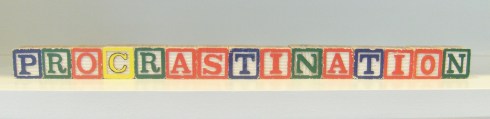
And if Procrastination is constantly lurking in the corners of your creative place too, I hope to help you block him out!
I think of Procrastination as my time thief. He poses as life’s daily minutia, unexpected interruptions and distractions, and the multitude of excuses that feel like they are “Must-Dos-Right-Now.” He will keep you from continuing on your story journey… if you let him.
The trick is…not to let him. But how? How do you fit consistent writing time into your daily life?
I’d like to pass along a few tips to keep your creative mojo fresh, and hopefully, Procrastination-free.
1. Attitude and Expectations
I once heard a wonderful author compare life’s interruptions to a game of “Whac-A-Mole.”
Great description! And as I thought about it, I discovered that I was waiting for a time in my life when those moles would keep to their hidey-holes, and provide me with some free time to write. But as Dr. Seuss says, The Waiting Place is “a most useless place.”
Once I tweaked my expectations and attitude about life’s craziness, I stopped making its ups and downs my excuse not to write. Decide to make time to write. You’ll be amazed at the joy it brings and how your stories start coming together in ways you never imagined.
2. Track Where Your Time Goes
This is an interesting experiment: For 2-3 days, keep a log of what you do. Jot it down every hour. Then examine where most of your time is going. Is it going towards something worthwhile? Is it something that you value or will be glad you did a year from now? Are there moments when you could let go of a little web surfing, Facebooking, volunteering, etc. to schedule some time to grow your stories?
3. Goals and Rewards
Writing a complete story can seem overwhelming, which is sure to make Procrastination come calling. Break it down by listing small goals to work towards each day.
- Today I’ll write about or draw possible characters. I’ll ask them questions.
- Tomorrow I’ll write or draw potential actions and obstacles.
- The next day I’ll play with fun word combinations, etc.
Once your daily writing goal is finished, your sense of accomplishment will be a real motivator! But you might consider a reward as well – your favorite recorded show, some Facebook time, chocolate, coffee…
I like to make a pact with myself that I cannot have my “reward” UNTIL I have finished my daily goal. For example, I am not going to eat that delicious snack-sized Snickers bar until I finish working on the next two stanzas of my rhyming picture book. I know it may sound a bit crazy or like I have “parenting issues” with myself. But it really does work for me. Try it – it might work for you too.
4. Schedule Writing Time
Take yourself seriously. You are a writer/ illustrator. Ask your family for the time and space you need to pursue your stories.
Then SCHEDULE time for your writing. Put it on the calendar and honor it like you would a doctor’s appointment. Turn off the email, internet, TV, and phone if possible.
Before my children were in school, I hired a babysitter once a week for a block of time, and went to Panera to write. It was a delicious, productive time—and my first book, THE GINGERBREAD MAN LOOSE IN THE SCHOOL, was written there. Panera holds a special place in my heart, as it was also the place where I received the email from GP Putnam’s Sons expressing interest in my story. Woo-Hoo!
But Panera also brings me to the 5th tip:
5. Go Somewhere Else to Write
If I am not making progress on my stories, it is usually a sign that I need to get away from all the little things that Procrastination tempts me to do. He rarely follows me into that corner booth of a coffee house, if all I bring with me are my ideas, a notebook, and my favorite writing pen.
I’ll leave you with a quote from From the Mixed up Files of Mrs. Basil E. Frankweiler by E.L. Konigsburg:
“Ideas drift like clouds in an undecided breeze,
taking first this direction and then that.”
Help your lovely, drifting ideas tell you which direction they’re going, by giving them the time they deserve (and not letting that sneaky thief whisk it away.
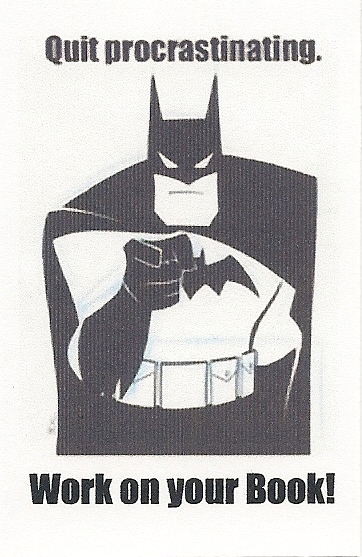
And speaking of thievery, I couldn’t help but “borrow” this cartoon from Facebook for my office cork board. It makes me laugh each time I look at it, but it’s also a good reminder.
.
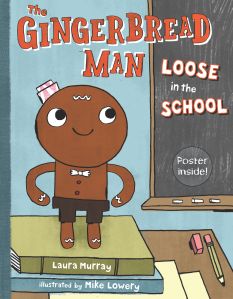 Laura Murray is a children’s author, former teacher, and mom of three mischief makers. Her rhyming picture book, THE GINGERBREAD MAN LOOSE IN THE SCHOOL (GP Putnam’s Sons, July 2011), received a starred ALA Booklist review, was chosen as Washington State, Florida, and Kentucky Children’s Choice Book Award Nominee, and has inspired a forthcoming sequel entitled THE GINGERBREAD MAN LOOSE ON THE FIRE TRUCK! (GP Putnam’s Sons, July 2013). She loves writing picture books with funny, mischievous characters, and middle grade adventure/mysteries. Please visit her online for printables and teacher’s guides at LauraMurrayBooks.com.
Check out the new Video Book Trailer of THE GINGERBREAD MAN LOOSE IN THE SCHOOL, made by the fabulous PiBoIdMo-er, Carter Higgins.
Laura got the opportunity to meet Mike Lowery, the book’s awesome illustrator, and have him sign a few copies of THE GINGERBREAD MAN LOOSE IN THE SCHOOL after its release. Please leave a comment to win a first edition (includes a poster) signed by both the author and the illustrator, as well as some fun Gingerbread Man SWAG! A winner will be selected in one week. Good luck!
 First, I know I’m not the only one who owes the inestimable Tara Lazar and the PiBoIdMo crew a huge debt of gratitude for turning an often cold, gloomy, and hectic November into a month of opportunity. What a wonderful time to gather seeds of imagination to counterbalance the weather outside. But now it’s December, potentially colder, gloomier, and even more fraught with relatives… I mean, activities. So what does that mean? It’s the perfect time to plant those seeds.
Tend Your Garden
It tickles me to make December a time of beginnings. Wait. Wasn’t that November? No… whether you beat the PiBoIdMo challenge by a mile, or only managed to come up with one idea, that was just the prelude to the beginnings. Writers write. Ideas are prerequisites to that, but no more.
Many people dream of having written… but then, people also dream about winning the lottery. I once dreamed of growing vegetables in a community garden. None of that dreaming is going to put food on your table. It bears repeating: the only way to be a writer is to WRITE. The only way to become a better writer is to write, critique and get critiqued, and revise, ad naseum. If you don’t have the time (and who does?), make it. If you can’t find the time, that’s fine. Nobody expects you to rearrange your life so you can write. But don’t be surprised if your literary garden ends up looking like, well, dirt.
Plot it Out
When I say plot, I don’t mean your story (that will come later), but your action plan. Just like I needed to know where to put the marigolds in relation to the tomatoes and how much real estate to allocate to the spinach, you should have some idea of where you’re headed. Otherwise you may end up with the debilitating disease known as writer’s cascade (a term which I have just now coined)—the inability to write due to the torrent of ideas that are streaming your way. Prioritize—by tackling the idea you’re most excited about or that’s most fleshed out or that you already think you have a market for or, heck, by choosing randomly if that’s your style. How you choose to start doesn’t matter; only that you start, and then continue putting one foot (or one word) in front of the other.
If you succeeded in generating lots of ideas, you might want to prioritize and prune. Not every idea is going to turn into a story. That’s as it should be. Not everything we think is going to be brilliant bears fruit every time, so it is fitting that we cull. But before you do so, take the time to ponder whether that weed is really a weed.
Rethink Your Weeds
When I lived in Colorado, I trained to be a volunteer naturalist. One day, some botanists came to lecture us on controlling weeds. For them, weeds were anything not native to the area. That’s a very different definition than what a home gardener would use, or a farmer. The lesson? One person’s weed could be another’s treasure.
So, before you yank an idea out, ponder whether you just need to look at it in a different context. That story idea that’s been done a thousand times before? Challenge yourself to turn it into a new classic. The idea that you’re just not excited about? Dig deeper to find out what’s missing for you, and then fix it. The story that seems too ambitious to undertake? Start it anyway, no matter how shaky your beginnings. You can’t grow as a writer if you don’t reach. And if it takes you three years to get those 500 words right, so be it. Might as well start now.
By the same token, be wary of the seeds that seem like sure-fire prize-winners. Perhaps they are. But the more I read and write, the more I realize those stories that come to us fully formed are rarely half as good as the ones that are hard-won. There’s too much to get right in a picture book—pacing, characterization, dialog, action, the interplay between pictures and words—for it to all come together perfectly the first (or even fourth) time. Sometimes those stories that come to us fully formed are the ones in need of most help.
 Nurture Your Seedlings
If you were to start a novel that lacked substance, it might take you a while, but you’d eventually probably figure out that something was missing. But picture books are so short that it’s easy to finish a manuscript that an editor would call, at best, “slight.” That means you’ve created something akin to a bamboo – all reedy and hollow in the middle. Instead, you should aim for a bonsai—tiny but intricate, fully formed and purposefully shaped. How do you do this? By asking heavy questions of your manuscript:
- Have you chosen the best character for the story? Is this the character with the most to lose or the most interesting journey?
- Have you chosen the best story for the character? If you ask my six-year-old, she will tell you the number one rule of writing is to be mean to your character. Age-appropriately mean, of course, but if there is no conflict, no struggle, then there probably isn’t a story.
- Have you started at the right place? You usually need to establish the tone, setting, main character, and at least the set up for the problem within the first few sentences.
- Does the story arc? You’d be surprised how many pb manuscripts are just slice-of-life vignettes instead of actual stories with beginnings, middles, and ends. Learn how to arc your stories—it’s one of the most fun things about being a writer. (Even nonfiction books can arc, and are usually better for it.)
- Does the ending satisfy?
- Is the writing tight? Does every word advance the plot or characterization?
Whether you like to get a first draft down first or plan out your story in advanced, at some point (and, more likely, various points) you need to make sure you are creating something with substance. Tend your garden, and watch it grow.
.
Ella Kennen is a globe-hopping homeschooling mom with a profound love for plants and two brown thumbs. Her first picture ebook, THE RELUCTANT CATERPILLAR was published by Mee Genius earlier this year. Her series of five sci-fi fairy tales, AMAZING TALES, is currently being released by CBAY Books. Ella also edits fiction for grown-ups at Musa Publishing.
 Wow—what an honor to be included in this group, but let’s clear the air straight out: I ain’t no author. I’d like to be…could tell you all the close calls…but all of us have war stories.
I was the kid who did horribly in school. I was always doodling in the back of the class. My parents even had me tested to see what the heck was wrong with me. So I’m probably the least likely to succeed as an author. Writing is definitely a second language—but I’m working on it.
But perhaps I can help the illustrators in the room by sharing how I approach a picture book project—and maybe give authors an idea of the considerations illustrators make on their manuscripts.
I remember watching one of my favorite flicks years ago—Glengarry Glen Ross—starring the amazing lineup: Al Pacino, Jack Lemmon, Alec Baldwin, Alan Arkin, Ed Harris, and Kevin Spacey. It mostly takes place on one set, in one room, with no special effects and I was amazed that these actors owned their parts enough to carry the story. I tried to imagine what it would be like to play the part of a fictional character. I remember listening to an interview with Morgan Freeman (one of my all-time favorites) and he talked about getting into character and preparing to become another person with motivations that were foreign to him. It stuck with me.
It was about this time that I started illustrating some of my first picture books and I realized that the characters I would be illustrating had a life before and after the few pages I was going to be illustrating. They had a story…and if I was going to be able to capture them I was going to have to figure out who they were before page 1. What were they proud of? What were they afraid of? What did they want? What did they need? …etc…

I’ve tried concepting at home in my studio but there are usually too many distractions (three boys), so when I get a new manuscript I take it to my “board room”—what I’ve named the mountains that surround me out here in Utah. I’ve been an avid hiker/ backpacker for many years and if you’re a Facebook friend, you’re probably sick of all the photos I post from my walks. But it really is the place I go to be alone with my thoughts. If you really want a good laugh, hide behind a tree as I’m passing by and you’ll sometimes here me speaking in the voice of a character I’m working on. At first I felt like a freak but now I know I am, so I just go with it. You really can accomplish a lot if you’re willing to get up out of your chair, change your environment, and act out scenes in your book. Narration is about gesture and it’s hard to get good gestures sitting at the computer.

Like the rattlesnake from SENORITA GORDITA by Helen Ketteman—he was especially fun to imagine—the trick was to make him a little scary but not too scary. My theory on kids is that they like to be scared a little—just not frightened. You see it all the time. You’re in line at the bank and a two year old is hiding behind mom’s legs peeking out at you. I always make a little face. The kid hides again—but not for long—he/she wants that little uncertainty. Capturing little scary expressions in my characters has been a goal. How much can I get away with?

The lizard in SENORITA was another really fun character to concept. I figured he had to be opportunistic and subsequently lazy, resting under his bush and not wanting to become to easily roused. He’s not the type to act to hastily but would prefer to talk his prey into coming closer and doing most of the work.
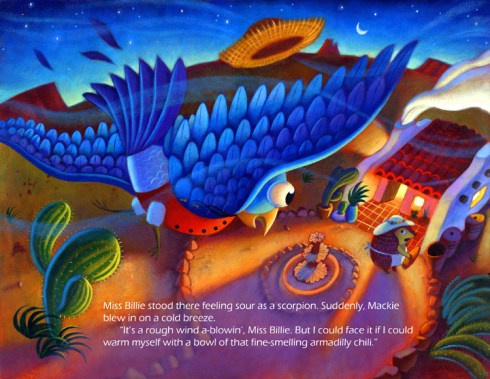
Then there’s Macky the blue bird from ARMADILLY CHILI by Helen Ketteman. I thought Macky had to be somewhat sophisticated because he wasn’t that good at flying, so I dressed him up in a vest, bolo tie, and hat.
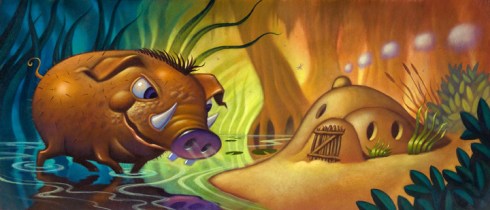
And the big-bottomed boar from THE THREE LITTLE GATORS by Helen Ketteman was a big bully. He was really easy because I had done my time in middle school. I knew the big-bottomed boar right off and couldn’t wait to illustrate those grill stripes in his butt at the end when he sears his back side going down the chimney! I had to edit from a very long list of bully smirks provided by my public school education. Butt again (pun intended) I had to make sure he didn’t cross over in to the “horrifying” realm. I didn’t want my audience to identify with him but I also wanted to keep him on the comical hillbilly, the “I don’t know any better” side of bullies.
So there you have it—not too complicated, but I do enjoy putting a little thought behind the characters I draw and paint. And speaking of painting, I’ve been illustrating in acrylics for the first 18 years of my career but switched over to Photoshop 2 years ago. I was so excited about working digitally because of control and speed that I made a video tutorial on my process! It’s available at folioacademy.com.
.
Will Terry has been illustrating for 20 years. He grew up just outside the beltway of Washington, D.C. wondering why the hell there were so many cars?! So he moved to Utah and the rocky mountains where he and his boys snowboard & hike. His work has appeared in publications such as: Time, Money, Wall Street Journal and ads for Sprint, Pizza Hut, M&M Mars, Fed Ex, and Master Card. He has illustrated over 25 children’s books for Random House, Simon Schuster, Scholastic, Dial, and Albert Whitman, plus 3 ebooks, 1 app, & co-founded a video tutorial company called folioacademy.com. He’s an avid blogger and currently teaches illustration at UVU.
Five…four…three…two…one…
Happy New Month!
And you know what that means, right? November’s over. (Already? Geesh, where did the month go? Oh yeah, I did spend some time in a blackout.)
So, do you have 30 new picture book ideas?
You do? Well, you beat me to it. That’s one of my well-kept PiBo secrets—I’ve yet to complete the challenge myself! (Did I mention a blackout?)
But YOU—I KNOW you did it!
You can qualify for one of our AMAZING prizes just by taking the following pledge:
I do solemnly swear that I have faithfully executed
the PiBoIdMo 30-ideas-in-30-days challenge,
and will, to the best of my ability,
parlay my ideas into picture book manuscripts.
Now I’m not saying all 30 ideas have to be good. Some may just be titles, some may be character quirks. Some may be problems and some may create problems when you sit down to write. Some may be high-concept and some barely a concept. But…they’re yours, all yours! Give them a big, fat, juicy smacker! SMOOCH!
You have until December 5th at 11:59:59PM EST to sign the pledge by leaving a comment on this post.
Remember, this is an honor system pledge.You don’t have to send in your ideas to prove you’ve got 30 of them. If you say so, I’ll believe you! Honestly, it’s that simple. (Wouldn’t it be nice if real life were that straightforward.)
If your name appears on both the registration post AND this winner’s pledge, you’ll be entered into the grand prize drawing: feedback on your best 5 ideas from a literary agent. There are four grand prizes! Thanks to Ammi-Joan Paquette of Erin Murphy Literary Agency, Teresa Kietlinki Dikun of Prospect Agency, Marietta B. Zacker of Nancy Gallt Literary Agency and Susan Hawk of The Bent Agency for volunteering their time and talent to PiBoIdMo.
Other prizes include picture books, manuscript critiques, original art, jewelry, plus all the stuff you saw during the month. All winners will be randomly selected by Random.org and announced on December 9th.
And guess what, PiBoIdMo doesn’t end here! From now until December 8th, stop in for daily posts about how to organize and flesh out your ideas. We’ll even teach you how to make a picture book dummy!
Plus—you can claim your first prize now: a winner badge for your website, blog or social media site, designed by Ward Jenkins. You can make it larger or smaller to fit anywhere. And if you want it on a mug, don’t forget to stop by the PiBoIdMo shop where every purchase benefits Reading is Fundamental (RIF).
So start signing the pledge and patting yourself on the back for a job well done.
And if you can do both at the same time, that’s even more impressive!

We’d all like to have a step-by-step guide to creating super-fantastic blockbuster children’s books. I’d buy that guide in a nanosecond. But I’m beginning to think that no such guide exists. I’m beginning to think we all have to figure things out for ourselves. In fact, I’m beginning to think it’s most important that we each learn to understand our own creative process, and when we understand our own unique ways of working we can each make our own unique “guide” to creating our own unique children’s books. Here’s what I’ve done to understand my creativity, and to devise my own “guide” to making children’s books—
Many of us have strong reactions to particular works of art. We’ll walk around a museum and say “Oh I love that painting SO MUCH” but we don’t always explore WHY we like it. So every now and then I make color copies, and tear out magazine pages, and print pictures from the internet, and I plaster my favorite images onto boards that I can move around my studio. I might dedicate one image board to my favorite color palettes, and another to my favorite compositions, and another to my favorite drawing styles. I surround myself with my favorite artwork.
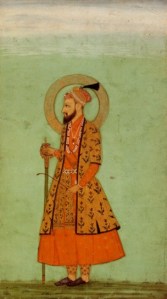
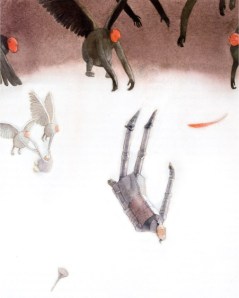
I always notice patterns in my tastes. I seem to love Folk Art and Indian court paintings. I love Lizbeth Zwerger and Kay Nielsen’s work, among others. I ask myself what it is, exactly, that I love about each of my favorite pieces of art. Slowly but surely, I develop a list of qualities that I love in other people’s art. The list of qualities is constantly changing, but it usually looks something like this…
QUALITIES I LOVE IN OTHER PEOPLE’S ART
- Naïve drawing (from Folk Art)

- Flat Perspective and Muted colors (from Indian Court Paintings)
- Compositions with areas of openness vs. areas of detail (from Lizbeth Zwerger)
- Repeated patterns (from Kay Nielsen)

With my list of aesthetic qualities I love most, I then try to make art that incorporates those qualities. As I’m sketching a book dummy, creating final art, or simply doodling in my notebook, I keep that list in mind. If I stay focused, those aesthetic qualities will begin to appear in my work. Sure, I’m borrowing artistic styles, but by blending those qualities in different ways an entirely new art style emerges: MY style. My tastes are always changing, and so my style is always changing. I imagine someday I’ll settle into a consistent style, like most of my artistic heroes, but for now I’m quite happy making art that represents my current tastes and interests…however fleeting they may be.
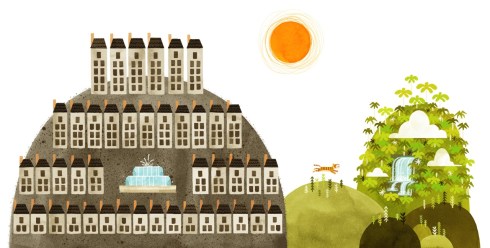
From my upcoming book MR. TIGER GOES WILD, coming out in Fall 2013.
I use the same process with writing. It’s a little different, because image boards don’t really work with writings, but I can still analyze what writing I love and why. I make lists of the writing qualities I love most, and I try to incorporate those qualities into a new, unique writing style.
My process for determining HOW I want to write and illustrate is hugely helpful in determining WHAT I want to write and illustrate. If I know I want to combine spare, funny, dry language with flat, graphic, colorful illustrations, I can eliminate all of my picture book ideas that would involve muted colors, syrupy sweet morals, and complicated plots. My style helps me filter my ideas. I can focus on developing the two or three story ideas that will be complemented by my art and writing styles.
Of course, none of this matters if I have zero story ideas. But ideas are everywhere. So I always keep a little notepad with me, to jot down ideas when they pop into my mind. Sometimes the ideas come quickly. Sometimes I go months without having a single idea. But the ideas accumulate over the years, and whenever it’s time to begin a new project, I have my own little “guide” to determine HOW and WHAT to make my next book.
So get to know your own style and tastes. And when you have a better understanding of your creativity you can begin to make your own unique “guide” to creating your own unique children’s books.
P.S. If you’re a writer but not an artist, consider exploring what art styles would complement your writings. You might even want to modify your writing style to better match the style of art you’d like in your books.
P.P.S. If you’re an artist but not a writer, consider exploring what writing styles would complement your art. You might even want to modify your art style to better match the style of writing you’d like in your books.
.
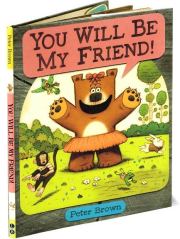 Peter Brown writes and illustrates books for young whippersnappers. He grew up in Hopewell, New Jersey, where he spent his time imagining and drawing silly characters. He studied Life Lessons at the School of Hard Knocks, and then got his B.F.A. in Illustration from Art Center College of Design in Pasadena, California.
After college Peter moved to Brooklyn and spent several years painting backgrounds for animated TV shows. And then in 2003 he got a book deal to write and illustrate his first picture book FLIGHT OF THE DODO, which is a story that involves bird poop…in case you’re into that kind of thing. Since then he’s written and illustrated three more picture books, and illustrated several other books for young whippersnappers. His books have been adapted into plays and animated short films, they have been translated into a dozen languages, and they include the 2010 E.B. White award winner, Children’s Choice Award winner, and New York Times bestselling book THE CURIOUS GARDEN.
His books CHILDREN MAKE TERRIBLE PETS, YOU WILL BE MY FRIEND! and his latest book, CREEPY CARROTS! are also New York Times bestsellers and award winners.
You can find out more about Peter and his books at PeterBrownStudio.com.
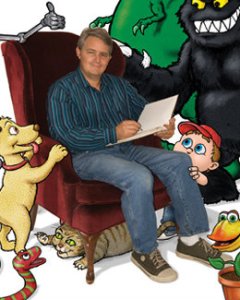 Actually, I love picture books, but I do have a new book coming out next year called I HATE PICTURE BOOKS!. I’m going to tell the story of how I had the idea for this book, but I want to back up a bit first.
Ever since I was a kid, I drew pictures and made clay sculptures of little guys and strange creatures. They always had stories of who they were and what they were doing, but that was in my head. I was an artist—not a writer—and I always figured that a writer would come along and look at my work and they would say “That looks good, let me write down the story of what you drew.” I don’t know what happened to that guy because he never showed up.
About 6 years ago, I finally realized I was going to have to write my story ideas myself. I wrote down a bunch of my ideas and worked them into stories that I thought were good and put together some sample pages of the illustrations and I felt I was ready to go. I had the good fortune of meeting an author who set up a meeting with Heidi Kilgras at Random House. I showed my ideas to her and although she said some nice things about the books I was showing her, what she really liked was my logo. It was on the bottom of every page and she kept saying how much she liked it and finally she said she wanted to do a book that looked like my logo.
So now I had a challenge. I knew the style of the book, now I needed to find the story and the illustrations that work in that style. On the long drive home from New York I had a million ideas running around in my head… what kind of characters do I like drawing? …aliens….robots…monsters. OK, monsters, now I have to look for a story about monsters and why they are in the book. Suddenly the title came to me…”I’m Looking For A Monster!” The young boy I pictured in my head started telling me his story of his search for the perfect monster. Two weeks later I sent a book dummy to Random House and they picked it up soon after. If you’d like to see the original dummy, check it out here.
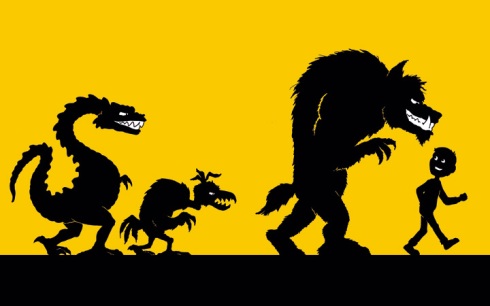
Later that year I sent Heidi a dummy for “They’re Coming!” She liked it and showed it to her acquisitions team. She came back saying they liked it, but they don’t want to follow one monster book with another. They asked if I had anything with dragons or dinosaurs.
Another challenge! A short time later I sent her outlines for “I’m Looking For A Dinosaur”, “Shadows On My Wall” and another with dragons. She liked “Shadows”, but marketing liked “I’m Looking For A Dinosaur”, which they acquired. (Why it’s not out is a long story for another day.)
So now I find myself either challenging myself or finding external challenges to come up with creative ideas. Most of the books that I have put out or am working on are in answer to those challenges. I’ve never gone back to the ones I thought were good picture books (although I might at some point if only to grab some nuggets out of them).
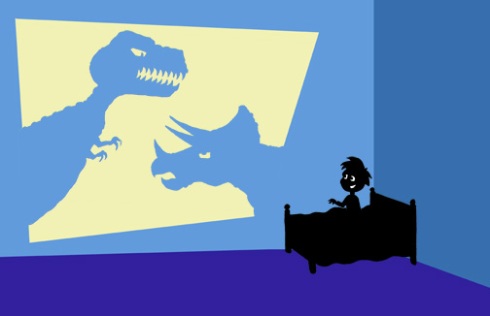
An idea sketch for SHADOWS ON MY WALL.
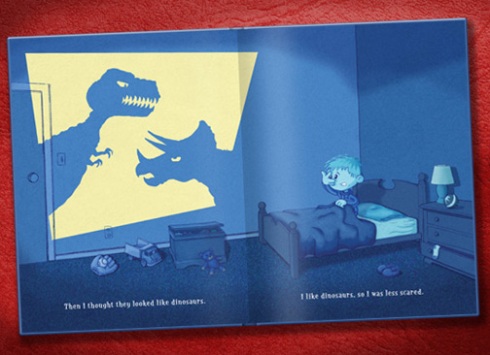
And the final version.
I promised to tell how I came up with I HATE PICTURE BOOKS!. I was at the NJ-SCBWI summer conference two years ago. I was on the faculty with some of the other authors in the KidLit Authors Club. I attended a couple of the seminars while there, including “Finding The Funny Stuff” with Audrey Vernick and Olugbemisola Rhuday-Perkovich. They were talking about parody (I love good parody) in children’s books and Olugbemisola made a very funny comment about Paddington Bear’s immigration status.
I started thinking about classic children’s books and this title popped into my head. I have to admit that I missed the rest of what they said in the seminar, because I was off…my character, a boy who is throwing away his books because he misinterprets them and then gets in trouble, was telling me his story. By the time I had driven home the next day I had the whole thing written in my head. I can’t wait until it comes out early in 2013. (Here’s a link to the publisher where you can pre-order it!)
Now I have to get back to the funny little bird who’s in the process of challenging me to tell his story.
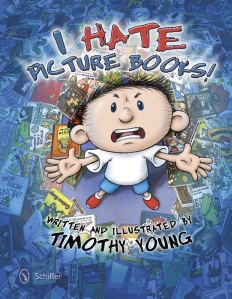 Timothy Young is the Founder and Creative Director of Creatures & Characters LLC. He has designed toys, worked on animation projects, licensed characters, and produced picture books. Timothy is the author-illustrator of I’M LOOKING FOR A MONSTER, SHADOWS ON MY WALL, THEY’RE COMING, and I HATE PICTURE BOOKS!. Visit his creations at CreaturesandCharacters.com.
Timothy is giving away a signed book of your choice and an original pencil sketch. Just leave a comment to enter (one per person, please). A winner will be selected next week. Good luck!





 Writing for Kids (While Raising Them)