by Kaz Windness
If you’re like me you have LOTS of book ideas. Too many at times. My ideas almost always start with a doodle in my sketchbook. But how do I decide which ideas are worth writing stories for? Which characters have the best chance of becoming a published book?
That’s where “high concept” comes in. I define high concept as “a striking and easily communicable idea.”
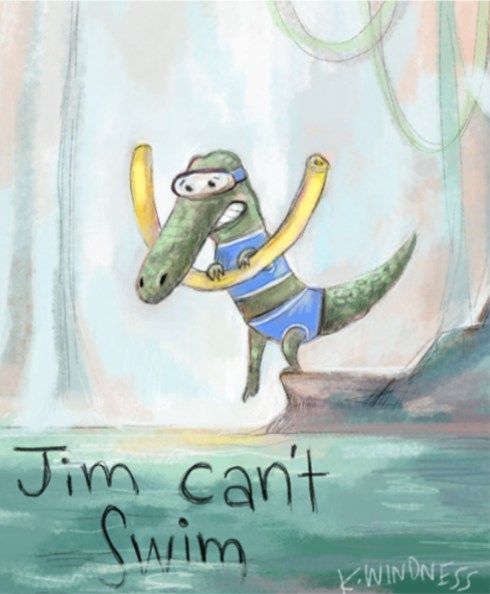
What if a child is afraid of the water? That could be a good story, but it’s expected. It doesn’t hook you in the way a crocodile who’s afraid of the water might.
This is the doodle that later became “Swim, Jim!” I got the idea from a news article about a real crocodile using a pool noodle to cross a canal in Florida.
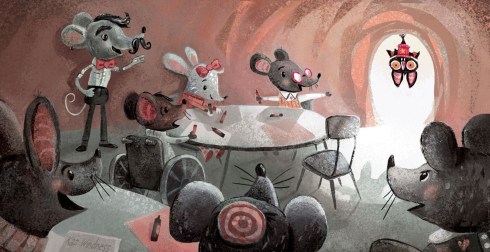
Being a neurodivergent child in a classroom has become a more commonplace story, but what if that experience is explained by a bat in a classroom for mice? That was how “Bitsy Bat, School Star” began.
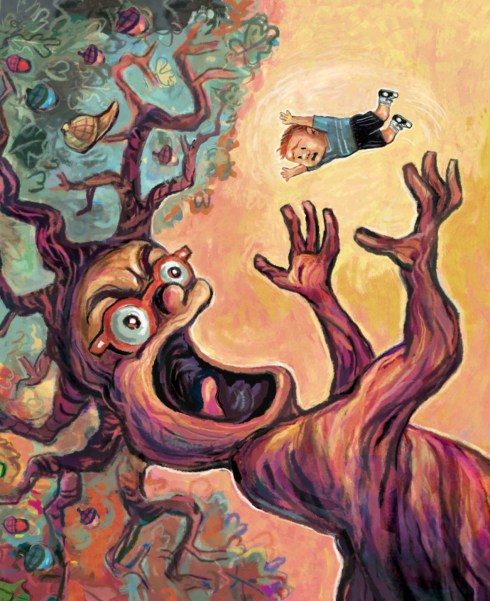
Dealing with bullies? Expected. Turning into a tree monster and eating your bully? That’s the hook in “Ollie, the Acorn, and the Mighty Idea,” written by Andrew Hacket, illustrated by me.
An easy way to come up with a “high concept” idea is to mash two popular or funny topics together in an unexpected way. I got series deals for both of these mashups:
- Cat + Spy = TUX GUY, CAT SPY
- Chickens + Time Travel = TIME TRAVELING CHICKENS: BAWK TO THE FUTURE
This hook hunt is easily turned into a writing game. Let’s play!
First, write down ten characters. Then, write down ten professions. There will be crossover, but the idea is to get some ideas flowing.
Here’s what I came up with:
Characters
- A Smelly Sock
- A Sentient Rutabaga
- Lost Stick of ChapStick
- An Extremely Small Alien
- A Gigantic Cat
- A Cowboy
- A Sleepy Jack-O-Lantern
- A Lost Aardvark
- A Barnyard Peacock
Professions
- Professional Wrestler
- A Garbage Truck Driver
- Super Hero
- Dog-Catcher
- A Farmer
- Milkman
- Weightlifter
- Astronaut
- Underpants Connoisseur
- Chef
Now, mash some of these together. Some examples:
- A ChapStick Wrestler: Battling a big pair of chapped lips maybe?
- A Cowboy Astronaut: Wrangling the stars atop a space ship named Horse?
- A Gigantic Cat Milkman: What happens when they drink the world out of milk?
Next, pick a mashup that’s piquing your curiosity and identify the problem. What will the character lose if they don’t solve their problem? A character without a problem or a desire isn’t very fun to read.
Example based on Cowboy Astronaut:
Why would a cowboy astronaut need to wrangle the stars? Have the stars lost their [milky] way?
Here’s a premise (logline) formula I use to figure out what the story and stakes might be:
Formula:
In a (SETTING)
a (PROTAGONIST)
has a (PROBLEM)
(caused by an ANTAGONIST)
and (faces CONFLICT)
as they try to (achieve a GOAL).
In deep space (SETTING), a cowboy astronaut (PROTAGONIST) must return a posse of stars (PROBLEM) scattered by a space storm (ANTAGONIST) back to their constellations so he can find his home planet before supper (GOAL).
This is obviously not the best story idea ever, but if you do enough of these, you’ll eventually hit gold.
What did you come up with? Happy writing!
 Kaz Windness is the award-winning, genre-crossing illustrator and author of funny and heart-warming books for young readers. Proudly neurodivergent (ASD/ADHD), Kaz specializes in character-driven books celebrating inclusivity, grit, and kindness. Her many books include the Geisel Honor recipient, “Worm and Caterpillar are Friends,” the Dolly Parton Imagination Library selection, “When You Love a Book,” and the acclaimed autism acceptance Bitsy Bat series. Kaz taught illustration at the Rocky Mountain College of Art + Design for 12+ years and is the founder of The Cuddlefish Academy, where she inspires students to tell stories with pictures. Kaz lives in Colorado with her English-teacher husband, two teenage children, and a bunny-obsessed Boston Terrier named Remy. Kaz loves making deep-dish pizza from scratch and sketching animals at the zoo.





 Writing for Kids (While Raising Them)
127 comments
Comments feed for this article
January 24, 2026 at 8:39 am
thecrowsmap
Kaz, I love your fun way of coming up with a story idea. I’m going to look for your books:) Thanks!
Gail Hartman
January 24, 2026 at 8:41 am
Jany Campana
Funny topics! Yay!!!
January 24, 2026 at 8:49 am
Elizabeth Volkmann
Lots of fabulous prompts to get creativity churning! Thank you so much!
January 24, 2026 at 9:01 am
Robin Currie
Wow – this was super helpful! Love the Cowgirl Astronaut!
January 24, 2026 at 9:13 am
Jennifer
What a great approach–thank you for sharing! I’m going to have fun trying it out. Let’s see: In the kidlit world, a creator must finish a story before she is lost in the blank page forever. 😉
January 24, 2026 at 9:17 am
Susan Burdorf
thanks
Susan Burdorf
January 24, 2026 at 9:32 am
gregoryfulgione
Love your matchup ideas! I’ll definitely try that method idea.
January 24, 2026 at 9:40 am
nrompella
I came up with two new ideas. Thanks!
January 24, 2026 at 10:04 am
eleanorannpeterson
II can’t wait to try your writing game and the formula. Thanks.
January 24, 2026 at 10:04 am
pathaap
What a great post, Kaz! I can’t wait to get started on my “hook hunt.” Thanks for the Saturday morning inspiration!
January 24, 2026 at 10:13 am
bookclubhbhs
I can’t wait to play this hook hunt mash-up game! Thank you for this fun and invaluable Storystorm post and logline formula!
January 24, 2026 at 10:21 am
Robin Brett Wechsler
Thank you, Kaz, for your playful, helpful prompt!
January 24, 2026 at 10:28 am
sullyweston
Kaz – You’re amazing! What an inspiring and unbelievably creative (not to mention hilarious!) post. Terrific mashup ideas…thanks for sharing!
January 24, 2026 at 10:29 am
literacylizlazar
Hearing about the jump from a child to a crocodi
January 24, 2026 at 10:40 am
Susan Wroble
These are fabulous suggestions! I keep trying to find a way to do something like this for nonfiction…
January 24, 2026 at 10:41 am
Prairie Garden Girl
Thank you, Kaz, for sharing your thoughts.
I feel high-concept picture books are instantly gripping. They have a unique premise and blend the ordinary with the extraordinary or outrageous
Suzy Leopold
January 24, 2026 at 10:47 am
Cynthia Leavitt
I loved this exercise – it launched a few exciting ideas – Thanks
January 24, 2026 at 10:58 am
schellijo
Wow! I love this. Thank you for sharing!
January 24, 2026 at 10:58 am
schellijo
Wow! I love this. Thank you for sharing!
January 24, 2026 at 11:09 am
tinamcho
My students & I love your books, Kaz. Thanks for this formula. Will give it a try.
January 24, 2026 at 11:21 am
amybeth349
What a great idea! I love a good character and profession mash up. I use log lines when I try to write screen plays. I will focus more with a log line in picture book writing. Great tip., Thank you!!
January 24, 2026 at 11:22 am
Danna Smith
Fun exercise, Kat! I’m looking forward to playing around with words!
January 24, 2026 at 11:23 am
Pam Barton
Great idea! I just retired in June as a school librarian at the elementary level, and had your books in my library. Bitsy Bat was a favorite!
January 24, 2026 at 11:23 am
Danna Smith
Oops, Kaz, 🙂
January 24, 2026 at 11:37 am
marshaelyn
Kaz! My creative juices waterfalled from reading your two lists: character and profession. Such a fun, inventive, and easy way to spark story ideas. Your Logline Formula for finding the “high concept” stories is a sure way to know whether to begin drafting an idea or to set it aside. Thank you for sharing your experience and your ideas. Sending you inspiration for your next venture….
January 24, 2026 at 11:45 am
lodobocreates
A noodle swimming alligator- now that’s funny!! Thanks for flipping things in my head. I’ve got a few ideas tossing around.
January 24, 2026 at 11:46 am
Karin Larson
What a fun and inspiring post, thank you so much. I’ve got ideas flowing:)
January 24, 2026 at 11:53 am
robineditorial
A playful way to come up with ideas 🙂
January 24, 2026 at 12:15 pm
Rona Shirdan
Thanks for the fun exercise to come up with a unique story idea!
January 24, 2026 at 12:21 pm
Janice Woods
Love this! Thanks for sharing.☺️
January 24, 2026 at 12:22 pm
rosecappelli
Fun exercise! Thanks for the jumpstart, Kaz.
January 24, 2026 at 12:27 pm
Christine Van Zandt HOT DOG! 2026 JLG gold-standard selection
What a great way to look at thr formula of a book. That makes it seem doable and covers all of the big aspects.
January 24, 2026 at 12:41 pm
sheriradovich0384
Ideas worth noting and fun way to set up story ideas. Picky eaters are on my list. I can find so many combinations to start a story with once I have a problem for the m.c. Thanks for tweaking my creative side.
January 24, 2026 at 12:51 pm
Dawn Prochovnic
Thanks, Kaz. Your method an examples for how you come up with high concept ideas is super helpful. I also like that you think about your logline as you are developing your story ideas. I’ve put several of your books on hold at my local library and look forward to reading them!
January 24, 2026 at 12:52 pm
nigel8it
Great advice for a fresh approach to brainstorming ideas! Thanks so much for your post!
January 24, 2026 at 1:25 pm
Becky Ross Michael
Wonderful reminder of a formula that works! Much appreciated, Kaz.
January 24, 2026 at 1:30 pm
Helen M. Waters
Such a fun idea! I’ll be playing this game for ideas regularly, I think. Thank you!
January 24, 2026 at 1:54 pm
roundswrite
What a great idea for a brainstorming exercise! Harder than I thought, but I’m going to keep at it today.
January 24, 2026 at 2:02 pm
dlapmandi
Thanks for the post. Great longline formula. Great idea leading to strong story ideas.
January 24, 2026 at 2:12 pm
Julia Wilder Banta
Love this!!!! You just inspired me to pull a story out of the files that is just crazy enough to find a life out in the world. THANK YOU!!!!
January 24, 2026 at 2:26 pm
debbuschman
Love it Kaz! That is my project for today. Thanks.
January 24, 2026 at 3:01 pm
Cathy Stefanec Ogren
Great post, Kaz! I love the mashup ideas.
January 24, 2026 at 3:18 pm
Teddie
How creative! Thank you for your hook hunt writing game. I’m excited to try this. I have many ideas, but not “high concept” ones. This is fantastic. Thanks so much. As a Florida native, who also heard that story about the gator, I’m impressed you took it and created such a cool picture book. Brilliant. 🙂
January 24, 2026 at 3:30 pm
sallymcclure
love this!
January 24, 2026 at 4:11 pm
heatherstigall
Fun exercise today, Kaz. Thanks!
January 24, 2026 at 4:13 pm
Kaye Baillie
Hi Kaz, Thanks so much for your fabulous examples and your clear instructions. I’m going to try it!! Love Itsy Bitsy too 🙂
January 24, 2026 at 4:16 pm
bevbaird
What great exercises to work on. Thanks Kaz
January 24, 2026 at 4:42 pm
Farida Zaman
A great idea, mashing up character, profession and more! Thank you Kaz for this fun way of coming up with a potentially unique store!
January 24, 2026 at 4:59 pm
Armineh Manookian
What an incredibly helpful exercise you have shared with us, Kaz! Thanks so much!
January 24, 2026 at 5:07 pm
Tracey Kiff-Judson
Love that approach! Thanks, Kaz!
January 24, 2026 at 5:17 pm
Goodreadswithronna.com
Mashups rock! Adore your artwork too.
Thank you, Kaz.
January 24, 2026 at 5:24 pm
rindabeach
I love your examples of how mashups work in your logline. Thanks for modeling how to turn it into a story premise.
January 24, 2026 at 5:31 pm
Maria Marshall
Love the mashup guide and logline formula! Thank you so much for a silly and productive afternoon.
January 24, 2026 at 5:41 pm
Claire A. B. Freeland
I love the wild mashup concept combined with the structured story pitch.
January 24, 2026 at 5:48 pm
Matt Forrest Esenwine
I agree, mashed-up ideas can be brilliant sometimes! And Kaz, with Orion and Canis Major hot at his heels, I’m eager to find out if the cowboy makes it home in time for supper before the dish runs away with the spoon. (Wait, what??)
January 24, 2026 at 6:15 pm
Rebecca Colby
Love mashups and have used the a few times. Thanks for sharing your own ideas in this respect and for the inspiration!
January 24, 2026 at 6:20 pm
kathleengauer
What a crazy, fun way to mash up ideas! Actually came up with a few gems that I never expected! Thanks for the inspiring post!
January 24, 2026 at 6:29 pm
L. Hofke
what a fun exercise to one up with strong and I retesting characters! Thanks.
January 24, 2026 at 7:44 pm
Sallye O'Rourke
The hook hunt as a writing game, love this!
January 24, 2026 at 7:55 pm
Laura Perdew
Hi Kaz! Thank you for such a fun and actionable post. It’s such a simple, yet clever way to get the ideas flowing…I’m’ ready to play! ~Laura
January 24, 2026 at 8:11 pm
TonyaAnn Pember
This was a great exercise to get the ideas flowing!
And hello to a fellow Colorado resident!
January 24, 2026 at 8:47 pm
lucystaugler
Kaz,
Ohhhh, I am having sooo much fun with this!!! Thank you!!!
Keep spreading your magic!!
Lucy
January 24, 2026 at 9:17 pm
Poupette
Such fun and imaginative prompts –thanks.
January 24, 2026 at 9:47 pm
seschipper
Thanks so much for sharing you “writing wisdom”!
I love mash ups❣️
January 24, 2026 at 11:33 pm
Sherry Dubis
This idea for ideas is exactly what I need right now. Thank you very much!
January 24, 2026 at 11:43 pm
Celeste
This was a blog packed with useful information to develop and idea and have lots of fun along the way. Thanks for sharing.
January 24, 2026 at 11:48 pm
serendipityinstars
I love this! Useful and fun for exploring those story ideas. Thank you!
January 25, 2026 at 12:00 am
Artelle Lenthall
Thanks Kaz, Great ideas and illos🙂 I do love you somewhat freaky bully-eating tree– chills!
January 25, 2026 at 12:01 am
angelamsteffen924
I find myself having many, many ideas as well. It’s difficult to choose which idea to explore more, but I have noticed there are ones that always come back to me. And I love your suggestions on blending unexpected things together. And thank you for the much-needed chuckle about the chapstick wrestling chapped lips! Thanks for the inspiration and smiles, Kaz!
January 25, 2026 at 12:20 am
Stan Yan
I love doing character mashups with students to brainstorm story ideas!
January 25, 2026 at 1:00 am
brightwishbooks
this is such a fun writing prompt! I’m still smiling at “bawk to the future”
January 25, 2026 at 11:26 am
anchance
What a cool exercise. Thank you!
January 25, 2026 at 12:09 pm
Colleen Owen Murphy
Kaz, I DID write down the ten characters and ten professions, but my mash-ups were nothing I would want to write about!! LOL. I will have to try again when my brain is functioning better.
January 25, 2026 at 12:26 pm
Catherine Friess
Thank you so much for all these great exercises Kaz 🙂
January 25, 2026 at 1:23 pm
horsewriterlady
Thank you for these fun mashup ideas! Storystorm is awesome!
January 25, 2026 at 1:24 pm
Laurel Ranveig Abell
Kaz, I enjoy your books (and posts) so much! Your energy and joy are contagious. And FUN!! Thank you.
January 25, 2026 at 1:52 pm
marywarth
Love the formula! Thank you.
January 25, 2026 at 3:58 pm
Gabi Snyder
Thanks for this fun writing game, Kaz! Generating ideas through your mash-up technique and premise formula was productive for me.
January 25, 2026 at 4:30 pm
Melissa Stoller
Hi Kaz – I love these writing prompts and I really enjoyed hearing about the inspiration and process for your stories. Thanks for a great post!
January 25, 2026 at 9:34 pm
writeremmcbride
Kaz, I thank you for this wonderful formula for coming up with a high-concept picture book! I appreciate your encouraging suggestions and your enthusiasm. I’m looking forward to developing some possibilities right away!
January 25, 2026 at 9:52 pm
brintonculp
Can’t wait for Time Traveling Chickens! Thanks for the inspirational ways to do mash-ups!
January 26, 2026 at 12:17 am
Jessica Iwanski
Wow, this is amazing! I’m going to have so much fun trying out your formula for generating high concept ideas! Thanks so much, Kaz. 🙂
January 26, 2026 at 9:27 am
Bhandi
Yes, another helpful writing exercise I can do to catch up because I’m behind on writing down ideas. I have idea I just haven’t been recording them .-.
January 26, 2026 at 11:46 am
brennajeanneret
Great post, Kaz! Thanks for the creative boost this morning!
January 26, 2026 at 1:47 pm
Amy Benoit
Such helpful advice, Kaz! truly appreciate this formulaic explanation. I’m ready to review my queries!
January 26, 2026 at 3:44 pm
Alicia Shawn Gagnon
I tried this. It worked!! I wrote a silly story that I never would have before…with fun and puns too. THX for layering the creativity! 🙂 Alicia
January 26, 2026 at 5:27 pm
dgottier
Love it!! I’ve generated some fun unexpected ideas, thanks!
January 26, 2026 at 6:36 pm
Diane McBee
What fun! Thank you for sharing.
January 26, 2026 at 7:01 pm
Cheryl A. Johnson
Love your easily understood definition of high concept!
January 26, 2026 at 7:39 pm
Mary Zychowicz
Great brainstorming idea for high concept books. This will be fun to play around with. Thank you!
January 26, 2026 at 9:45 pm
bookfish1
Great post. Appreciate the template you gave us and how to mix and match stories into ideas. Love your books.
January 26, 2026 at 10:15 pm
marty bellis
Lots of fun ideas to play with here. Thanks, Kaz!
January 27, 2026 at 12:56 am
rachelcritchleya061056d76
i will look for my high concept
January 27, 2026 at 9:57 am
Lauri Meyers
Super exercise! Got the ideas flowing
January 27, 2026 at 11:27 am
syorkeviney
Kaz, I love this playful approach to writing! Great ideas here! Thank you!
January 27, 2026 at 1:19 pm
Mona Pease
This was fun! Came up with a new story idea before I finished my second list. Thanks, Kaz.
January 27, 2026 at 3:14 pm
Stephanie Alter Jones
Just the thing to launch me into an idea zone today! Thanks!
January 27, 2026 at 6:39 pm
tinefg
Fabulous suggestion, and so much fun! Thank you for sharing Kaz.
January 27, 2026 at 7:49 pm
ABMitch
I really love these ideas! Thank you so much!
January 27, 2026 at 7:49 pm
ABMitch
I really love these ideas! Thank you so much!
January 27, 2026 at 8:28 pm
Jacqueline Adams
I love that the crocodile with the pool noodle turned into a picture book! I can’t wait to read it. Thanks for all of the fun suggestions!
January 28, 2026 at 1:13 am
Adriana Gutierrez
What a fun formula for story ideas and pitches! Thank you!
January 28, 2026 at 8:05 am
Freda L.
I love this crocodile and the noodle. I’m still laughing!
January 28, 2026 at 1:29 pm
ptnozell
Thank you for these story-generating prompts, Kaz! I love SWIM, JIM (as does my grandson), but I had no idea that a real crocodile used a noodle to swim across a canal!
January 28, 2026 at 3:13 pm
brigitus6620
I totally get the ND idea bog, too many ideas can be too much sometimes. I adored this post and the homework. And, A Sentient Rutabaga, LOL, that’s one I want to read. Great post Kaz, as always you are that bright and shiny sparkle we all need.
January 28, 2026 at 5:06 pm
joanswanson58
The mash up ideas and the formula are very helpful…thank you!
January 28, 2026 at 6:45 pm
triciacandy
Thank you! This is a great exercise! Mine was ridiculous, but I needed that!
January 28, 2026 at 8:26 pm
mrbellasgmailcom
Your formula is brilliant! Just what I needed as I developed my new picture book story idea! Thank you so much, Kaz!!
Best, Mari
January 28, 2026 at 9:20 pm
Judith Snyder
Kaz, it’s so fun to read about your successes. I’ve moved from Colorado, but think of you now and then and the wisdom you have shared with me. Thank you for the creative ideas in this post. I’ll have fun trying them during these final days.
January 29, 2026 at 7:15 am
Robynn Hyde
What a fun exercise – thank you! And I love having the high concept aspect nailed down right from the beginning. It is so easy to get an idea, write the story, then find out it doesn’t really have a strong idea or concept shining through. Thank you Kaz – I am looking forward to trying this!
January 29, 2026 at 11:24 am
ralucasirbu
I love love love your post, Kaz. Your formula works wonders. Congratulations on all your achievements. Cheers to overflowing imagination!
January 29, 2026 at 12:31 pm
Sally Matheny
Mashups are fun! Thanks for the inspiration.
January 29, 2026 at 2:46 pm
helenedebelak
I’m filing this one away to do! To use as exercises and story arcs. Thanks!
January 29, 2026 at 5:10 pm
Donna Cangelosi
I agree, mashups are fun. Thanks for sharing your creative ideas. Love your illustrations!
January 29, 2026 at 6:04 pm
J Ganter
I’ve heard this concept before, but you put it in such a user-friendly and easy to read way. Thanks, Kaz
January 31, 2026 at 6:23 am
chrisynthia
You gave me the structure my ADHD brain needed to wrangle my ideas. So simple and fun.
January 31, 2026 at 9:21 am
Monica Acker
Such a fun practice for idea mining!
January 31, 2026 at 5:12 pm
Keeping the Me in Mommy
I am currently struggling with this concept for two story ideas. Currently, the outcomes are too predictable. I’m inspired to look at them with your words in mind!
January 31, 2026 at 5:12 pm
Keeping the Me in Mommy
I am currently struggling with this concept for two story ideas. Currently, the outcomes are too predictable. I’m inspired to look at them with your words in mind!
January 31, 2026 at 6:58 pm
Marie Prins
Thank-you for this formula!
January 31, 2026 at 7:24 pm
8catpaws
“In a pond, a playwriting fish must rescue its script stolen by a prankish parrot, now perched in a tree, before the parrot reads it aloud and claims it as its own…” –Attempt at a mash-up!
January 31, 2026 at 9:52 pm
Megan McNamara
So much gold in here but BAWK TO THE FUTURE is the best!
February 1, 2026 at 12:46 am
jilltatara
Fun writing prompts! Thank you!
February 1, 2026 at 1:53 pm
marcihersel
So much fun, I can’t wait to dive in! Thank you!
February 1, 2026 at 5:02 pm
Debbie Moeller
Great tips to spark story ideas. I hope I can come up with something as clever as Bawk to the Future! I can’t to read that one!
Thanks for sharing.
February 2, 2026 at 2:39 pm
Angela De Groot
Fun exercise! Thanks, Kaz.
February 2, 2026 at 8:46 pm
carmen2750
What a great way to ‘stretch your imagination’ using your mashup exercise! Thank you!