You are currently browsing the monthly archive for April 2020.
Confession time: I’ve always thought of myself as a dog person. I wasn’t too keen on cats, probably because I had never spent a lot of time around them. Sure, when I was a kid, one of my besties owned a cat, but he was a finicky feline. I don’t think Mr. Bojangles ever let me pet him.
Then, a few years ago, I met Sasha. What a beauty! Emerald eyes and the fluffiest white coat. And when I arrive at my friend’s house, Sasha cuddles up to me, jumps on my lap, and lets me love on her. So I’ve given cats a second chance. Now I participate in #Caturday and share adorable cat GIFs on Twitter, as one does.
So when Susi Schaefer got in touch to show me her debut author-illustrator picture book, I took an immediate interest in the cute, quirky and colorful illustrations.
This is CAT LADIES!

There are four Cat Ladies to be exact—Molly, Millie, Maridl and Merthel—and they all share one lovely white Princess.
So Susi, this question BEGS to be asked: are YOU a Cat Lady?
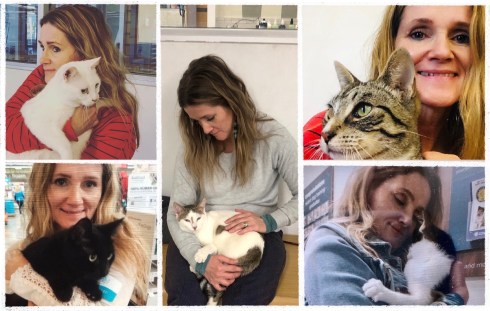
I am a Cat Lady! I am not currently owned by a cat, but I serve many as a volunteer for a cat rescue.
Hmm, that first cat looks a lot like Princess! Did she serve as your model?
She most certainly was a significant influence. Her name is Marilyn, and she has a very glam and regal aura about her.
How did you decide that one cat should have so many ladies looking after her? Was it that regal aura?
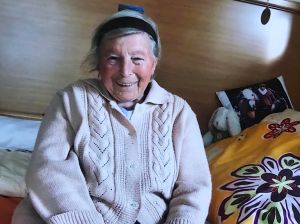 Here is the story behind the story.
When my dad’s elderly cousin, Maridl, had to move into a care home, she couldn’t take her beloved cat, Poppele, with her.
I was trying to imaging what if…
What if… Poppele could have moved along with Maridl.
What if…she would have been the center of all that attention.
What if…that attention was somehow diverted.
Side-note: My parents have been accepted as the bringer of food by Poppele.
And, Marilyn’s regal aura is cattitude galore.
Oh, I love meeting the original Maridl!
Do you think Princess is available now to answer some questions?
Princess, you’re a special cat to have four ladies to watch after you. Be honest, do you have a favorite Cat Lady?
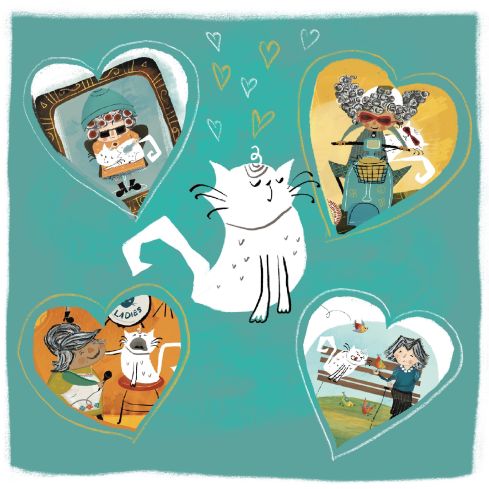
Seriously, Princess? You can’t pick a favorite? (You can just whisper it to me…)
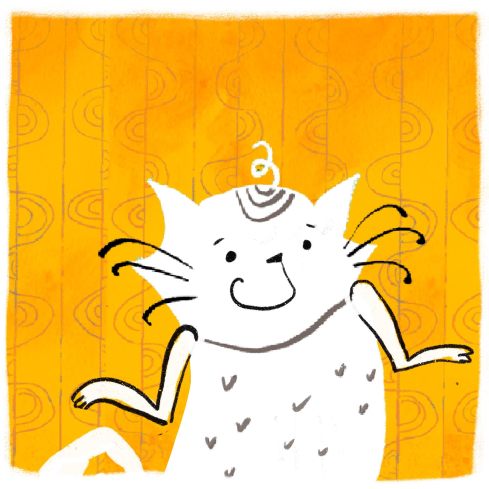
Oh Princess, I understand it’s tough to pick the one you love above all others.
But for cats who aren’t as lucky as you, what advice do you have for felines who want to be pampered? How can they attract more cat ladies?

Awww, well done, Princess!
Susi, let me circle back to you. What do you want readers to take away after reading Cat Ladies?
Cats rock!
Ladies rock!
Cat Ladies most certainly rock!
And sometimes, unexpected life changes bring lovely and unanticipated benefits.
Yes, I don’t want to give away what happens in the story, but, I do want to ask you—how did the clever resolution come about?
I had the first and the last line of the story written very early on. And my agent had a brilliant idea that added more heart to everything. Writing and publishing is a team sport!
It sure is!
And this team effort is available now from Abrams!
Or win a copy here!
Leave one comment below about your favorite cat or cat lady! A winner will be randomly selected in two weeks.
Good luck!
Susi Schaefer trained as a glass painter in the medieval town of Rattenberg, Austria, before moving to Southern California to study graphic design. She’s the illustrator of Zoo Zen by Kristen Fischer. Cat Ladies is her author-illustrator debut. Susi volunteers for a cat rescue group and lives in North Tustin, California, with her family. One day she hopes to use the words “Newfangled”, “Gobbledygoogk” and “Rigmarole” in her work, but she hasn’t yet had the chance to do so. Visit her at SusiSchaefer.com.
Do you make time to play every day? I won’t lie and say that I do—sometimes life gets in the way, but I’m trying (and mostly failing) at making play a priority. PLAY LIKE AN ANIMAL was born from the realization and the frustration that play is disappearing from kids’ too busy and over-scheduled lives. Young kids have “play dates” and scores of enrichment activities instead of time for free play. Schools are cutting, or even eliminating recess and increasing testing. And it’s not just young kids, it seems that teenagers practically have to be Olympic athletes to participate in sports—what happened to the importance of camaraderie, being a good sport and learning teamwork? And that sports/exercise are beneficial for combatting stress and anxiety too. Is it a wonder our kids are anxious?
Rather than ranting, I chose to write a “playful” book to celebrate play, and to inspire kids, parents and educators to dive right in because play is life—play is important, and not trivial. Play teaches compassion, empathy, cooperation and how to be fair; play helps us express creativity and explore our imaginations; and play helps us problem solve. But above all, play is fun!!
Mia Powell’s vibrant and whimsical art is the perfect match for the active text which encourages kids to get moving and to play like animals do:
Do you plonk like a peccary?
Surf like a dolphin?
Sled like a raven (or crowboard like a crow?)
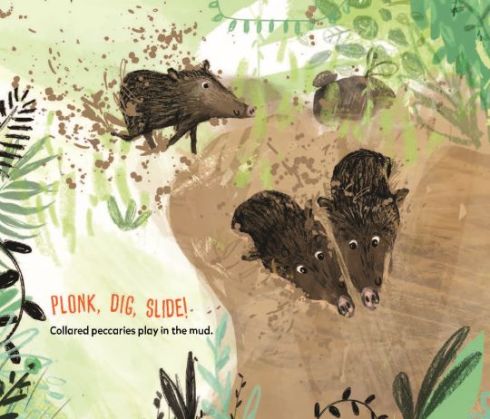


Lerner Publishing has generously offered to donate a copy of PLAY LIKE AN ANIMAL. Just leave a comment telling us your favorite family game or your favorite way to play to be entered for a chance to win (sorry—US residents only).
Thanks for having me here, Tara, who’s always punny and playful in all of her books!
 You. can visit Maria and all her books online at MariaGianferrari.com.
Twice a year I visit a juried art show with artisans of every type, from photography to pottery, woodworking to knitwear. Wandering the aisles of talented artisans and their wares boosts my own creativity. I always linger in one particular booth, that of a cut paper artist. She works with black silhouette paper and Exacto knives, creating intricate designs of lush gardens and playful children. I sort through the amazing remnants, which she leaves in a pile on her table. They feel alive with energy.
So when Brooke Hartman contacted me about her new book, LOTTE’S MAGICAL PAPER PUPPETS, I gasped with excitement. This is a book about a cut paper artist!
Brooke, tell us more…
LOTTE’S MAGICAL PAPER PUPPETS: the Woman Behind the First Animated Feature Film is a narrative nonfiction picture book about Charlotte “Lotte” Reiniger, the German paper cut silhouette artist who predated Walt Disney in the creation of a full-length animated feature film by almost a decade. She also invented one of the first multi-plane cameras, which uses panes of glass, lighting, and stop-motion camera techniques to create animation. Even more amazing, all of her films were made with articulated shadow puppets that she drew, cut, and pieced together by hand. Top this off with her whimsical fairytale style and the fact that almost all of her films were classic tales such as Cinderella, 1001 Arabian Nights, and Thumbelina, and the results were gorgeous animated films that take your breath away.
What inspired you to write this story?
Facebook. Duh, where do you get your ideas? Seriously though, I was surfing Facebook one day and came across a YouTube clip someone posted on the life of Lotte Reiniger. The moment I glimpsed her beautiful animations, I was hooked. I’ve always loved fairytales, whimsical art, and artists (some of my favorites are Michael Hague, Terri Windling, and Brian Froud) and couldn’t believe I’d never heard of Lotte Reiniger before.
I’d been writing picture book texts for a few years by then, and my first book, DREAM FLIGHTS ON ARTIC NIGHTS (2019), would be published later that year. I also love playing with rhyme, and after I’d watched YouTube video after YouTube video of Lotte’s animations, the first stanza of her story started wheeling through my head:
Long before a cartoon mouse,
Or Snow White found a little house,
There was a girl named Charlotte.
Everyone called her Lotte.
That was it. I had to write about Lotte!
But I didn’t know if it had ever been done before. After poking around on the Internet, the only texts about her I unearthed were a couple nonfiction novels, some websites, and your standard Wikipedia entry.
The next thing I did was contact the Stadt Museum in Tubingen, Germany, which has a permanent exhibit dedicated to Lotte Reiniger, to see if they knew of any picture books about her. This proved a fun experiment as their contact form was all in German (thank you, Google Translate!). A week later, they replied that, to their knowledge, there were no picture books about Lotte Reiniger, but would love for someone to write one, and please, if I did, could someone translate it into German? (We’re still working on that part.)
This email fueled my already raging fire, and the rest of Lotte’s story flooded into my head. I wanted to write it in a way that captured her whimsical fairytale films, but still left room for her life’s more difficult moments; Lotte wasn’t just an artist, she was an artist in Germany during WWII, and spent over a decade fleeing from country to country in an attempt to avoid being sucked into the confines of the Third Reich. When her mother became ill, Lotte was forced to return home, where the Third Reich quickly tried to force her into creating propaganda films for their regime. But—and here’s the part that cinched for me that Lotte’s story needed to be told—she refused to bend to their wishes and instead created one of her most classic films, The Golden Goose. My editor and I worked on this part of the text for a loooong time. We wanted to get it absolutely perfect, and I think we nailed it.
How did you and your publisher find each other?
I was agentless at the time after spending two years under representation by someone who earned themselves a very bad name in the publishing industry…but that’s a whole other blog post. Anyhow, I’d recently rejoined the world of Twitter and thought I’d give the #PitMad and #PBPitch Twitter pitch fests a try. I entered the 4-line stanza above, plus a brief statement about Lotte Reiniger’s life. Courtney Burke, then an assistant editor with Page Street Kids, liked my tweet. She’d been a film major in college and, like me, was also shocked that she’d never heard about this incredible female artist and animator.
Then enter the illustrator…
From the get go, the Page Street team had a vision for this book that perfectly mirrored mine. This showed more than ever when they sent me links to three potential illustrators—all of who used the same paper cut silhouette style as Lotte Reiniger. I was blown away by the talent. It was a tough choice, all of the illustrators were amazing, but the Page Street team and I gravitated to Kathryn Carr; not only is she brilliantly talented, but her style matched the whimsical fairytale themes that Lotte used in her own work. (Check out Kathryn’s beautiful artwork here at gocarrgo.com.)
Kathryn brought the book blazing into existence. The vivid, rich pages feel like you’re viewing one of Lotte’s films while living the life of a remarkable artist and animator, one who survived a war and refused to let fear rule her.
I encourage anyone who isn’t familiar with Lotte Reiniger to check out her films, many of which can be viewed on YouTube.
Before we talk more with Kathryn, let’s take the first look at the cover!
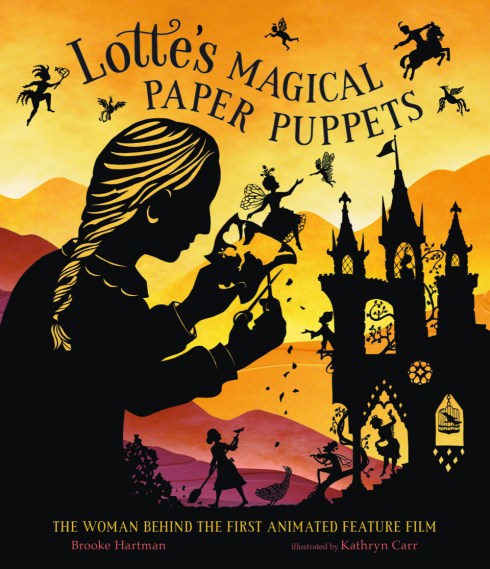
It’s gorgeous!
Now, more about the illustrations, a discussion with Kathryn Carr:
Imagine a girl about 12 years old with thick braids in her hair sitting at the dining room table. Her eyes are keenly focused on her hands that are cutting shapes from black paper. Tiny scissors snip, snip, snip. At first the pieces are unrecognizable but then they are arranged and constructed to reveal amazing and magical silhouette puppets. Scenes of fantasy and fairytales begin to appear all around her. The girl’s name is Lotte and this is where the story begins and this is the book cover of Lotte’s Magical Paper Puppets.
I feel I have a kindred spirit with Lotte in that we both have surrounded our lives with making art and the love of sharing it with others. Like Lotte, my art has been inspired by fairytales from my childhood. Some of my favorite stories were written by the Brothers Grimm and Hans Christian Andersen.
The illustrations started with research about Lotte’s life. I gained a great understanding about her through books, movies, the internet, and discussions with others that knew a lot about her. I learned as much as I could about the city where she grew up, her travels, the time period in which she lived and her artistic process. Then I did lots of sketches and planned out my art to accompany the story. Once I had a plan I started to cut out the puppets and the backgrounds and assemble the scenes like a miniature stage. I took a ton of photos with the art in different arrangements and with various lighting angles to achieve the best composition.
How long did it take to illustrate the book? What was your process?
All in all I worked on this project on and off for about 10 months. I made well over 200 paper cut elements, some were used in the book while others didn’t make the cut…pun intended…
It was an honor to illustrate this story about such a wonderfully creative, brave, and daring artist. A warm thank you to the Page Street Kids publishing team for asking me to work on this project and all your feedback and thoughts though out the process. Many thanks to Brooke Hartman for passionately crafting the story so that others may come to know more about Lotte and her magical paper puppets.
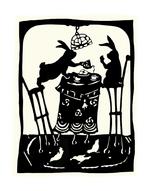
Print by Kathryn Carr
I’ve been a full time paper cut artist since 2010. Over those years my art has been in galleries and homes around the world. I have a line of greeting cards and I teach paper cutting workshops and give lectures. I have illustrated one other book in this paper cutting style and I hope that there will be more illustrating opportunities in my future.
I hope so, too, Kathryn! I adore your sweet and delicate style.
Brooke and Kathryn, thank you for sharing your cover reveal with us and some secrets behind the book’s creation!
LOTTE’S MAGICAL PAPER PUPPETS: the Woman Behind the First Animated Feature Film will be released on October 20, 2020. You can pre-order a copy now (and if you do, get it from your local independent bookseller…they need our support right now).
You can follow Brooke Hartman on Twitter @BrookeHartman79 and Kathryn Carr on Instagram @gocarrgo.
If you’ve been in children’s publishing for any length of time, then you know Margery Cuyler. Margery served as an executive editor for decades, at Holiday House, Marshall Cavendish and finally Two Lions before recently retiring. But she’s also a very accomplished author in her own right. Margery has published over 50 books for children, including the popular THAT’S GOOD! THAT’S BAD! series and one of my favorites, THE BIGGEST, BEST SNOWMAN, with frequent collaborator, illustrator Will Hillenbrand.
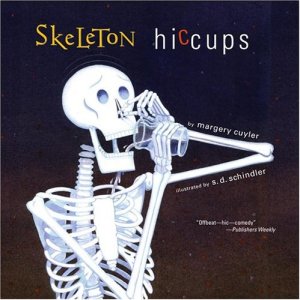
She also seems to be quite fond of skeletons. Perhaps you’ve heard of this Halloween classic?
A couple of years ago, Margery came on the blog with her newest skeleton character, Bonaparte, illustrated by Will Terry.
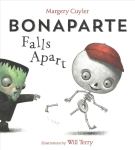 Bonaparte is a skeleton whose loose bones occasionally fly off. In the first book, BONAPARTE FALLS APART, Bonaparte is reluctant to start school because he worries that the other “kids” (different monsters) will make fun of him. His friends try to help ease Bonaparte’s worries, but none of their suggestions work. Bonaparte finally adopts a dog named Mandible who retrieves his bones and accompanies him to school. They both turn out to be popular!
And now…Bonaparte is back in a second spine-tingling adventure.
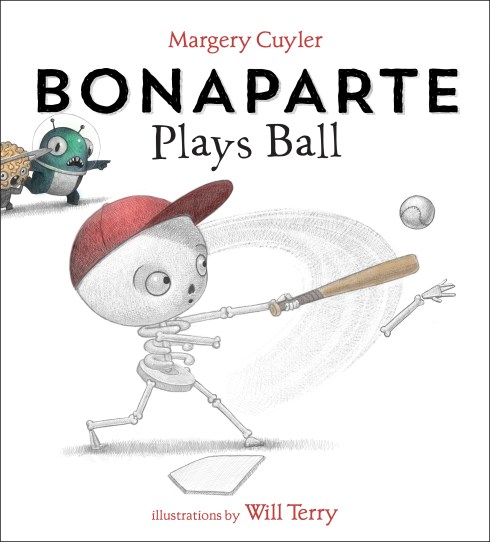
Margery, why did you decide the follow-up Bonaparte book should be about baseball?
Before writing the second book, I thought of different situations that would be challenging for Bonaparte, even with Mandible’s help. At the same time, I was hearing from bookstores that there weren’t enough sports stories for the picture-book set. Bingo! Why not put Bonaparte in the middle of a baseball story? Surely he’d be stressed if he had to bat and run.
What was the most challenging aspect of writing a baseball story?
Learning about baseball! There are a lot of rules that I had to bone up on. Also, baseball has its own language. For example, “moon shot,” “bouncer,” “slider,” “shutout,” “pop-up,” “dinger,” and “swing for the fences.” I worked them into the text whenever possible. In addition, I tried to include puns if they made sense. For example, the Mighty Aliens “orbit” the bases. All in all, it was quite a challenge to hold it all together, but my editor, Emily Easton at Crown/Random House, was very helpful.
What do you think makes Bonaparte a better baseball player than soccer star or basketball champ?
Well, truthfully, Bonaparte would have been anxious playing any sport. I picked baseball because I thought it would be cool to have a game in the World Series which became the Weird Series in my new book.
The Weird Series! My kind of championship! Which teams are playing?
The Little Monsters (Bonaparte’s team) vs. The Mighty Aliens.
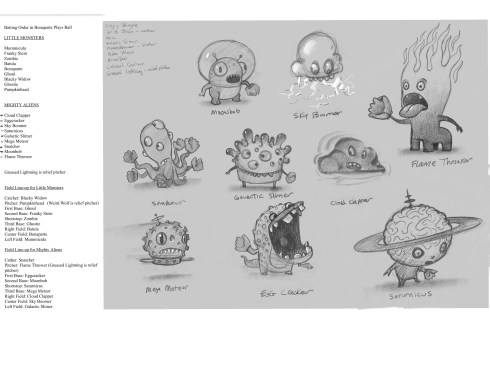

OK, I’m rooting for The Little Monsters!
Is Bonaparte nervous for the big game? What does he do to calm his bones?
You bet Bonaparte is nervous! He’s a “jittery jumble of bones.” And so he practices the drills assigned by the coach to get prepared, but that isn’t enough to calm his nerves. Maybe if I were to rewrite the book, I’d have him do some mindfulness exercises! Or yoga. Or drink some herb tea (which would go right through him). In any case, most of the book is about what happens during the game.
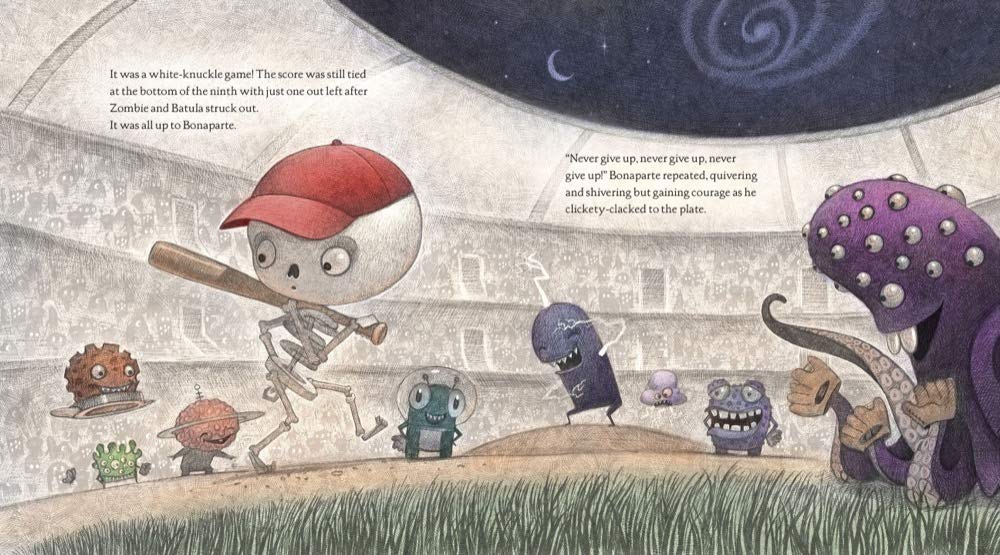
As you know, a lot of kids can’t play baseball with their teammates right now. What words of wisdom do you have for them?
There’s no substitute for being outdoors and playing baseball! My heart goes out to all baseball players, no matter what age, who have to self-isolate and/or postpone games till the virus calms down. My advice would be to continue with drills, just like the ones Bonaparte does, to stay fit. There are also plenty of videos on game strategy that would be helpful to watch. Or, players can have vicarious pleasure reading BONAPARTE PLAYS BALL!
What else will Bonaparte be doing to keep busy?
Bonaparte is considering starring in a third book in which he discovers that his house is haunted. Is it being haunted by a ghost who wants to be accepted into his group of friends? Or does the spirit have something else in mind? Whatever the case, the ghost’s presence makes Bonaparte rattle and shake, losing bones along the way until he discovers that his bones can be useful.
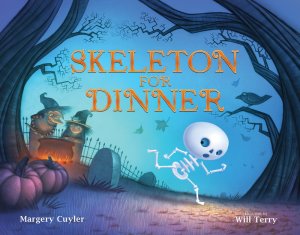 OK, finally I have to ask about your interest in skeletons!
When I was five years old, I had several ribs removed during an operation. I remember becoming fascinated by the fact there was this invisible, bony frame under my skin and I started drawing skeletons. It’s actually quite amazing I didn’t grow up to be an orthopedic surgeon! Then as an adult, I wrote a children’s book called SKELETON HICCUPS which generated and continues to generate mail from children. Often I received requests to write another skeleton book and that led to SKELETON FOR DINNER. (The paperback edition will be released in August 2020). The BONAPARTE books came about because I made a life-sized skeleton as a Halloween decoration and it fell apart. Rattle-clatter! (I’m really not very good at crafts!) That’s when the name “Bonaparte” popped into my head, a character begging for a story.
Margery, that’s an awesome story-behind-the-story! I love that your five-year-old self is still fascinated and I’m thankful that curiosity brought us such a winning character.
Blog readers, you can win a copy of BONAPARTE PLAYS BALL!
Leave one comment below to enter.
A random winner will be selected in two weeks.
Good luck!
Let’s play ball!
 Margery Cuyler’s career has been devoted to children’s books. She has written more than 50 books, served at the executive level in the children’s divisions of several publishers, and continues to enjoy interacting with children, teachers, and librarians on school visits. She and her husband, the parents of two grown sons, live in Lawrenceville, NJ. Visit her at margerycuyler.com and on Twitter @cuylermargery.
I pressed pause on the blog but realized–hey, now is the perfect time to be talking about books! We all need them, and thanks to much of the country being shut down, people need to learn about wonderful new ones.
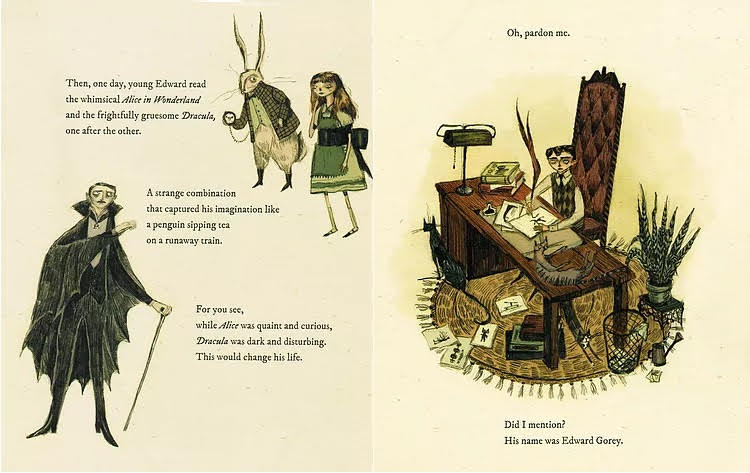
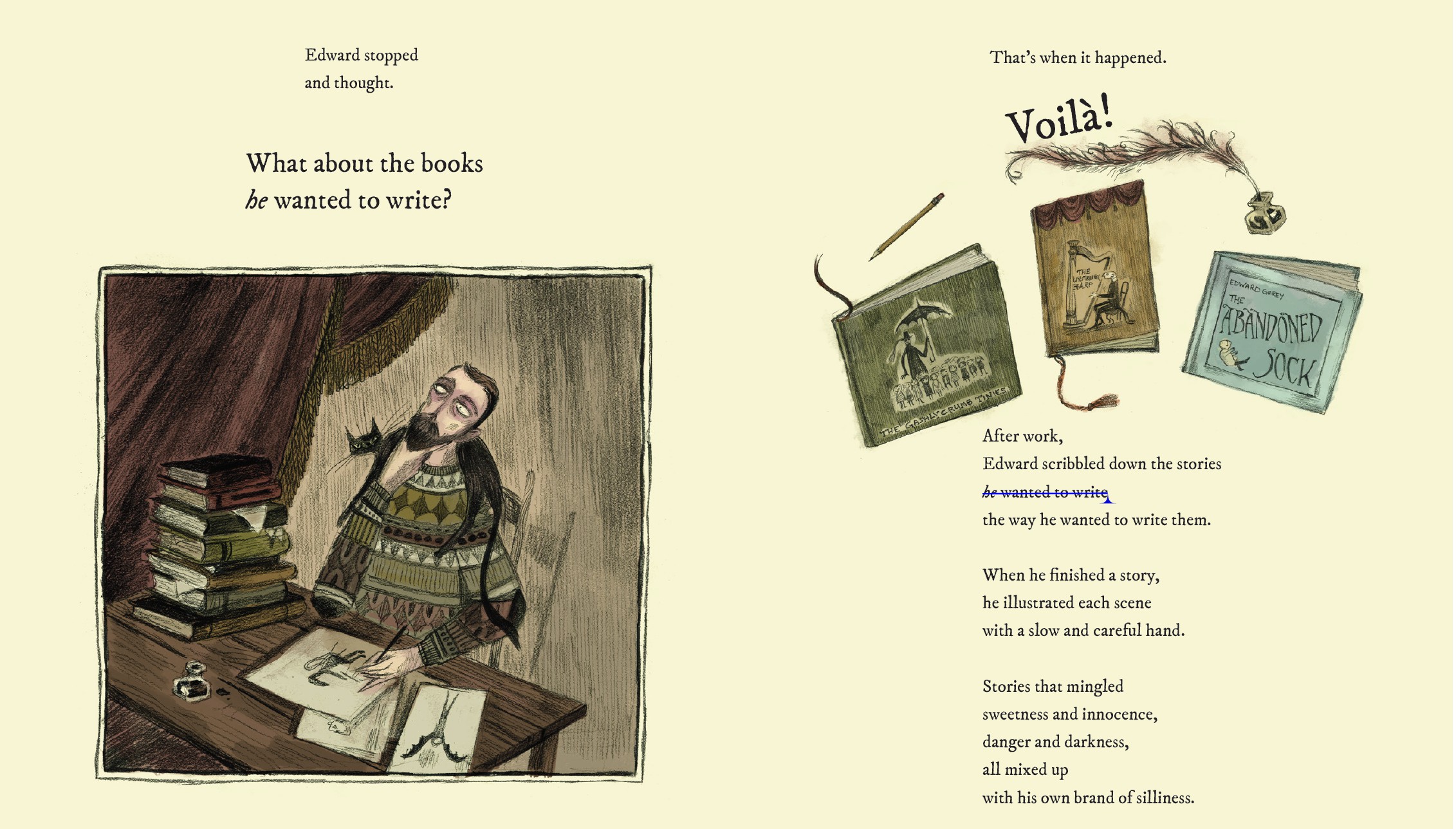
Last week, Lori Mortensen released her newest book and it’s a wondrous NONSENSE! romp. No, the book isn’t filled with language you can’t understand! It’s about the quirky genius, author-illustrator Edward Gorey.
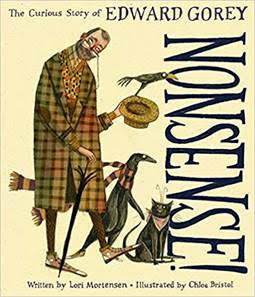
Lori, why did you want to write about Edward Gorey?
I was reminded of Edward Gorey one day while I was out on my morning walk and happened to catch a podcast about him on “Stuff You Missed in History Class”. As I listened, his name and dark style reminded me of a book from my childhood. When I arrived home, I found the book I’d been thinking of—THE MAN WHO SANG THE SILLIES. It was a collection of odd poems written by John Ciardi and illustrated by Edward Gorey.
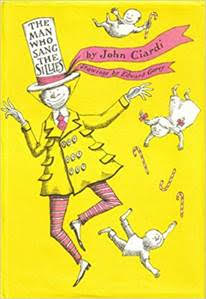 One of the most memorable poems, “The Happy Family” began:
Before the children say goodnight,
Mother, Father, stop and think:
Have you screwed their heads on tight?
Have you washed their ears with ink?
The poem was accompanied by Gorey’s memorable illustration of children trying to catch their floating heads.
As I delved into the research, I couldn’t wait to write an equally memorable picture book biography about this curious, whimsical, one-of-a-kind artist.
Why do you think we don’t see more books with children’s heads floating away? I mean, it’s dark, but it’s equally zany and humorous!
Bring on the floating heads! Actually, while THE MAN WHO SANG THE SILLIES was a bit of silly unexpected fun in 1961, I’m delighted children’s literature has continued to grow, expand and evolve in so many wonderful directions. The best part has been, and is, being part of this wonderful industry as well. Some of my favorite picture books include I JUST ATE MY FRIEND by Heidi McKinnon, SAM AND DAVE DIG A HOLE by Mac Barnett and Jon Klassen, and RUDE CAKES by Rowboat Watkins. Zany. Silly. Clever. Sign me up! It doesn’t get better than that.
Telling a life story in the compact space of a picture book is a difficult task! How did you find your focus for this biography?
People’s lives are always vastly more complex than what can be included in a picture book. As you noted, the key is to find that thread or focus that ties certain events in a subject’s life together in a meaningful way. Interestingly, as I researched Edward Gorey’s life, a particular thread stood out right away—how a brilliant child turned into the curious, mysterious, eccentric and whimsical creator we know today and influenced so many others along the way.
After writing about this creator of silly and zany, do you have any plans for those kind of fiction PBs yourself?
Humorous, zany picture books are some of my favorites and I’m always excited to write (and read!) new ones. One of my most popular silly and zany titles is COWPOKE CLYDE AND DIRTY DAWG, where Cowpoke Clyde spots his ol’ dirty dawg, but when Clyde tries to give him a bath—the chase is on! It was great fun to figure how it would all turn out. Does Dawg get his bath? That’s the question, isn’t it? Next year, Abrams will release my new silly and zany picture book, ARLO DRAWS AN OCTOPUS, illustrated by wonderful Rob Sayegh.
Do you have any surprising “making of” stories?
Interestingly, before the coronavirus hit, I would have shared where-I-got-the-idea stories about some of my favorite stories, such as CINDY MOO (I saw a cow-jumping-over-the-moon figurine at the thrift store) or COWPOKE CLYDE AND DIRTY DAWG (my neighbor’s dogs used to regularly escape from their backyard and race down the street, hence the chase to catch the dog for a bath), but these days, I’ve entered a whole new realm of surprising “making of” stories when I began tackling author videos for some of my publishers who encouraged them.
Yes, it’s a whole new world for book videos! Not something authors are used to doing!
For my first project, decided to do an author reading of my picture book biography, AWAY WITH WORDS, THE DARING STORY OF ISABELLA BIRD. You’d think it would pretty straight forward—sit down and read the book, for goodness sake! Over the course of a week, I filmed in my office, then in the backyard, then to a local park, but every location had its problems from neighbors bouncing their basketball, to chatty people wandering by in the park. Then, my husband said, “Hey, why don’t we drive up to the mountain top where I go paragliding?”
Suddenly, the only location that made sense was the mountain top. So off we went. An hour later, there I was. By now, I’d read the book about a zillion times, and after recording a read aloud for the third time for good measure on the mountain, we went back home. Surely, we’d done everything we could do. However, when I looked at the video more closely at home, (I’ve since learned how to see results on location—duh!) I realized the shot was pulled in too close. Shouldn’t you be able to see the book in my hands while I’m holding it? And wasn’t the top of the video too close to the top of my head? Ack! I tried to convince myself that it didn’t matter. And, after all, if I wanted to redo it, I didn’t have to go back to the mountain. Now that we knew what to do, we could go to the nice woodsy park.
 But somehow by morning, only the mountain would do. So we went back and videoed again. The good news is tomorrow, April 7, Peachtree will be sharing my reading of AWAY WITH WORDS on Instagram. Although I’m not riding a horse up a volcano, or hiking across the numbing, windswept desert at the roof of the world like Isabella, I think she would be pleased. (I am, anyway!) Since then, I’ve made several other author videos. Check them out here!
Lori, thank you so much for this quirky look at a visionary creator. And I also have to thank you for nudging me to blog again! We all need the hope that new books provide!
Blog readers, leave one comment below and you can win a copy of NONSENSE! THE CURIOUS STORY OF EDWARD GOREY.
Of course, it will be shipped when publishers get back to their offices. Good luck!
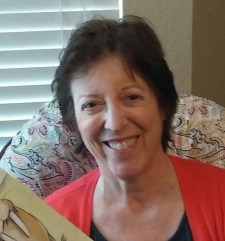 Lori Mortensen is an award-winning children’s book author of more than 100 books and over 500 stories and articles. Recent releases include her picture book biography, AWAY WITH WORDS, THE DARING STORY OF ISABELLA BIRD (Peachtree), about the first woman inducted into the Royal Geographical Society, IF WENDELL HAD A WALRUS (Henry Holt), CHICKEN LILY, (Henry Holt), Mousequerade Ball (Bloomsbury) illustrated by New York Times bestselling illustrator Betsy Lewin, and COWPOKE CLYDE RIDES THE RANGE (Clarion, 2016). When she’s not letting her cat in, or out, or in, she’s tapping away at her computer, conjuring, coaxing, and prodding her latest stories to life. For more information about her books, events, critique service, and upcoming releases, visit her website at lorimortensen.com.





 Writing for Kids (While Raising Them)