You are currently browsing the category archive for the ‘STORYSTORM 2025’ category.
by Alan Silberberg


 Alan is a cartoonist and writer who loves making funny food books for kids. P is for PASTRAMI – The ABCs of JEWISH FOOD keeps company with MEET THE LATKES, MEET THE MATZAH and MEET THE HAMANTASHEN (Viking/ Penguin Random House). His new book, THE BAGEL WHO WANTED EVERYTHING will be published Summer 2025 followed by THE FALAFEL WHO FELT AWFUL in 2026.
His illustrated middle-grade novel, MILO; STICKY NOTES & BRAIN FREEZE won the SCBWI Sid Fleischman Humor Award.
Alan is from Boston but happily lives in Montreal.
He likes chocolate chip cookies.
Learn more at SilberBooks.com and follow him on Instagram @alan_silberberg.

Alan Silberberg is giving away a signed copy of one of his books, one lucky winner’s choice.
You’re eligible to win if you’re a registered Storystorm 2025 participant and you have commented only once below.
Prizes will be distributed at the conclusion of Storystorm.
by Joann Howeth
People ask what inspired the writing of my picture book biography THE MOLLYS B. and why I chose the parallel story-telling format. It started with an incident in which a heifer executed (forgive the pun—perverse, for sure, but for some reason makes me chuckle) her grand escape from a slaughterhouse in Great Falls, Montana in 2006. That was a busy year for me; I was taking care of my elderly parents, working full-time, and just getting through each day. I remember reading the article about her in the local newspaper. Mostly, I was amused, but I was also inspired by this bovine’s determination and pleased that she had been granted clemency. I cut it out of the newspaper, added it to a folder about animals I’d been keeping for years, and then forgot about it.
Eight years later this heifer made the news again. The article provided a recap of her escapade (hilarious again in its retelling) and proceeded to tell readers about what she’d been doing in the intervening years. Having evaded slaughter and now named Molly, she had been a resident of two large animal sanctuaries. When both of those operations had to close, a third home was found for her at a farm animal sanctuary located in my hometown. The story once again tickled my funny bone, so for my own amusement, I cut the article out of the newspaper, filed it away, and proceeded to forget about it.
By this time, my parents had both died, I was no longer working full-time, and I was engaged in learning the craft of writing children’s books. Always on the lookout for story ideas, I visited my folder about animals where I stumbled across the newspaper articles about Molly. I remember thinking what fun it would be to write her story, but how? A cow escaping from a slaughterhouse? For children?
Fast forward another eight years: it was November. My husband and I were flying home from New York City, and I was as sick as sick could be—the kind of embarrassing sick that had me using the motion sickness bag. And in that weird, brain-fogged, “please let me die” place, I was touched by magic, and THE MOLLYS B. landed in my lap.
In 2006 when Molly the heifer was recaptured and returned to the meat packing plant, the manager didn’t have the heart to send her back to the slaughter pens. Her gumption to overcome her fate spoke to him. He secured her freedom and humorously named her “Molly” after the original unsinkable “Molly”—Margaret Tobin Brown— famous for having survived the sinking of the RMS Titanic in 1912. He saw that the two females shared a natural buoyancy: not only had Molly the heifer survived encounters with moving objects (cars, trucks, and a train), like Margaret she had also survived an ordeal with water—a fast-moving ride down the Missouri River.
In my flulike stupor, I envisioned these two, indomitable gals side-by-side. The text started unfurling and with racing thoughts, I dictated it to my husband, who patiently let me interrupt his reading each time I leaned over with a fresh line. I wrote the first draft of THE MOLLYS B. in four brain-addled hours, but it’s evident that the desire to tell this story had been germinating a long time—sixteen years! Success? Yes, sort of. I had found my way into the story. I had words down on paper, but I still had a sticky problem.
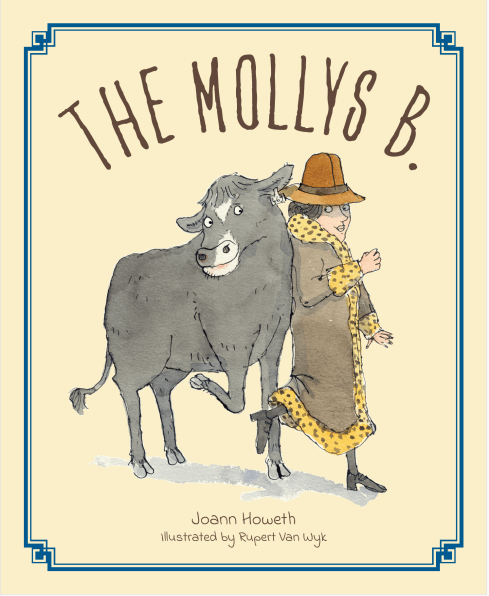
Photo credit: Blue Balloon Books
How does one explain a slaughterhouse to little children? What was my responsibility here? I really wanted to tell Molly’s story—her gumption inspired me. I wanted to celebrate that. But how? Finally, I decided I could tell the story by focusing on one single, shared experience, and how both females, from places of determination and inner strength, fought to save their lives.
Fast forward another two years: after a year of conducting interviews, obtaining testimonials from experts, purchasing licenses for photographs, rewriting, and revising, and then another year of working with a publisher and illustrator, the dual story of the Mollys is at last ready for its audience. It has been a long journey, demanding an amount of patience for which no synonym exists, but I’ll tell you what—it has been FUN! With capital letters. Immensely rewarding and gratifying, I wouldn’t change any part of it.
So don’t ignore those niggling ideas that keep you awake at night, no matter how outlandish they may at first seem. One of those ideas may be a story longing to be told and you may be the only one who can tell it. Find your way into it and start writing!
*Footnote: for the parents of the astute child who questions Molly’s presence in a slaughterhouse in the first place, my book provides resources that will hopefully guide them in finding answers for the toughest of questions they may find lobbed at them.

Photo credit: Adler Boncher Creative
Expecting to become a high school English teacher, Joann was secretly relieved when a scarcity of jobs following graduation nudged her into a complete change of directions. Finding employment in the jewelry industry, she spent many happy creative years as a designer and goldsmith. Comparably satisfying, Joann now writes children’s books. She is a member of the SCBWI and the winner of a handful of awards. THE MOLLYS B. is her second book. Joann makes Montana her home. Visit her at JoannHoweth.com and follow her on Instagram @joannhoweth.author.
Joann Howeth is giving away a signed copy of THE MOLLYS B. to one lucky winner.
You’re eligible to win if you’re a registered Storystorm 2025 participant and you have commented only once below.
Prizes will be distributed at the conclusion of Storystorm.
by Michelle Schaub
Just as the variety of scrumptious flavors in a layer cake tantalize taste buds, layers in a children’s book deepen its richness. What do I mean by layers? In my mind, a layer is any distinct element that connects with readers. This might be a specific topic, like polar bears or pies, a theme, like friendship or forgiveness, or a curricular subject, like geography or government. The more layers a picture book contains, the wider its reader appeal.
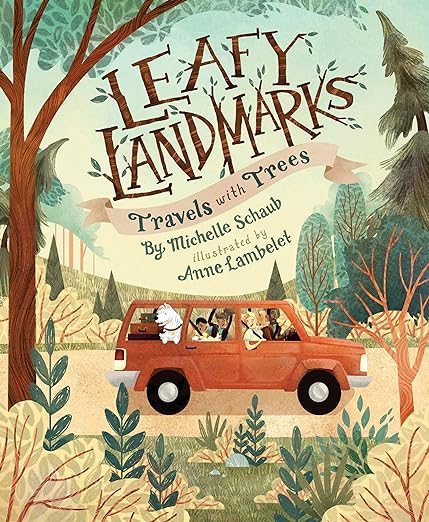
I discovered the importance of layers during my eighteen-year publication journey with LEAFY LANDMARKS: Travels with Trees, illustrated by Anne Lambelet and published by Sleeping Bear Press (March 2024). It’s a family road trip through poems to visit 14 famous and historic trees around the United States.
I wrote the first version of this book in 2007, after discovering that a burr oak my children and I liked to picnic under at our local arboretum had once been a gathering place for the Potawatomi people. This sparked the question, “What other important historical moments have trees witnessed?” Through research, I discovered hundreds of famous and historic trees around the country. I gathered the ones I found the most in-TREE-guing (sorry, couldn’t help myself), wrote a narrative vignette about each, and organized them chronologically according to historical moments. From the start, I had two layers: history and trees. Pretty tasty, I thought.
After several years of submission and rejection, I realized that my vignette approach (too many words!) was falling flat. At this point, I had been honing my poetic voice and successfully publishing poems in children’s magazines and anthologies. I decided to trust my palette for poetry and add this layer. I trimmed the vignettes into sidebars and wrote a poem for each tree. As an educator, I know that teachers seek out poetry collections that model different poetic forms, so I used a variety of unique forms, from etheree to zeno. With three layers, my flavor profile was expanding.
I got some nibbles of interest, but no bites. I had an inkling that my chronological structure wasn’t appealing to kids’ (or editors’) appetites. I thought back to what made my own kids excited to join me on tree research trips. The thrill of the expedition! So, I reframed the collect as a family road trip. Until this point, most of the trees I featured were from the eastern US. I extended the road trip to include trees from western states, including the Grove of Titans in California, home to the tallest trees in the world, and the Pando Aspen Grove in Utah, which is one giant organism with over 40,000 cloned trunks. I also added an introductory poem, “Hit the Road” and a map to indicate the locations of the trees along the road trip route. With geography added to the book’s layers, I finally struck the right flavor balance to tantalize Barb McNally at Sleeping Bear, who purchased the manuscript!
Yes, layers add appeal to children’s books. In my years of reading manuscripts with the Rhyme Doctors (the critique business I run with fellow “docs” Eileen Meyer and Patricia Toht), I’ve learned that layers are often what’s missing in novice manuscripts. I encourage clients to seek out fun and unique flavor notes to add to their stories. But this doesn’t mean opening that writing spice cabinet and randomly sprinkling in additional topics, themes, or formats. Cayenne pepper might add zing to a chocolate cake, but mixing in sardines? I don’t suggest it. Likewise, you want to layer topics and themes into your story that, while surprising, meld in a cohesive, balanced way.
I love giving my Rhyme Doctors’ clients mentor texts to help them during revision. So here are a couple recent picture books that showcase a creative but cohesive use of layers:

The Reindeer Remainders: A Lesson in Working Together and Including Others by Katey Howes, illustrated by Marie Hermansson (Sourcebooks, 2024)
This book expertly layers math with social emotional learning topics such as friendship and inclusion, all in a pleasing rhyming narrative. Sadly, Katey passed away unexpectedly in 2024, but her spirit lives on in her heartfelt picture books.

Nancy Bess Had a Dress, by Claire Annette Noland, illustrated by Angela C. Hawkins (Gnome Road, 2024)
The scrumptious layers in this book include historical fiction, crafting, recycling, and through the art (yes, art can add layers too,) a growing family.

From Park to Playa: The Trails that Connect Us, by Nell Cross Beckerman, illustrated by Sophie Diao (Cameron Kids, 2024)
This book creatively layers urban communities, diverse cultures, nature, and lyrical language.
Looking for layer inspiration? Try browsing following curricular “cookbooks.” (Note: Curriculum standards can differ state by state, but these sites provide an idea of topics covered at various grade levels.)
- Social Emotional Learning Standards
- Next Generation Science Standards
- National Curriculum Standards for Social Studies
- Math Core Standards
Happy baking—I mean writing—everyone!
Michelle Schaub is an award-winning children’s author, poet, and teacher. Her most recent books are A Place for Rain (an Indiana Library Federation 2025 Best Read Aloud selection) and Leafy Landmarks: Travels with Trees (a California Reading Association 2025 Eureka Gold and NCTE 2025 Poetry Notable.) Michelle mentors aspiring children’s book writers through the Rhyme Doctors. She lives in Colorado, where she enjoys biking, hiking, and eating layer cake with her lazy golden retriever named Bear. Learn more about Michelle at MichelleSchaub.com and follow her on Instagram @schaubwrites.
Michelle Schaub is giving away a signed copy of LEAFY LANDMARKS to one lucky winner.
You’re eligible to win if you’re a registered Storystorm 2025 participant and you have commented only once below.
Prizes will be distributed at the conclusion of Storystorm.
You know that writing friend you have? The one you haven’t spoken to in you-can’t-remember-how-long, but you’re pretty sure it was pre-pandemic?
Yeah, her.
Call her.
Can you believe she hasn’t put out a new book in ages? Or that she hasn’t written anything new lately?
Well, I can’t believe it, either!
Tell her to stop being so selfish!
She’s keeping all her talent and creativity to herself and not sharing it with the world! She is selfishly depriving us of her genius! Her unique perspective! Her inspirational voice!
Once you tell her, she will thank you.
And then she’ll tell you to DO ALL THE THINGS.
It doesn’t matter if THE THINGS get published or not and make money or not. DO ALL THE THINGS just to do them. Because doing the things you do makes you happy. They don’t have to yield anything BUT JOY IN THE DOING.
There.
Now, wasn’t that call good?
Don’t you feel motivated?
She does, too.
Yay.
Pass it on.
More than you want to know about Tara is here.
Tara Lazar is giving away a fiction picture book critique to one lucky Storystorm winner.
You’re eligible to win if you’re a registered Storystorm 2025 participant and you have commented only once below.
Prizes will be distributed at the conclusion of Storystorm.
by Lisa Gerin
As a former elementary school teacher-librarian, I must have done 1000s of story times. And kids always loved the books that had repetition, rhymed phrases or refrains we would repeat together. So why did it take me almost ten years to use this technique in my own writing?
Now I’m primarily a writer of nonfiction picture books. I first go down the research rabbit hole looking for facts and quotes to use as inspiration for the rest of my text. Then after jotting down my first drafts, I go back and try to insert more lyrical language. It wasn’t until I sold my first biography in 2020, that I realized that a repeated refrain was going to be my book’s hook and subsequently its title. I had written two prior picture book bios and a slew of fiction before I honed my craft and sold my first title, a biography about British scientist Rosalind Franklin for kids.
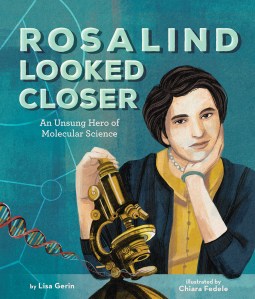
ROSALIND LOOKED CLOSER: AN UNSUNG HERO OF MOLECULAR SCIENCE (Beaming Books 2022) was not the original title of my manuscript. It was originally entitled THE GIRL WHO LOVED SCIENCE. After my editor thought the book needed something to spice up the writing, I came up with the refrain “Rosalind always took a closer look.” With the rule of the power of three for picture book writing, I put the refrain in the text 3 times. It also ended up becoming the last line in the story and inspired the new title.
Here’s a look at two of the pages in the story with the refrain:

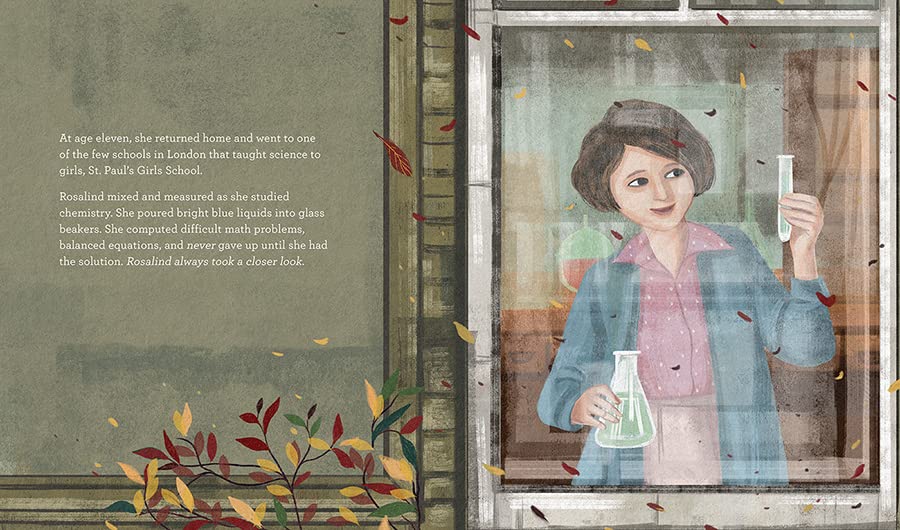
In looking at your own writing and when revising, think about using a refrain. It’s like the chorus in a song that children always remember. Refrains work in fiction and nonfiction picture books. Try a refrain in your next writing project; it may just change your direction and give you a new hook you didn’t know you needed!
Here’s one of my favorite fiction books that uses refrain, PETE THE CAT AND HIS FOUR GROOVY BUTTONS, from the Pete the Cat series by Eric Litwin and James Dean. Happy writing!


Lisa Gerin is a former school librarian and high school teacher with a master’s degree in education. She writes creative nonfiction and biography for children. She lives in Tucson, Arizona, but was raised in New York City.
She is the author of the Junior Library Guild Gold Standard selection: ROSALIND LOOKED CLOSER: AN UNSUNG HERO OF MOLECULAR SCIENCE (Beaming Books) 2022. In September 2022, she spoke to NPR radio, ARIZONA SPOTLIGHT, about her book. In 2023, she appeared on a children’s panel at the Tucson Festival of Books, talking about research methods in writing nonfiction for children. She loves doing school visits. Her newest picture book biography publishes in 2026 with Beaming Books. Find out more about her at LisaGerin.com and follow her on Instagram @_.lisagerinwriter.
Lisa Gerin will give 2 winners a choice of either a critique of their picture book (fiction or non-fiction) or a copy of ROSALIND LOOKED CLOSER.
You’re eligible to win if you’re a registered Storystorm 2025 participant and you have commented only once below.
Prizes will be distributed at the conclusion of Storystorm.
by Nancy Stewart
“What in the world is voice?”
When I was a fledgling author, this would not have been an unusual question for me. In fact, as I look back at those years now, I realize how much I did not know about many aspects of writing. I have also learned that it usually takes a lot of writing to become proficient. After much practice and (I’ll admit it) several books for children, I began to realize how crucial voice is for an author to have any hope of connecting with a reader.
Here are some things I have learned about voice, how one can “capture” it and then use it to your and your reader’s advantage. After all, voice says so much. However, sometimes it doesn’t have to say much at all. The expression can be transferred through gazes, sighs, etc. as long as voice is evident to support expression.
To begin finding and using one’s voice, is to write at least your initial attempt in first person. This is the closest an author can get to the inner thoughts, feelings, hopes and dreams, especially to the all-important protagonist.
Stay close to the emotions of your cast of characters. I find if I can almost be “at one” with them, voice comes more easily. If there is anything similar about them to you (and let’s face it; there always is a chard of memory from our own past), mine it. Go deep into your past. Find the feelings—comfortable or not. It is amazing how much better and authentic your book will be!
If these tips seem heavy on knowing your protagonist/s emotions, then you would be right. One can never know too much about their characters. Knowing their hearts, desires, fears, goals and needs will help the author know what to say or do or act in an accurate manner. AND it will help your reader understand why the characters act the way they do.
When I began writing my Middle Grade novel, Me and the Missouri Moon, two years ago, I knew that I was a different author. That knowledge took me nearly eight years to attain. I knew from the outset that the protagonist, Scarlet, was going to triumph through the troubles that beset her, and how her best friend, Cricket, her mama, and several others, would help her save the day. Voice helped save the day. And the practice of listening to one’s characters and speaking for them in their voices is what makes reality happen in a book of fiction.
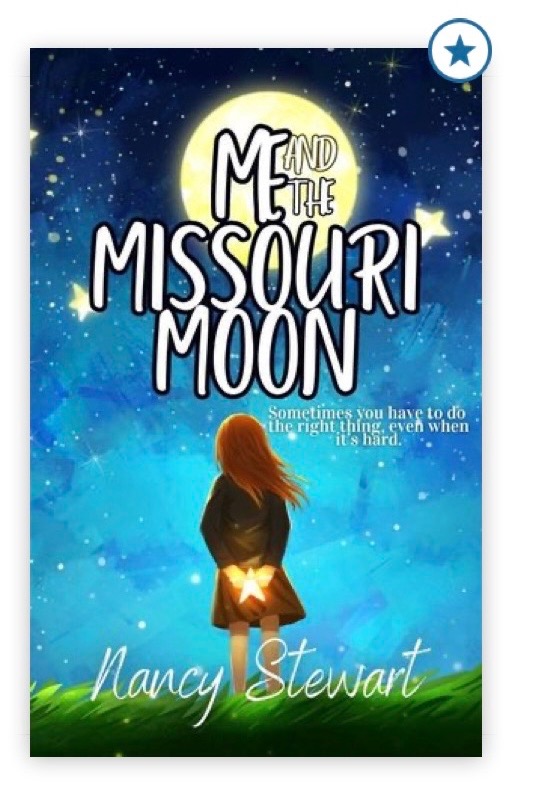
An example of voice used in Me and the Missouri Moon:
I propped my elbows on the chilly windowsill and rested my head on my hands. Tears plopped down on it, and I wiped them off the wood with my PJ top. Between Cricket, and Malcom, and Daddy, these past three months had been the best and the worst of my life.
The moon was all fuzzy when I looked back up at it through teary eyes. “Remember when I asked you to guide me like the North Star? Well, I needed your help then, but tonight I need it super bad. Problem is, I wasn’t constant and true to my best friend. Now, she won’t be my friend anymore, ‘cause I was mean to her without any real reason. But I believe in your magic, like Grandma says. So, if you could help me, I’d surely appreciate it. That’s all. Good Night.”
I climbed into bed, wiped the last tears away, and snuggled into my comforter. But as much as I loved that old moon, I knew in my heart it couldn’t help me. I was the only one who could.
This book is a starred Kirkus Star winner, 2024.
 A graduate of Washington University in St. Louis, Missouri, Nancy Stewart taught grade school and was a university professor, specializing in Children’s and Young Adult Literature. She was fortunate to have lived in London with her family for a number of years and, while there, traveled the world, particularly Africa. Nancy’s debut Young Adult novel, Beulah Land, was a finalist in the Forward Indies Book of the Year Awards. It was also one of the most anticipated books at Barnes & Nobel in 2017. Her new Middle Grade novel, Me and the Missouri Moon, won a Starred Kirkus Award in October 2024, a star from The Children’s Book Review, and a gold medal from Literary Titan. Visit her at NancyStewartWrites.com and follow her on Instagram @rosenthalstewart.
She, her husband, and their (adopted from the Missouri Ozarks) pup, Louie, live in Tampa, Florida.
Nancy Stewart is giving away a signed, soft-cover copy of her book Me and the Missouri Moon.
You’re eligible to win if you’re a registered Storystorm 2025 participant and you have commented only once below.
Prizes will be distributed at the conclusion of Storystorm.
by Tanya Konerman
“Put your ear down close to your soul and listen hard.”
–Poet Anne Sexton
We’ve all heard the advice to “Write What You Know.” But I don’t adhere to that limiting concept, of writing about only that which I’ve gotten a degree in or do in my day job. Instead, I believe in “Write What You Love,” writing about that which fills my mind and heart the rest of the time, through serious hobbies or interests my family wishes I could stop talking about every chance I get.
“I think you’ve mentioned that obscure fact a time or two…”
Write What You Love is the idea that we all have concepts, items, places, people, moments, ideas, and ideals which are meaningful, important, and life-affirming for us. Each one of us feels strongly about different things, and that potency in feeling is what can make us strong writers about those things…IF we pay attention.
“Hello! Are you listening?”
For instance, I am a nature girl–always have been, always will be. Get me started on talking about forests, trees, frogs, turtles, birds, bears, or anything related to nature in general and you will have to stop me in my size 8 tracks.
This is why I also write about nature, and nature-related topics: because I can do my best writing when I look forward to it, when I am eager to share the deeply-ingrained or experience-obtained information I possess in a creative way that shares my passion with others, and when I pay attention to the topics which seemingly flow my way (yes, I do believe we attract that which we think about and act on most in our lives).
“It came to me in a dream…no, wait, it floated down from the heavens.”
Also, by writing MY passion, I am less likely to commit the ungracious and soul-crushing sin of “Passion Appropriation” (yes, I did just coin that!).
We’ve all been there. You’re drafting or revising or even subbing your newest book, based on your personal knowledge, extensive research, and thousands of hours spent reading, following, experiencing, and obsessing over your favorite niche topic. Then, you open your newest PW email to find an announcement that sends chills down your spine: YOUR BOOK is already being published via someone else, someone possibly not as ardent or heartfelt, perhaps not as “in the know,” maybe not as connected to the topic as you are.
“Woe is me. WHATEVER shall I do?”
And while you know your book may be different in every way that counts, you also realize the market for this topic has already been breached—perhaps even saturated depending on the topic—and your heart pinches while your body grows numb with shock and you whisper…
“If only I had gone into accounting instead…”
Do you really want to be responsible for this happening to someone else when you seize upon an idea you’re not the right person to claim? I sure don’t.
So if you’re looking for your next idea, one that will make your writing feel true and right (and, dare I say, easier than if you write about something you have no interest in), plus one that shows YOU are the best one to create this book, look no further than your heart and write what you love—Write Your Passion.
“I can’t believe I get to write about what I love…what a life!”
 Tanya Konerman is a children’s author, writing fiction and nonfiction in both prose and verse for kids ages 0-12. Her debut picture book, Mud to the Rescue! How Animals Use Mud to Thrive and Survive, is a lyrical nonfiction look at the ingenious ways animals around the world use mud. It is forthcoming May 20, 2025, from Web of Life Children’s Books. Tanya’s ghost story for 9-12 year-olds, “Danger in the Dunes,” was chosen to represent Indiana in the anthology for middle graders, The Haunted States of America, published by Macmillan’s Laura Godwin Books in July of 2024. Visit her at TanyaKonerman.wordpress.com.

Tanya is giving away a choice of: one copy of Mud to the Rescue! How Animals Use Mud to Thrive and Survive (must reside in U.S.; book will be sent after 5/20/25) OR a free picture book critique for a non-rhyming, 750-word or less picture book.
You’re eligible to win if you’re a registered Storystorm 2025 participant and you have commented only once below.
Prizes will be distributed at the conclusion of Storystorm.
Again, this is not an advertisement, just something I wanted to share.
You probably have a large collection of books. And, if you’re like me, they’re haphazardly scattered all over the house. BUT WHERE IS MY COPY OF [INSERT TITLE HERE]??? Lined up on the staircase, like in Richard Sherman’s apartment from “The Seven Year Itch”? Or in ascending size order on the living room window sill? Or tucked into the bedroom bookcase for a good night’s sleep?

Well, with the app libib, you can create a digital cloud archive of all the titles you own, and to easily add them to your collection, you scan the barcode quickly with your phone (or search and enter them manually). Organize your shelves any way you wish—by genre, by TBR piles, or by location in your home (genius). It is free for up to 5,000 books.
Just search for libib in the App Store or Google Play and download it while you wait for today’s Storystorm post, coming later this afternoon!
HAPPY CATALOGING!

by Becca McMurdie
 A few years ago, I had the tremendous opportunity to spend two months living and learning in Costa Rica. I will never forget my first encounter with a wild toucan in the Monteverde rainforest. Immediately fascinated by these majestic creatures, I vowed to learn as much about them as possible. A local birdwatching guide told me about a famous toucan at a nearby rescue center who had endured an injury and received a prosthetic beak—the first of its kind. Grecia was the bird’s name.
Curious about the story, I looked up local news articles online about it. I learned that the creation of Grecia’s prosthetic beak brought together scientists and engineers from around the globe. And not only that, the story of her injury and recovery inspired a wildlife protection movement that led to sweeping rainforest protection laws! The more I learned, the more inspired I was by the story. Why? A universal theme was emerging: While people are capable of harm and destruction (her injury was caused by humans), we are even more capable of teamwork, innovation, and love.
That winter, in Costa Rica, I was a pre-agented, pre-published author. I had only written fiction picture book manuscripts, which I had been querying for over six months. But something about this topic tickled my creative energy. There was an engaging character, a lush setting, a problem, a solution, and most of all a universal message that would pull the story together. Before long, I realized that my first narrative nonfiction picture book was coming to life. But I needed more, so I embarked on a life-altering research journey, including a visit to the rescue center where the story happened, and an interview with a member of the team involved in Grecia’s new beak. What began as curiosity and a desire to learn became the first draft of a manuscript that would eventually land me my agent AND my first book deal. BUILDING A BEAK: HOW A TOUCAN’S RESCUE INSPIRED THE WORLD released this past June with Page Street Kids.

This month, our challenge is to ideate and brainstorm and seek inspiration as much as possible. Just like with Grecia and her Costa Rican rainforest home, story ideas are all around us, even if we aren’t traveling and exploring the world. Do a quick scan in your mind for a real-life story that inspires you. This could be a heartwarming moment that you happened to see or experience on your morning commute. Or, maybe it’s an inspiring true story you learned from the news or social media. What happened, exactly, in this moment you experienced, or story you read about? Once you have a plot idea or a character that speaks to you, check in with yourself and your creative spirit. Ask yourself: Why does this story move me? What is the universal message we can glean from it? The answers to these two questions will reveal an emotional thread that will become the internal, emotional arc to your story.
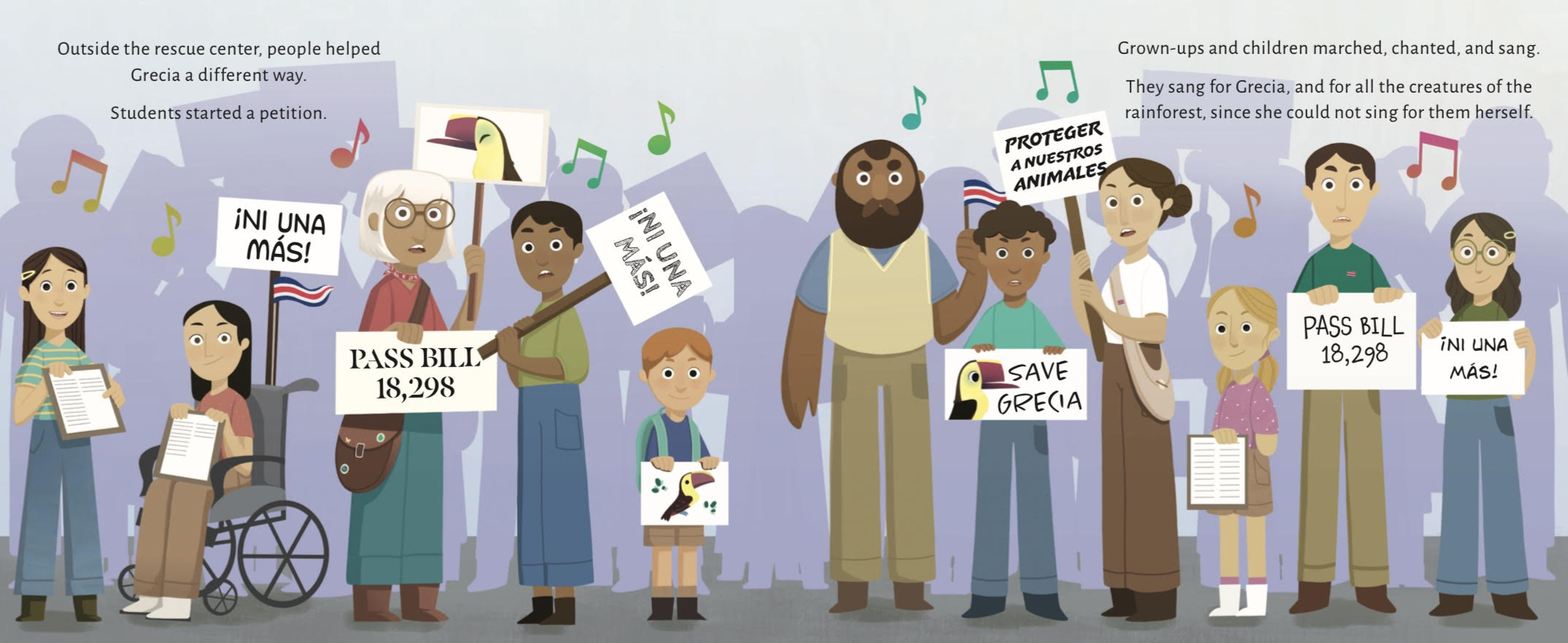
One of the greatest lessons Grecia taught me as a writer starting out in her career was that through observation, inspiration is everywhere. One of my upcoming books, JUST A PUDDLE…OR IS IT?, splashed into life after watching my two-year old nephew jump in puddles. The mud hole was just a puddle to me, but to a cat, it was a drink, to a bird it was a bath, and to my nephew, it was pure joy! And BOOM….a beautiful message about appreciation of different points of view emerged. The ideas and universal themes are everywhere!

 Becca is a preschool director residing in New York City. She is the author of BUILDING A BEAK: HOW A TOUCAN’S RESCUE INSPIRED THE WORLD, published by Page Street Kids in 2024, and JUST A SHELL…OR IS IT? and JUST A PUDDLE…OR IS IT? releasing with Abrams Appleseed in 2026 and 2027, respectively. Find out more about her at BeccaMcMurdie.com or on Instagram @BeccaMcMurdieBooks.
Becca McMurdie is giving away two prizes. Each winner has a choice of a fiction or nonfiction picture book manuscript critique OR a copy of BUILDING A BEAK: HOW A TOUCAN’S RESCUE INSPIRED THE WORLD.
You’re eligible to win if you’re a registered Storystorm 2025 participant and you have commented only once below.
Prizes will be distributed at the conclusion of Storystorm.
by Nancy Tupper Ling
When I visit schools or talk to future authors, I’m often asked: “How do I break into the world of writing?” My first piece of advice will resonate with all of you Storystorm folks. Start with an idea! Not just one idea, but two or three or . . . thirty, if you’re a full-fledged Storystormer!
Thankfully, our ideas flow from a variety of places (hikes, train rides, day-to-day observations at work). Along with this “idea factory” that we’re generating however, we need to actually write . . . eventually. (Sigh! or Huzzah!—depending on how you’re feeling at the moment.)
 T
T
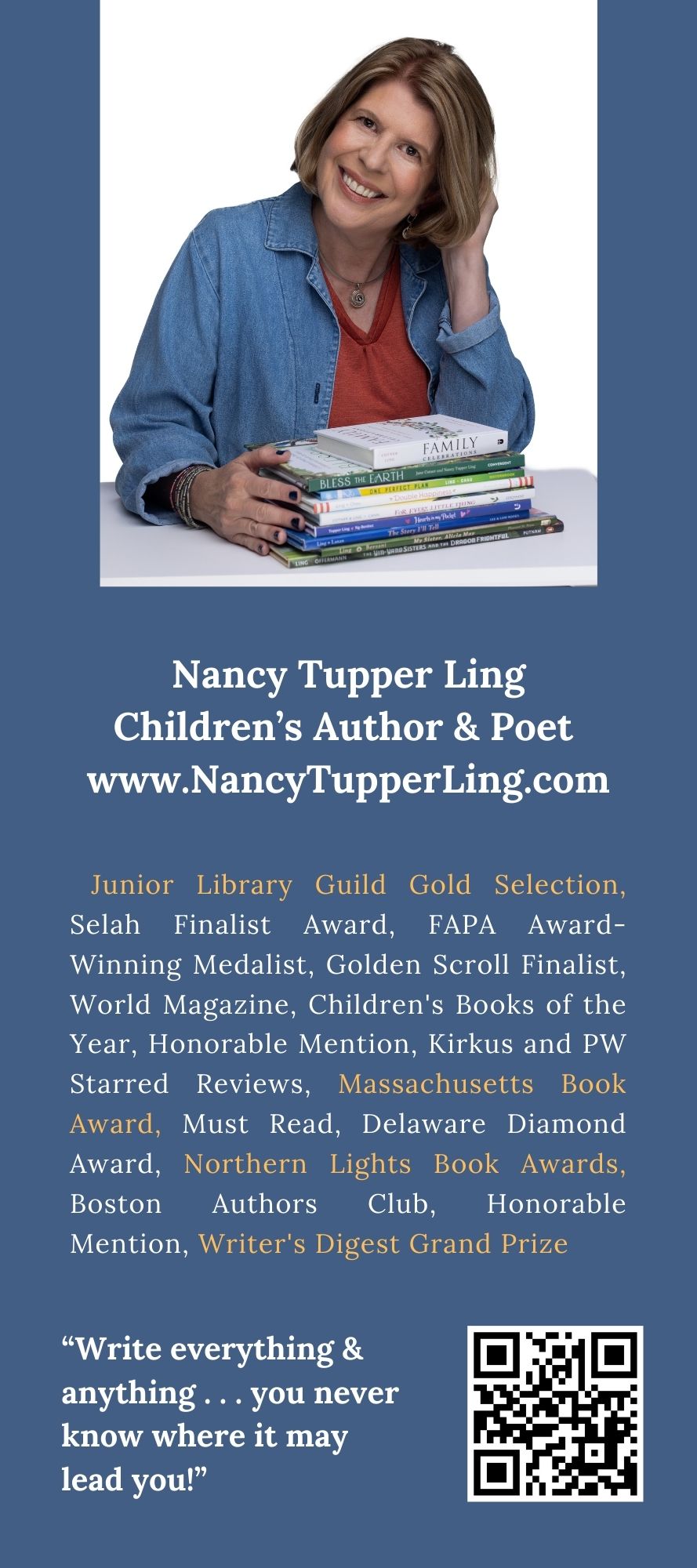
That’s where my second piece of advice comes in. As a matter of fact, I’ve pasted this quote onto my latest batch of rack cards: “Write everything and anything . . . you never know where it may lead you.” Sometimes this advice seems a bit shocking. After all, we’ve often been told that we need to hone our particular craft and concentrate on a certain genre, whether that’s picture books, middle grade, poetry, etc.
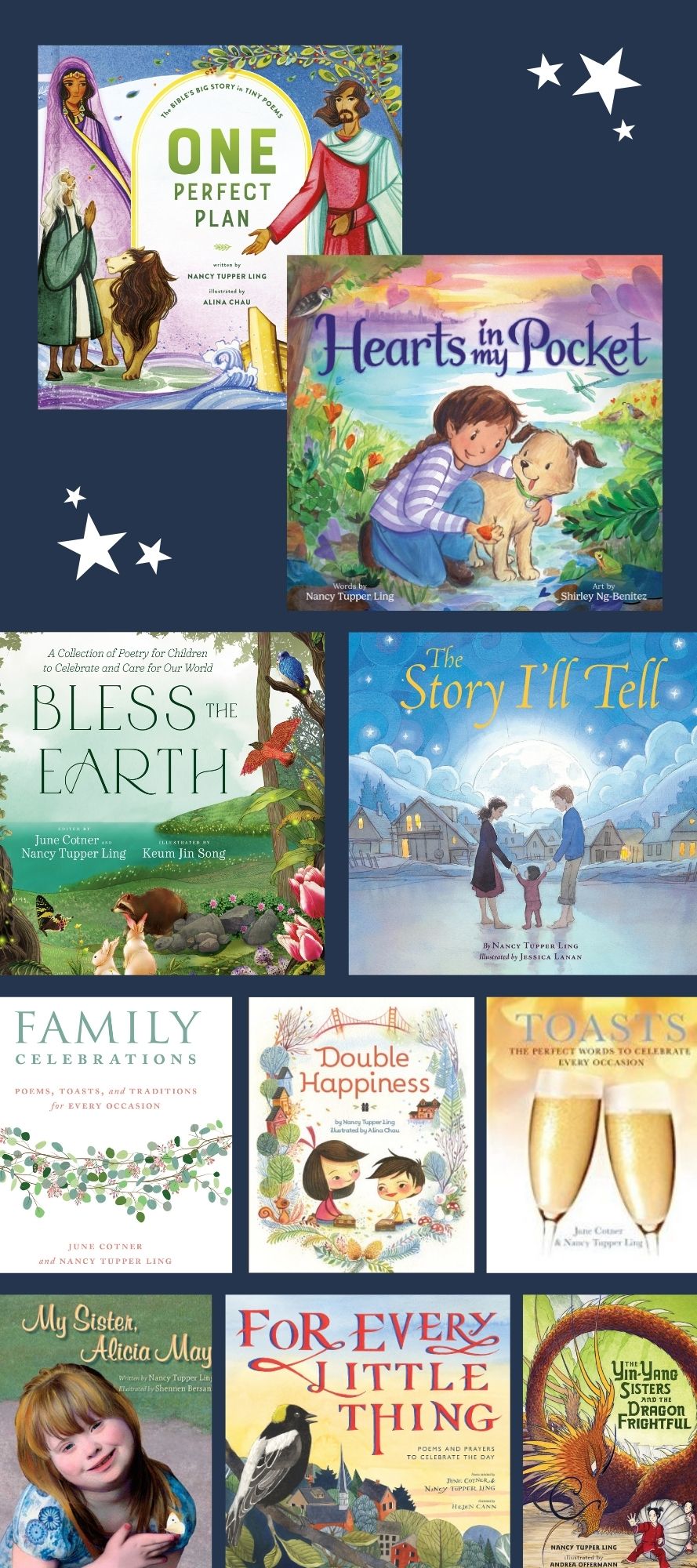
But nope! I’m here to disagree. I believe our writing improves and develops when we tackle a variety of genres simultaneously. Really, we are building our resumes and relationships in all that we do. A blog post might lead to an article; a short story might weave its way into a novel. Likewise, a poem might lead to a picture book. That’s exactly what happened to me with my most recent book, HEARTS IN MY POCKET (Union Square). It’s a true-blue example of how writing everything and anything can lead to amazing twists and turns.

Several years back, I wrote a poem entitled “Hearts in my Pocket” for the anthology, FOR EVERY LITTLE THING (Eerdmans Publishing), that I coauthored with June Cotner. The editor, Kathleen Merz, had asked for a poem related to divorce or separation. Of course, I sat down and penned one that evening. Certainly, that poem could have been all that I wrote. After several edits, it was included in our anthology. Done!
 But as Storystormers, we never shut off that “idea faucet.” Therefore, I began to wonder . . . could this poem possible turn into a picture book story? Believe it or not, it did, but not in an abracadabra kind of way. Rather, in a many drafts, edits, and tears kind of way. Eventually it sold to Union Square Kids in a bidding auction. Even now, my favorite parts of the story are its poetic spreads, where the reader can take a pause, enjoy the illustrations, and listen to the rhyming couplets such as: “Hearts break, leaves shake.”When we witness various forms of our writing coming together into one work, that’s a wonderful thing.

True, this January we’re in an ideas percolating stage! We’re not supposed to be thinking dark, heavy thoughts about submissions, acceptances, and publication. But let’s face it! It’s impossible not to wonder about these things. If we’ve been submitting for a while, we can’t help but fear rejection as well. Yet, I come bearing good news! While we await that first or next acceptance, we have some options. That’s the wonderful idea behind “writing everything and anything. You never know where it may lead you!!”
I’ve published the whole gamete—traditional, non-traditional, self-published, tiny chapbook press, faith-based, journals, start-up children’s publishers, and anthologies. Many of these genres don’t require you to have an agent and are open for submission. All that’s to say, play with your story ideas. Consider whether one or two might work their way into a poem or a short story instead. Then, take a chance and submit them. Believe me when I say, I cannot wait to hear about everything and anything that you write this year! Good things await!
Blessings!

Nancy Tupper Ling is a children’s author, poet, book seller and librarian. Her latest books are Hearts in my Pocket and Bless the Earth with co-editor, June Cotner. Along the way her work has received various honors including the Writer’s Digest Grand Prize, Delaware Diamond Award, Northern Lights Book Awards, and a Golden Scroll Award Finalist. Visit her at NancyTupperLing.com and follow her on Blue Sky and Instagram.
Nancy Tupper Ling is giving away 3 copies of HEARTS IN MY POCKET to 3 separate winners.
You’re eligible to win if you’re a registered Storystorm 2025 participant and you have commented only once below.
Prizes will be distributed at the conclusion of Storystorm.





 Writing for Kids (While Raising Them)