You are currently browsing the category archive for the ‘PiBoIdMo 2012’ category.

We’d all like to have a step-by-step guide to creating super-fantastic blockbuster children’s books. I’d buy that guide in a nanosecond. But I’m beginning to think that no such guide exists. I’m beginning to think we all have to figure things out for ourselves. In fact, I’m beginning to think it’s most important that we each learn to understand our own creative process, and when we understand our own unique ways of working we can each make our own unique “guide” to creating our own unique children’s books. Here’s what I’ve done to understand my creativity, and to devise my own “guide” to making children’s books—
Many of us have strong reactions to particular works of art. We’ll walk around a museum and say “Oh I love that painting SO MUCH” but we don’t always explore WHY we like it. So every now and then I make color copies, and tear out magazine pages, and print pictures from the internet, and I plaster my favorite images onto boards that I can move around my studio. I might dedicate one image board to my favorite color palettes, and another to my favorite compositions, and another to my favorite drawing styles. I surround myself with my favorite artwork.
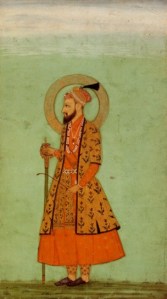
I always notice patterns in my tastes. I seem to love Folk Art and Indian court paintings. I love Lizbeth Zwerger and Kay Nielsen’s work, among others. I ask myself what it is, exactly, that I love about each of my favorite pieces of art. Slowly but surely, I develop a list of qualities that I love in other people’s art. The list of qualities is constantly changing, but it usually looks something like this…
QUALITIES I LOVE IN OTHER PEOPLE’S ART
- Naïve drawing (from Folk Art)

- Flat Perspective and Muted colors (from Indian Court Paintings)
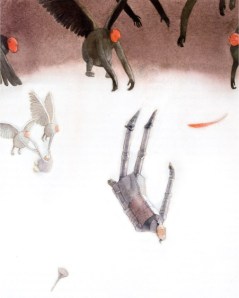
- Compositions with areas of openness vs. areas of detail (from Lizbeth Zwerger)
- Repeated patterns (from Kay Nielsen)

With my list of aesthetic qualities I love most, I then try to make art that incorporates those qualities. As I’m sketching a book dummy, creating final art, or simply doodling in my notebook, I keep that list in mind. If I stay focused, those aesthetic qualities will begin to appear in my work. Sure, I’m borrowing artistic styles, but by blending those qualities in different ways an entirely new art style emerges: MY style. My tastes are always changing, and so my style is always changing. I imagine someday I’ll settle into a consistent style, like most of my artistic heroes, but for now I’m quite happy making art that represents my current tastes and interests…however fleeting they may be.

From my upcoming book MR. TIGER GOES WILD, coming out in Fall 2013.
I use the same process with writing. It’s a little different, because image boards don’t really work with writings, but I can still analyze what writing I love and why. I make lists of the writing qualities I love most, and I try to incorporate those qualities into a new, unique writing style.
My process for determining HOW I want to write and illustrate is hugely helpful in determining WHAT I want to write and illustrate. If I know I want to combine spare, funny, dry language with flat, graphic, colorful illustrations, I can eliminate all of my picture book ideas that would involve muted colors, syrupy sweet morals, and complicated plots. My style helps me filter my ideas. I can focus on developing the two or three story ideas that will be complemented by my art and writing styles.
Of course, none of this matters if I have zero story ideas. But ideas are everywhere. So I always keep a little notepad with me, to jot down ideas when they pop into my mind. Sometimes the ideas come quickly. Sometimes I go months without having a single idea. But the ideas accumulate over the years, and whenever it’s time to begin a new project, I have my own little “guide” to determine HOW and WHAT to make my next book.
So get to know your own style and tastes. And when you have a better understanding of your creativity you can begin to make your own unique “guide” to creating your own unique children’s books.
P.S. If you’re a writer but not an artist, consider exploring what art styles would complement your writings. You might even want to modify your writing style to better match the style of art you’d like in your books.
P.P.S. If you’re an artist but not a writer, consider exploring what writing styles would complement your art. You might even want to modify your art style to better match the style of writing you’d like in your books.
.
 Peter Brown writes and illustrates books for young whippersnappers. He grew up in Hopewell, New Jersey, where he spent his time imagining and drawing silly characters. He studied Life Lessons at the School of Hard Knocks, and then got his B.F.A. in Illustration from Art Center College of Design in Pasadena, California.
After college Peter moved to Brooklyn and spent several years painting backgrounds for animated TV shows. And then in 2003 he got a book deal to write and illustrate his first picture book FLIGHT OF THE DODO, which is a story that involves bird poop…in case you’re into that kind of thing. Since then he’s written and illustrated three more picture books, and illustrated several other books for young whippersnappers. His books have been adapted into plays and animated short films, they have been translated into a dozen languages, and they include the 2010 E.B. White award winner, Children’s Choice Award winner, and New York Times bestselling book THE CURIOUS GARDEN.
His books CHILDREN MAKE TERRIBLE PETS, YOU WILL BE MY FRIEND! and his latest book, CREEPY CARROTS! are also New York Times bestsellers and award winners.
You can find out more about Peter and his books at PeterBrownStudio.com.
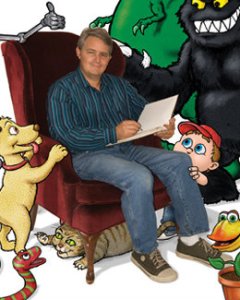 Actually, I love picture books, but I do have a new book coming out next year called I HATE PICTURE BOOKS!. I’m going to tell the story of how I had the idea for this book, but I want to back up a bit first.
Ever since I was a kid, I drew pictures and made clay sculptures of little guys and strange creatures. They always had stories of who they were and what they were doing, but that was in my head. I was an artist—not a writer—and I always figured that a writer would come along and look at my work and they would say “That looks good, let me write down the story of what you drew.” I don’t know what happened to that guy because he never showed up.
About 6 years ago, I finally realized I was going to have to write my story ideas myself. I wrote down a bunch of my ideas and worked them into stories that I thought were good and put together some sample pages of the illustrations and I felt I was ready to go. I had the good fortune of meeting an author who set up a meeting with Heidi Kilgras at Random House. I showed my ideas to her and although she said some nice things about the books I was showing her, what she really liked was my logo. It was on the bottom of every page and she kept saying how much she liked it and finally she said she wanted to do a book that looked like my logo.
So now I had a challenge. I knew the style of the book, now I needed to find the story and the illustrations that work in that style. On the long drive home from New York I had a million ideas running around in my head… what kind of characters do I like drawing? …aliens….robots…monsters. OK, monsters, now I have to look for a story about monsters and why they are in the book. Suddenly the title came to me…”I’m Looking For A Monster!” The young boy I pictured in my head started telling me his story of his search for the perfect monster. Two weeks later I sent a book dummy to Random House and they picked it up soon after. If you’d like to see the original dummy, check it out here.
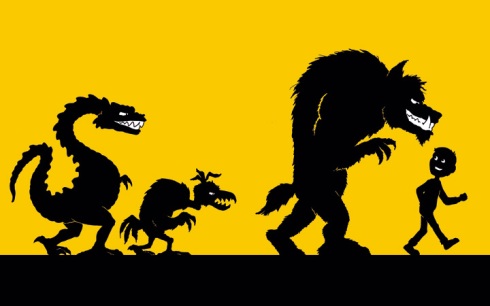
Later that year I sent Heidi a dummy for “They’re Coming!” She liked it and showed it to her acquisitions team. She came back saying they liked it, but they don’t want to follow one monster book with another. They asked if I had anything with dragons or dinosaurs.
Another challenge! A short time later I sent her outlines for “I’m Looking For A Dinosaur”, “Shadows On My Wall” and another with dragons. She liked “Shadows”, but marketing liked “I’m Looking For A Dinosaur”, which they acquired. (Why it’s not out is a long story for another day.)
So now I find myself either challenging myself or finding external challenges to come up with creative ideas. Most of the books that I have put out or am working on are in answer to those challenges. I’ve never gone back to the ones I thought were good picture books (although I might at some point if only to grab some nuggets out of them).
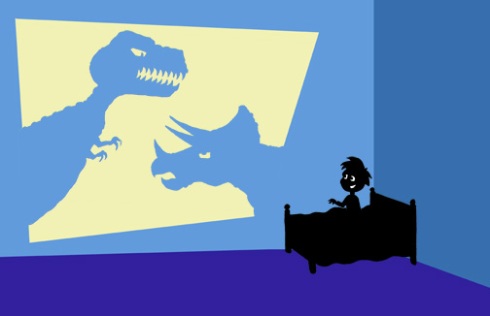
An idea sketch for SHADOWS ON MY WALL.
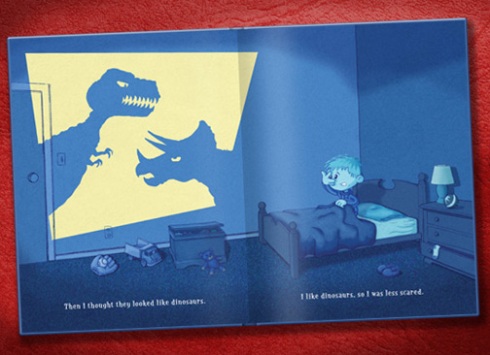
And the final version.
I promised to tell how I came up with I HATE PICTURE BOOKS!. I was at the NJ-SCBWI summer conference two years ago. I was on the faculty with some of the other authors in the KidLit Authors Club. I attended a couple of the seminars while there, including “Finding The Funny Stuff” with Audrey Vernick and Olugbemisola Rhuday-Perkovich. They were talking about parody (I love good parody) in children’s books and Olugbemisola made a very funny comment about Paddington Bear’s immigration status.
I started thinking about classic children’s books and this title popped into my head. I have to admit that I missed the rest of what they said in the seminar, because I was off…my character, a boy who is throwing away his books because he misinterprets them and then gets in trouble, was telling me his story. By the time I had driven home the next day I had the whole thing written in my head. I can’t wait until it comes out early in 2013. (Here’s a link to the publisher where you can pre-order it!)
Now I have to get back to the funny little bird who’s in the process of challenging me to tell his story.
 Timothy Young is the Founder and Creative Director of Creatures & Characters LLC. He has designed toys, worked on animation projects, licensed characters, and produced picture books. Timothy is the author-illustrator of I’M LOOKING FOR A MONSTER, SHADOWS ON MY WALL, THEY’RE COMING, and I HATE PICTURE BOOKS!. Visit his creations at CreaturesandCharacters.com.
Timothy is giving away a signed book of your choice and an original pencil sketch. Just leave a comment to enter (one per person, please). A winner will be selected next week. Good luck!
 Hey there, PiBoIdMo-ers. Hope you’re all well nourished and ready to roar through these final days! This post is about two things: perseverance and truth. The way I see it, there really aren’t many truths in life at all. There’s Death. There’s Taxes. There’s the fact I will wash every load of laundry at least twice because I will forget to put it in the drier and discover it days later…but I digress.
There’s also another:
“Stopping before you reach your goal guarantees you will not reach your goal.”
Now, that may sound like a bit of “duh” phrase. But is it, really? It’s one of many things I take from this incredibly inspirational cartoon about perseverance:
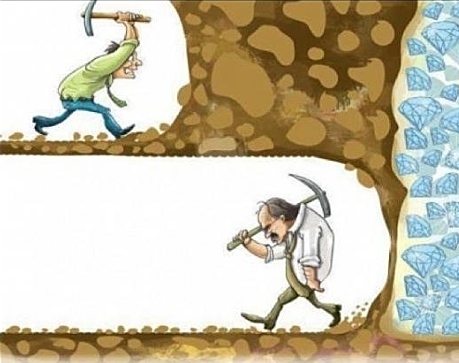
What do you take from it?
Oh, and here’s a little rhyming pep talk for ya, too:
You’re near the end it’s getting tough.
You’re all tapped out of clever stuff.
You may be thinking, this is it.
I’ve done enough. Who needs this s—?
So give it up. Admit defeat.
Or better yet, just lie. Or cheat!
Who needs blood or sweat or tears.
Respect from who? A bunch of peers?
And who needs real integrity.
Who needs a contract? Eh. Not me.
Empty pages float my boat.
27? All she wrote.
30 is for suckers, dude.
Embrace that downer attitude.
Writing’s hard, you’re filled with dread.
Let other people write instead.
Grab your towel. Throw it in,
and let the giving up begin!
BUT….
if you choose to persevere…
to fight and push, then listen here:
To you, I bow. I bow down low.
You’ll win the battle. Blow by blow.
Your quest to find the best of you
will dominate the rest of you.
Your goals and dreams are yours to lose.
And yours to harness….if you choose.
So choose the challenge. Choose to win!
Dig down deep for what’s within.
And one day gaze upon a shelf,
filled with books,
you wrote
yourself.
You never know!! That little idea on day 30 could be the next NYT Bestseller!!
GO PiBoIdMo-ers….GO!!
.
 Tiffany Strelitz Haber has eaten fried bugs, jumped out of airplanes and lives for adventures. Tiffany grew up in NYC, but is now located in central NJ, and available for workshops everywhere.
Her debut picture book, THE MONSTER WHO LOST HIS MEAN (Holt/Macmillan) was recently featured in the NY Times Sunday Book Review and the art will be featured in the Society of Illustrators 2013 Original Art Show Traveling Exhibit.
Her next book, OLLIE AND CLAIRE (Philomel/Penguin) is due out April, 2013.
Please visit Tiffany at her website: ItsRhymeTime.com, on Facebook, or Tweet her @TiffRhymes.
Tiffany is giving away a signed copy of THE MONSTER WHO LOST HIS MEAN (which is very NICE)! Leave a comment to enter (one comment per person). A winner will be randomly selected in one week. Good luck!
 This month has been a brilliant crash course in Picture Book Ideas 101. Here it is day 27 and by now you have a myriad of ideas (or one) that you’re excited about. What’s next? How do you begin to flesh out these ideas and keep your enthusiasm up?
Taking classes and doing things like PiBoIdMo rearranges how I think about what I’m doing. A number of years ago, wanting to learn more about collage, I took a class. Adding collage to my art was fun, with the right amount of devil-may-care messiness. It felt like playing—pushing bits of torn paper, letting interesting juxtapositions happen. As the class was winding down, the students wondered how could we bring this same sense of ease back into our studio work. Being in the studio felt like I was supposed to accomplish something. Could something this easy count as “work”? Our teacher said to us, “If you’re in your studio, you’re working.” Whoa! Even when you’re sitting around drinking tea and looking at picture books? Yep. What a great concept! But was it true?
Soon after taking that class, my editor agreed on a picture book idea I had proposed to write and illustrate. My foray as an author was to rewrite Little Red Riding Hood, a story with a ready-made plot. I named my main character Carmine, after the purpley-red color.
The day came when (with a contract signed and dated), I had to begin. I sat at my desk and wrote: “Once upon a time a girl named Carmine…” Hmmm. What was Carmine going do? Who were the other characters? How would she get to Granny’s? I was stumped. A few more forgettable sentences followed. That was enough writing for one day.

Was I working? I was in my studio, so, yes. As I was doing it, it was impossible to know if each exercise would be useful, but it didn’t matter.
After playing, there was more to write about.
Months later, still moving at a glacial pace on Carmine, I made a list of 100 random words that I like: nincompoop, reckon and zillion and attempted to write the story using all 100 words–just as an exercise. It didn’t work at all, but I noticed I had the entire alphabet within that list. I plucked out those words and wrote the story as an alphabet book, (or an abecedarian–a subject told in alphabetical order).
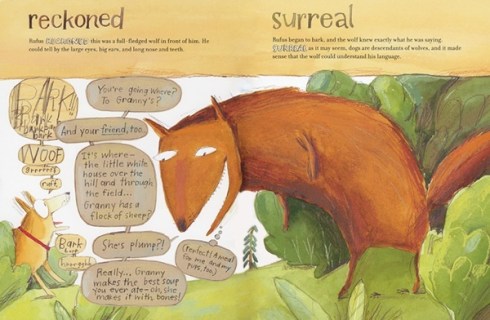
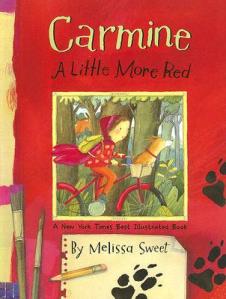
Voila!, CARMINE: A LITTLE MORE RED came to life.
Later, when I was writing Balloons Over Broadway, I made toys and puppets to get to know Tony Sarg better.

More recently I gathered snippets of fabric to inspire the color palette of my next book making a Pinterest-esque wall, but in real time.
Pinned to that wall is this quote that gives me permission to do whatever I need to do when I begin to write or make art:
“I believe that the so-called ‘writing block’ is a product of some kind of disproportion between your standards and your performance … one should lower his standards until there is no felt threshold to go over in writing.
It’s easy to write. You just shouldn’t have standards that inhibit you from writing …I can imagine a person beginning to feel he’s not able to write up to that standard he imagines the world has set for him. But to me that’s surrealistic. The only standard I can rationally have is the standard I’m meeting right now … You should be more willing to forgive yourself. It doesn’t make any difference if you are good or bad today. The assessment of the product is something that happens after you’ve done it.”
—William Stafford, writer
What’s next for me is printing out the piboidmo posts and putting them in a notebook. I want to revisit them at my leisure far away from the black hole of my computer.
Then I’m headed to the studio where I’ll take my mom’s advice, as she told us a zillion times:
“Now, you kids go out and play!”
.
Melissa Sweet has illustrated many award-winning books. She wrote and illustrated CARMINE: A LITTLE MORE RED, a New York Times Best Illustrated, TUPELO RIDES THE RAILS and BALLOONS OVER BROADWAY which garnered the 2012 Sibert Medal. She illustrated A RIVER OF WORDS: The Story of William Carlos Williams, by Jen Bryant, a 2009 Caldecott Honor book. Jen and Melissa’s next book, A SPLASH OF RED: The Life and Art of Horace Pippen will be out January, 2013.
She collages up a storm in Rockport, Maine. See more at MelissaSweet.net.


Melissa is generously giving away a SWEET prize pack! You are eligible if you comment here *and* complete the 30-ideas-in-30-days challenge by taking the PiBo-Pledge in early December. You can win a signed copy of BALLOONS OVER BROADWAY, CARMINE: A LITTLE MORE RED, A Splash Of Red coloring pencils, plus whatever SWAG she can find. Remember, one comment per person. And good luck!
 Being an artist and doodler at heart, I thought I’d share with you my sure-fire way of getting creative ideas flowing for me. It’s quite simple really: sketching. I carry two sketchbooks with me everywhere I go: a large one for anything work-related, and a smaller sketchbook for on-the-go sketching whenever the mood strikes me.
Now, I know what you’re thinking: “Hey, not all of us are as artistically inclined to just pick up a pencil and start drawing!” No problem. The same thinking that I use for drawing while looking at people and places around me can be applied for you writers who might need a jumpstart for coming up with ideas for characters.
When I first moved to Portland, I would ride the bus back and forth to work daily. I loved noticing all the different assortment of people who’d ride along with me—some regulars, some not so regular. I began to bring along my 5 x 7 inch notebook to record some of these interesting characters and to at least capture the moments that might otherwise be lost if I didn’t somehow sketch them down.
At first, I was drawing my surroundings, mostly:

Then I’d muster up the courage to start drawing others around me while sitting, hoping that maybe no one would see (or care) that I was perhaps drawing them. I had to be stealthy.
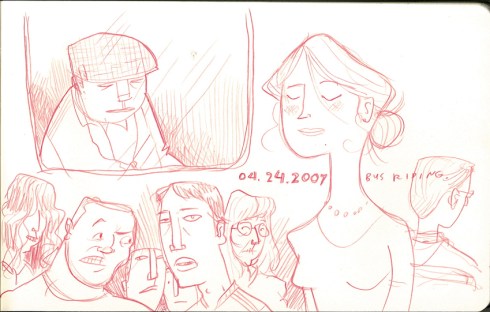
As I found my groove, I’d capture the little things, the little moments that might’ve been overlooked: the pencil with a large eraser stuck in a young woman’s hair, the tilt of a hat on an older gentlemen’s head, the way a woman would read the morning paper.
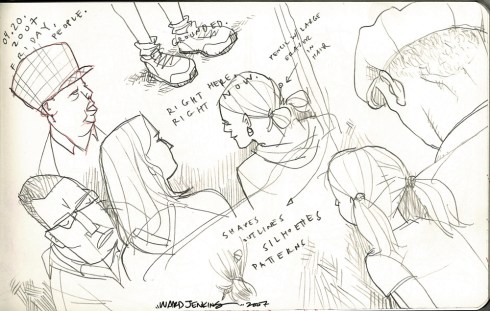

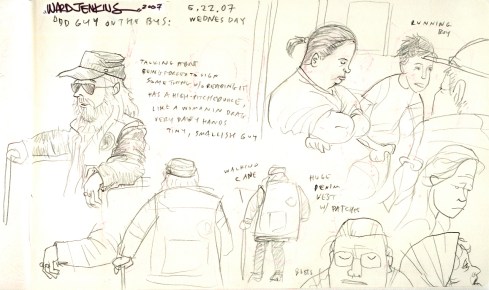
Every once in a while, a really interesting person would show up on the bus and I’d start sketching feverishly, capturing the details the best I could, as well as jotting down notes:
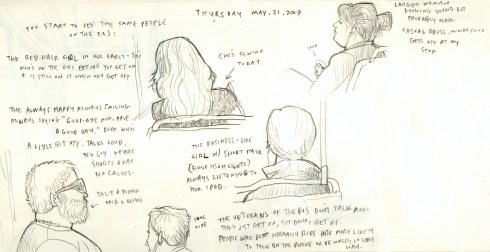
The regulars were always an interesting bunch, as well. One day I decided to draw only them, since I’d see them every morning, along with some notes and details to help me remember the little things:
Out of these daily sketching sessions, I’d eventually gather a great deal of character ideas. Great for character development. For some, I’d make up backstories in my head while I was sketching them. This character building would even spill over into my work while coming up with characters for the picture books I’d illustrate, especially the City, Baby! books. It might’ve been a simple pose that someone on the bus did for a brief moment, and the ideas would snowball into a fully-fledged character with pathos and perhaps their own story arc.
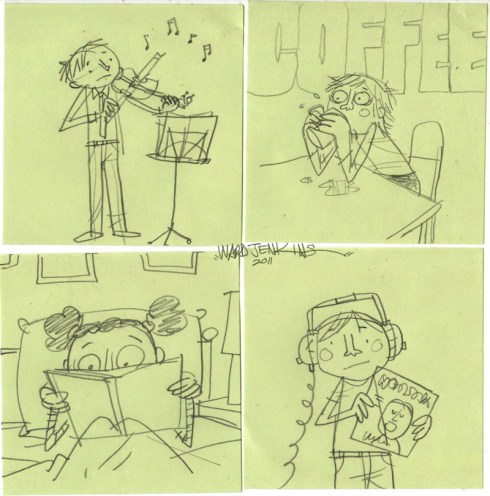
If you don’t have a sketchbook, that’s fine. A notebook or anything with pages for you to write something down should work out perfectly. Or, if it’s more convenient, Post-It notes. Whenever creative lightning would strike, but a sketchbook is nowhere to be found, Post-It notes always did the trick for me! And you can always collect and stick them into your sketchbook when the time is right:
It’s all about observation. Being aware of your surroundings, of the people around you, and taking in all the details.
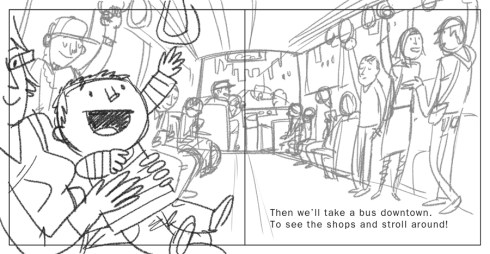
Here’s a spread from NEW YORK, BABY! with plenty of characters gathered on—yup, you guessed it, a city bus:

Like I said earlier, you don’t have to be an artist to do this sort of thing. You can simply write down what you see. And you don’t have to be on the bus, either. This exercise can be done while waiting for your flight, while eating in the food court at your favorite mall, or watching TV. Recording the little moments that happen all around you. By building up this assortment of details, of moments, you are adding on to your cache of characters. Whether it be actual sketches or scribbled down notes, being aware of the canvases around you can be constant jumping off points for any type of character, whether human or human-like. The ideas for character development are limitless.
Best of luck with creating your characters!
.
Ward Jenkins is an animator, illustrator, and lover of all things aesthetically pleasing. He is the designer behind PiBoIdMo 2012’s logo and badges, and his sketchbook shared here today is online at Flickr. Ward illustrated Michael Phelp’s HOW TO TRAIN LIKE A T-REX AND WIN 8 GOLD MEDALS, Sudipta Bardhan-Quallen’s CHICKS RUN WILD as well as Chronicle’s NEW YORK, BABY! and SAN FRANCISCO, BABY! Catch him blogging at Ward-o-Matic and if you like his art, you can get some for your walls at his Ward-o-Matic shop (Tara’s favorite, which hangs in her home, is “Speaking in Color”).
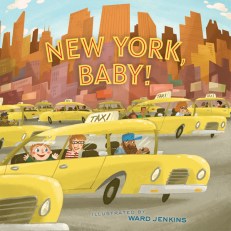
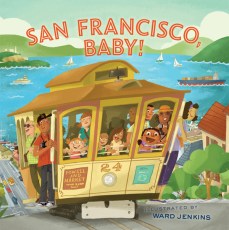
Ward is generously giving away a signed copy of NEW YORK, BABY! and SAN FRANCISCO, BABY! to two winners who comment below. Remember, one comment per person, please. Winners will be selected in one week. Good luck!
 You wanna know what’s great about PiBoIdMo? Besides the fact that Tara’s letting a non-picture book author like me make a guest post? What do you mean, you don’t think that’s so great??
The greatness of PiBoIdMo lies in its lack of limitations. This is the idea stage, where anything goes, babies! Do you want to write a book about a reclusive green alien named Melonhead who assuages his loneliness by routinely traveling to the planet Earth and kidnapping pigs from isolated farmhouses in rural America? BAM! Idea Number 1! Have you always had the urge to write a picture book about a pet rock that’s been stubbornly kept in a drawer by a mad scientist since the mid-seventies and gained sentience via an unexpected spill of that scientist’s insane-but-brilliantly-created vat of artificial intelligence serum? Yo, Idea Number 2! A picture book about talking laptop computers who have a wacky adventure when an IT staffer mistakenly leaves a bottle of super-fun shredder lubricant on the ergonomic chair next to the desk where they live? Crap, utter crap, but hey, Idea Number 3!
I’m kidding. Kind of. Not really. I don’t actually mean you should deliberately spend your energy coming up with a bunch of deliberately crappy and unusable ideas. But you could definitely choose to come up with ideas that display some eccentricity, fall outside your normal comfort zone, or feel impossible to actually turn into a book.
By the way, those are all real ideas that I’ve actually tried to turn into real stories. HANDS OFF.
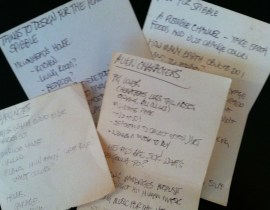
See, I really did try to write this book.
I’ve tried to write picture books, you know, and I don’t know how you people do it—when I try, it feels like I’m performing a lobotomy on myself with a soup spoon and a pair of knitting needles. Picture books are hard. Picture book ideas are easier. That’s true for all kinds of books, isn’t it? I don’t say that to invalidate the worthiness of PiBoIdMo, however, because the fact that coming up with an idea is easier than turning an idea into an actual book doesn’t mean that coming up with an idea is just plain old EASY. These creative processes are infinitely malleable in nature, and unique to the character and proclivities of the individual pursuing them.
During my one feeble attempt at PiBoIdMo I found myself swearing roundly at the horribly mundane, hackneyed ideas coming out of my tortured braincase. At least I thought they were mundane and hackneyed—maybe they weren’t at all, but the fact that I felt that way was messing with my head, you know what I mean? My solution was to say “well then, I’m just gonna use AAAAAALL the crazy ideas. Gonna take the wraps off my inner weirdness and just go to Bizarro World for the rest of the month.”
In creative terms, I do believe there’s a big upside to just thinking about the most wacky ideas in your head, without evaluating them for plausibility, market-readiness, industry trends, or genuine viability as potential stories. I’m a believer in the power of unfettered brainstorming—by removing boundaries on what kind of things qualify as legitimate ideas, you’ll sink a tap into a bigger aquifer of source material than you might otherwise. Your free associations will have more building blocks to link together. You’ll stretch your brain. Maybe you’ll find some avenue of inspiration that you didn’t even know you possessed. And you might be able to take one of those off-the-wall ideas and recognize a sane, strong, usable core inside it.
Or maybe all those daring ideas will come to nothing, I don’t know. That would actually be okay, wouldn’t it? There’s a price to doing business in the marketplace of creativity, and it usually involves the dismissal of efforts that prove unviable or untimely. Then again, maybe one of those cray-cray, easy-to-scorn ideas will turn into something entirely new. Where would we be without the advocates of previously unembraced change, the children’s book creators who were willing to try things that no one else was trying? Where would we be without Scieszka and Smith’s THE STINKY CHEESE MAN AND OTHER FAIRLY STUPID TALES, or Ezra Jack Keats’s THE SNOWY DAY, or Dr. Seuss’s THE CAT IN THE HAT?
Go crazy, people. Test the boundaries of your conceptual world, write down those nutty, unrealistic ideas, and then see if they take you some place you might not have gone if you’d stayed within the borders of The Town of Reasonable Thinking. Me? I’m definitely writing that alien-and-pig picture book one of these days. Try and stop me.
 Mike Jung is an author, library professional, public speaker, blogger, amateur musician, former art student, and geek, but his preferred title is “Internet Despot.” Mike blogs, Facebooks and Tweets. He lives in Oakland, CA with his wife and two children. GEEKS, GIRLS, AND SECRET IDENTITIES (Arthur A. Levine Books/Scholastic) is his first novel.
 Where do you get your ideas?
As soon as I call on a kid at a school visit and they ask this question, dozens of other hands go down. You’ll hear countless children’s authors say it’s the question they’re asked the most. I get ideas everywhere (yes, that’s a copout statement), and so can you!
But first, you have to get past Miss Midge and her like. Those nasty voices that say miserable things to you. Here she is in my journal (and right now she’s saying “You’re not an artist, what are you doing!?!”)
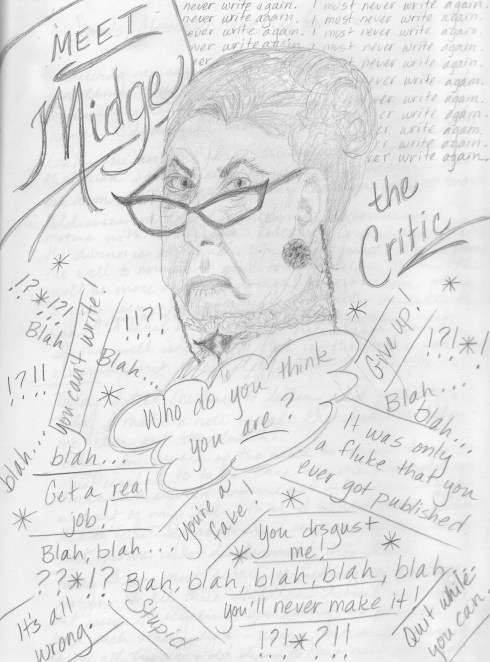
GAG YOUR INNER CRITIC!
If you’ve been moaning about being behind in your PiBo count—stop perfectionizing! (Since my dinobooks, I’ve thrown out the dictionary. We are all powerful. We create worlds. We can create our own words.) Write down ALL the ideas you consider. You don’t know what will piggyback on them or what new variation will emerge. Let in the misfits and barefoot ideas that blankly stare at you.
But, back to the coach in me who wants you to stop being so durned critical… Name that beast inside you and move on. Sorry, but you gotta be tough about this one. Stand up for yourself. No self-bullying allowed!
Done exorcising that evil shadow? (Not totally? Okay, we’ll visit this again a little later.) Let’s move on to your hunting training.
BECOME AN IDEA HUNTER!
Ideas lurk. They hide. They disguise themselves. It’s your job to hunt them down. You develop x-ray vision, you study playground shenanigans and never say Bah Humbug about any holiday that involves kids, chaos, and giddiness. You train your family and friends. You observe like a four year old. You and your trainees share knowing looks. Picture book? Picture book!
MINE YOUR MEMORIES & UNLEASH YOUR IMAGINATION!
I always say writing is part imagination and part memory—it’s just the ratio that changes. Open your eyes with this in mind and you’ll never lack for ideas.
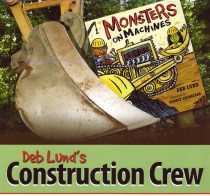
While other four-year-olds were playing in their sandboxes, I sat on my dad’s lap and operated the levers on his backhoe. I helped him “build.” Those experiences inspired MONSTERS ON MACHINES.
I sailed with The Shifty Sailors (the motley crew below) from Seattle to Olympia, and we took the train on the way home… DINOSAILORS and ALL ABOARD THE DINOTRAIN.
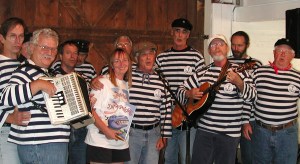
You see? Memory and imagination.
Along with memories come emotions. That takes a little deeper mining, but that’s what makes prose sing. What keeps readers engaged, holding their breaths, laughing out loud, shedding tears. Feel as you write. Wring yourself out onto the page. Write the words that pour from that space that aches, that cries for joy. Replace your judgment with curiosity and write as if your words can save the world. Because they can.
ALL WORK AND NO PLAY MAKES JACK A DULL WRITER!
Picture book creators must play! Go galumphing! (Says my good friend George Shannon—who is great at accessing his four year old). Twist those ideas, turn them upside down, pack them with surprises and yummy words until you’re clapping and Yay-ing! Be four!
So, little girl or boy inside that big grown-up writer, what do you want? What’s your big dream or wish? Write it. Write whatever “it” becomes. And big outside writer, let that four-year-old go where it’s going to go. Don’t wait for the tantrum. If Miss Midge hears the kicking and yelling, she’ll be all over me.
I promised you another try at quieting your inner critics. Ready?
Raise your write hand and repeat after me…
Note: Did you know some people are so controlled by their inner critic that they can’t even get their hands in the air? RAISE THEM! There. Was that really so tough?
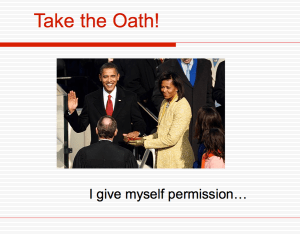
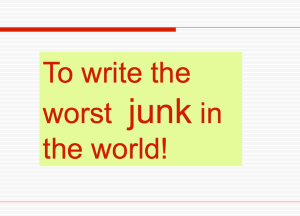
Write badly! Write junk—and lots of it! You gotta dig through lots of rocks to unearth the gems. You clean the mess up later—not before it hits the page.
No excuses, no stopping, no perfectionizing…
Just do it! And may the Fours be with you!
Deb Lund is a picture book author, creativity coach, continuing education instructor, and writing teacher. In her past lives, she’s been a music and classroom teacher, an elementary librarian, and a school founding director. If Deb’s rambling sparked anything for you, check out more on her blog. She lives on Whidbey Island, but if you can’t make it there to hang out with her, you can find her on Facebook, Twitter, and YouTube.
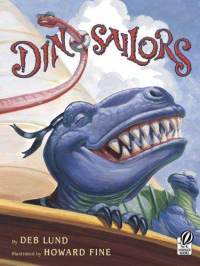
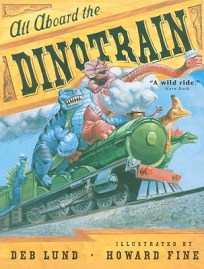
Deb is generously giving away one signed copy each of DINOSAILORS and ALL ABOARD THE DINOTRAIN! Just leave a comment to enter. Two winners will be selected in one week. Good luck!
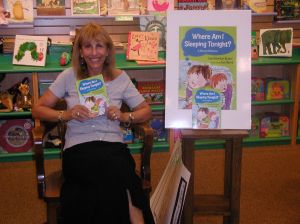 Last year I was a lurker on the PiBoIdMo site. The posts were inspirational. But I couldn’t (more accurately, I wouldn’t) do the listing of ideas. I taught elementary school for 35 years. My days lacked flexibility and overflowed with structure. Bells rang throughout the day telling me where to go and what to do. Perhaps too many years in a classroom have left me seriously resistant to following directives. And even though I‘ve been retired for a few years, my mind and body bolt to such demands: “Gather an idea a day”. Ha! I’ll wait until they come to me!
I like my ideas to come from a place of trust. I trust that when I finish a manuscript, another idea will present itself. I let my ideas float in on a dream when they are ready for me. My favorite stories have come to me that way. The pad and pen next to my bed sits nightly hoping to be written on.
Unfortunately, I have lost more than one story when I was away from home and a pad was not nearby. As many times as I repeated that idea before slumbering off again, it was completely forgotten by morning.
Typically, I am hesitant to join things, even something as motivational as PiBoIdMo. But then I read one of the posts on this site…and I decided to look more carefully with my author eyes that day. As I left my health club after yoga, I noticed the person at the front desk was wearing an unusual witch costume. Yes, it was Halloween. I looked at her and told her she just might be the inspiration for a new story. I got home and started my PiBoIdMo ‘12 ideas folder. I wrote down my thoughts for that story. And in the days that followed, because of all the pouring out of picture book love and posts on coming up with ideas, I started looking more actively rather than waiting for a story to hit me over the head. I believe wholeheartedly, whether we search with intention or passively, that the stories that are meant for us will find us.
Picture books touch me. I used them daily when I taught 4th grade to enhance every subject, or to make a point when a social situation arose that needed to be dealt with. Picture books are a quick and sweet way to avoid lectures or a boring review. Just read a book! It can touch upon a myriad of bases.
I think about the many gifted picture book authors and pause to contemplate their stories and what I might learn from their work. Can I move others to tears like Patricia Pollaco does in many of her stories? She writes about what she knows. My favorite story of hers is THANK YOU, MR. FALKER. That was her story as a child. And when I read the amazing picture book, IS YOUR BUFFALO READY FOR KINDERGARTEN? by Audrey Vernick, it spun out a new idea in my brain. Yes, I’m gathering ideas while I’m reading other author’s picture books. That’s a creative thinking skill… it was called piggy-backing when I taught it. It’s not that different from Diana Murray’s clever concept “mash-up” from Day 10, which brought forth more than one listing for my 30 stories in 30 days.
Once I determined to take on this PiBoIdMo commitment, I began observing the world more intensely. As my husband drove us to NY one weekend recently, I sat with my laptop as billboard signs and store names brought forth more to add to my PiBoIdMo file. I watched the kids play with their iPods in a waiting room when I sat patiently to get blood drawn for my yearly physical. I was almost sorry when they called me rather quickly. I was like a detective on a case…there might be more for me to see! I jotted down a story title sparked from an article in the AARP Magazine. Anyone under 50 doesn’t know what they are missing! I was more open to collecting from the universe of ideas. Thank you, PiBoIdMo, for your push to participate in this structured activity that can only help me grow as a writer. I hope to start the seed of a story that will touch little lives.
After all, that is why I’m writing.
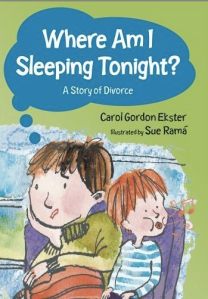

Carol Gordon Ekster’s first published book, WHERE AM I SLEEPING TONIGHT? A STORY OF DIVORCE, Boulden Publishing, Fall 2008, was an About.com finalist for best book for single parent families. Another story, “The Library Is The Perfect Place”, was in Library Sparks magazine, February 2010. A picture book, RUTH THE SLEUTH AND THE MESSY ROOM, December 2011, was part of the debut list by the innovative publisher, Character Publishing. Now retired from teaching, Carol is grateful that her writing gives her a way to continue communicating with children. She also hopes to spread her love of picture books, as she did earlier this month at the Literacy For All Conference through Lesley University in her presentation, Using Picture Books to Enhance Curriculum for Grades 3-6. She lives in Andover, MA with her husband Mark. Learn more at CarolGordonEkster.com
and follow her on Twitter @CEkster.
Carol is generously giving away a picture book critique to a lucky PiBoIdMo’er who completes the 30-ideas-in-30-days challenge. Leave a comment on this post to enter…and if you also take the PiBo-Pledge in early December confirming you have 30 ideas, you’ll be entered to win. Good luck!
 I don’t write, illustrate, publish, or edit picture books. I don’t work in a bookshop or belong to a school library marketing team. So what do I do then? I read. I read. I READ.
I read thousands of picture books every year. I’m always searching for the next best picture book. When I find *that* picture book, I feel compelled to promote it during my annual road trip, purchase copies for strangers, blog and tweet about it, feature it on a #kidlit sticker, and encourage every child who enters my school library to add it to their to-read list.
.
.
Mr. Colby Sharp attended children’s literature expert Anita Silvey’s session during the NCTE Annual Convention. He tweeted:

Anita Silvey succinctly sums up how I feel about children’s books. (If you’re not familiar with Anita’s work, you MUST follow her Children’s Book-A-Day Almanac.) Most of you reading this blog post are hard at work creating one of the most remarkable things on the face of the earth. Your picture book could change the way a child looks at the world, turn a dormant reader into an avid reader, and even win the coveted Caldecott Medal.
I am thankful my second through fifth graders (150 students) have checked out over 5,000 picture books during Picture Book Month. Treasures that have not circulated in over two years are taking a much-deserved trip in a child’s backpack. I get goose bumps whenever I spot a fifth grader checking out a book he loved in first grade. He usually hugs it and says, “I love this book.” I always pretend the book smiles and whispers, “Hey, I love you, too.”
I wish I found a magic wand in my mailbox with the following note attached to it:
Dear Mr. Schu,
Thank you for supporting and believing in picture books. This colorful wand allows you to send five 2012 picture books to everyone hard at work writing and illustrating picture books. I know you will select books that will inspire individuals to “create the most remarkable thing on the face of the earth.”
Thanks for all you do for picture books.
Your friend,
Picture Book

BOY + BOT. Written by Ame Dyckman. Illustrated by Dan Yaccarino. Random House, 2012.
.
HELLO! HELLO! Written and illustrated by Matthew Cordell. Hyperion, 2012.
.
GOOD NEWS, BAD NEWS! Written and illustrated by Jeff Mack. Chronicle Books, 2012.
.
Z IS FOR MOOSE. Written by Kelly Bingham. Illustrated Paul O. Zelinsky. HarperCollins, 2012.
.
THE THREE NINJA PIGS. Written by Corey Rosen Schwartz. Illustrated by Dan Santat. Putnam Books, 2012.
.
I cannot wait to share your picture book with my students.
Happy reading, writing, and Thanksgiving!
.
John Schumacher (aka Mr. Schu) is a teacher-librarian at Brook Forest Elementary School in Oak Brook, Illinois. John graduated from St. Xavier University with a Masters in Teaching and Leadership and from Dominican University with a Masters in Library and Information Science. He has taught English in Seoul, South Korea, and is in his ninth year at Brook Forest. John serves on AASL’s Best Websites for Teaching and Learning, the Monarch Readers’ Choice Selection Committee, and the 2014 Newbery Committee. He was a judge for School Library Journal‘s 2011 Trailee Awards and recently became a FableVision Ambassador. In his spare time (ummm…what’s that?) he reads, travels, and blogs at Watch. Connect. Read. John is a 2011 Library Journal Mover and Shaker.
Mr. Schu is giving away not ONE, but TWO books: HELLO! HELLO! and Z IS FOR MOOSE! Two winners will be selected in one week. Just leave a comment to enter (one entry per person). Good luck!
.
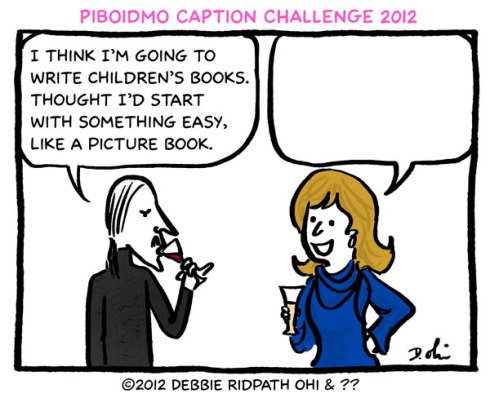
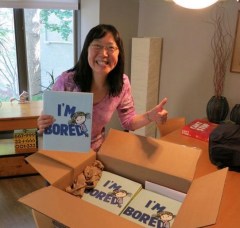 Your PiBoIdMo caption challenge: Any suggestions for what the children’s book writer on the right should say? Post your caption suggestion in the comments section—I’ll pick one. The winner gets a signed copy of I’M BORED with a hand-drawn doodle inside. If you already have a copy of the book (yay, thank you!), I will inscribe the book to anyone you’d like and send it to them. Even if you DON’T win, all commenters will be entered in a random drawing for a hand-drawn doodle.
Sadly, the comic was inspired by a real-life comment by someone who didn’t appreciate how difficult it is to write a good picture book. Has anyone else encountered this sort of attitude?
But to the topic at hand: PICTURE BOOK IDEAS. Kudos to Tara Lazar for PiBoIdMo. I’m currently writing and illustrating a picture book for Simon & Schuster Books For Young Readers which came about because of last year’s PiBoIdMo and NaPiBoWriWee (Paula Yoo’s National Picture Book Writing Week). (Tara’s Note: Another PiBoIdMo success story! Sadly I have lost count of how many deals y’all have made!)
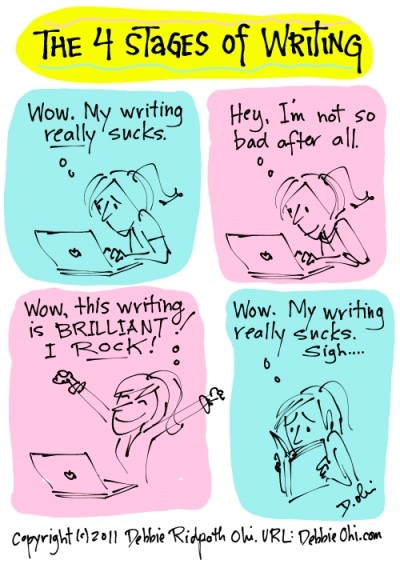
My process for coming up with picture book ideas:
- Brainstorm. I keep a paper book idea notebook, a Scrivener idea notebook and I also jot down quick ideas in Simplenote via iPhone or iPad if I don’t have time to do anything else.
- After I’ve collected a bunch of ideas (after PiBoIdMo, for example), I’ll go through the most lame ideas and cross them off.
- I’ll examine the remaining list of ideas and realize that pretty much every single idea has already been used in some published picture book.
- Massive insecurity sets in. I wonder if there’s any point to trying to write a picture book if all the good stories have already been taken. Or what if I write a story I think is original but then it turns out that it’s already been written?
- More angsting. Self-deprecation. Chocolate.
- Take a deep breath, stop obsessing about failings and focus again on pure brainstorming. I set aside some regular time when I sit and focus completely on coming up with words, phrases, paragraphs, scenes, titles, situations, characters. I try to focus on elements that appeal to ME, not the market.
- Then I go through the list and start matching up elements, purposely trying for unusual combinations. Inevitably some of these combos will spark a longer picture book idea.
- When I’ve come up with this second list of ideas, I fight the urge to get angsty when I find that some of the plot ideas are already out there. Instead, I try add my own unique twist instead, perhaps in voice, character, setting or ending.
Good luck with those ideas, and I look forward to seeing your caption suggestions! (Please keep suggestions family-friendly.)
Debbie Ridpath Ohi is the illustrator of I’M BORED, a new picture book written by Michael Ian Black and published by Simon & Schuster Books For Young Readers. Her current and upcoming projects include two books for S&S (one of which she is also writing) and illustrating the new RUBY ROSE series by Rob Sanders (HarperCollins). Visit her at DebbieOhi.com and follow along on Twitter @inkyelbows.





 Writing for Kids (While Raising Them)